
If you've watched the recent *League of Legends* World Championship (Worlds) or *Dota 2* The International (TI), you'll surely remember these scenes vividly: massive 3D game characters “landing” atop the dome of a real stadium; real-life commentators sitting in a broadcast desk floating within a virtual universe; real-time data charts swirling around the players like magic.
In the field of brand marketing, from the global debut of new EV startups to the autumn launch events of top-tier mobile phone manufacturers, XR (Extended Reality) spectacles blending the virtual and real have become standard.
Behind these “visual nukes” that excite tens of millions of viewers worldwide lies an extremely challenging real-time broadcast technology. In this field,Aximmetry It is becoming the “go-to commander” for the world's top event producers and PR agencies. How does it manage these high-stakes, zero-tolerance scenarios?
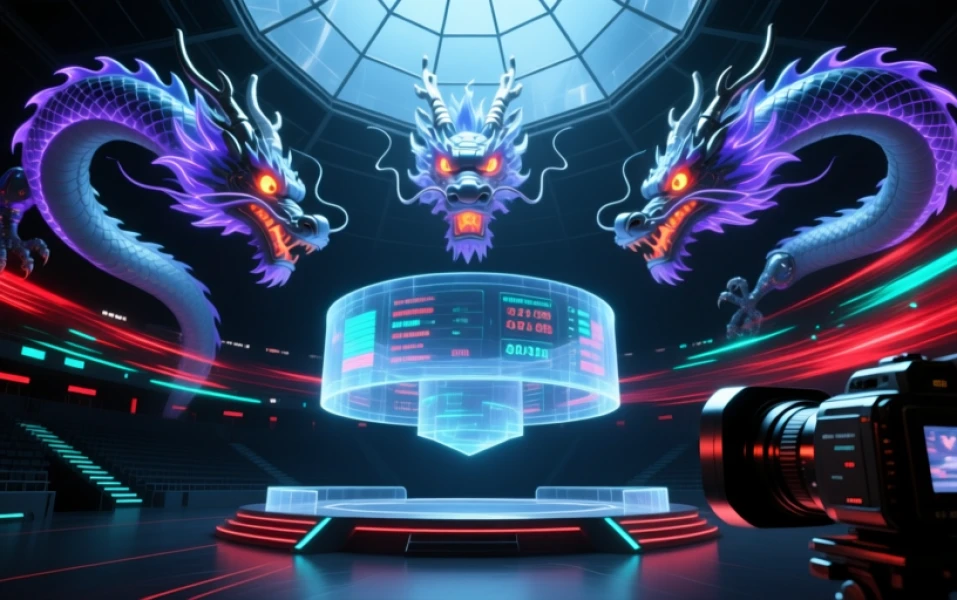
Commanding the “Hundred-Camera Interconnection” Scene: The Ultimate Orchestration of Multi-Camera Tracking and Synchronization
In an esports arena or a launch event for thousands, the broadcast environment is extremely complex. Spidercams fly overhead, Steadicams roam the floor, and broadcast cameras with mechanical jibs are positioned nearby. To perfectly align these constantly moving real-world shots with virtual scenes from Unreal Engine, the biggest enemy isLatency and Synchronization。
Aximmetry acts like an incredibly powerful “air traffic controller.” It natively integrates all the world's top camera tracking protocols (such as stYpe, Mo-Sys, Ncam, etc.). No matter how many different camera models are on site, Aximmetry uses its underlying algorithms to performframe-level precise alignment of the physical distortion, spatial position (6DoF data), and video signal timecode for all lenses.。
When a jib sweeps rapidly across the real stage, the 3D dragon and virtual data panels in the live broadcast remain firmly “pinned” in mid-air, without drifting or breaking the illusion, demonstrating extremely impressive system stability.
The Magic of Data: Bringing Cold Esports Data to Life
One of the core attractions of esports events is data analysis: gold difference, damage conversion rate, players' real-time heart rate, etc. In the past, this data could only be displayed as 2D subtitles stuck to the edge of the screen.
Leveraging Aximmetry's powerfulReal-time Data Binding and Interface Communication capabilities, the broadcast team can use API interfaces (such as WebSocket, HTTP, JSON) to directly connect the backend data from the match server into the rendering pipeline.
This means that when a “First Blood” occurs in the match, Aximmetry can automatically trigger commands, turning the entire real stage lighting red and instantly “growing” a holographic 3D data chart on the commentator desk floor. This kind of real-time data-driven 3D visual spectacle pushes the audience's immersion to the extreme.
Expanding Horizons: XR Technology Reshapes Product Launches
For top-tier brands like Porsche, BMW, or Apple, traditional PPT presentations have long caused aesthetic fatigue. They need to showcase a real new car on the surface of Mars, in a deep-sea base, or within a cyberpunk city.
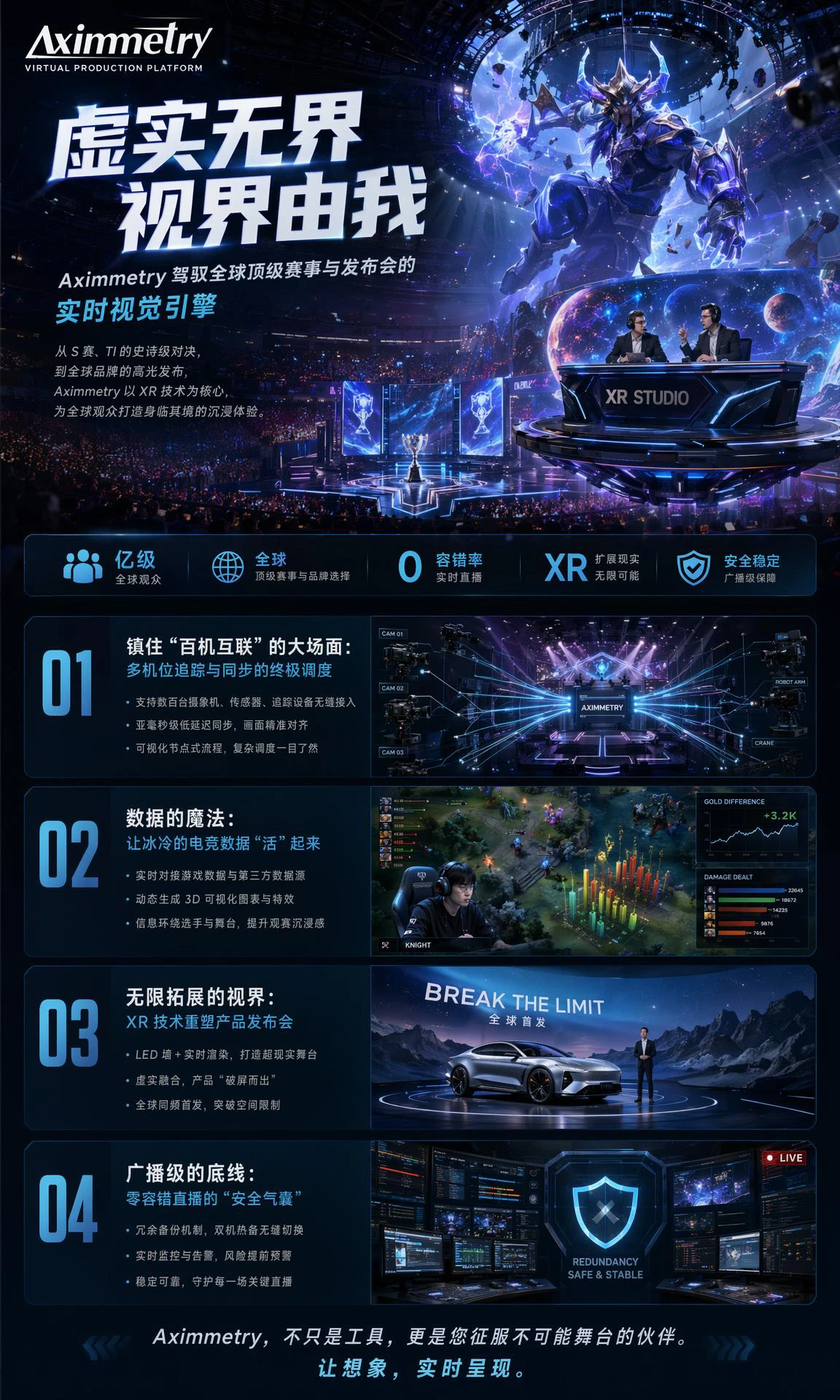
Here, the Aximmetry + LED wall XR (Extended Reality) Workflowplays a decisive role. Aximmetry is responsible for calculating the real camera's “Frustum” in real-time, projecting the high-precision UE5 scene onto the giant LED screen without latency. The real new car sits center stage; the LED screen provides physically accurate environmental reflections, while the real space outside the screen is filled in real-time by Aximmetry using AR technology (Set Extension).
What the audience sees in the live broadcast is no longer a stage confined to an arena, but a boundless, grand world. This reconstruction of “limited physical space, unlimited visual space” creates an unprecedented sense of technology and premium quality for the brand.
The Broadcast-Grade Bottom Line: The “Airbag” for Zero-Tolerance Live Broadcasts”
The highest principle for esports events and large-scale launches is just three words:No Interruptions. Even a single second of black screen can turn into a PR disaster.
This is the core reason why top teams dare to use Aximmetry. Although it integrates the stunning visuals of Unreal Engine, its system architecture is designed according tostrict broadcast standards.Hot Backup System
- : Supports seamless switching between primary and backup servers. If the main server encounters an anomaly, the backup server can take over the signal in milliseconds.Node-Based Fault Tolerance
- : During a live broadcast, the technical director can even modify other business logic in real-time on Aximmetry's node interface while the show is airing, without causing frame drops or stuttering.Independent I/O Management
- : It handles all video input and output, avoiding the weakness of traditional game engines that tend to crash when processing large amounts of 4K SDI signals.Conclusion: An Irreversible Revolution in Audiovisual Experience
Whether it's the ancient dragon roaring above the Summoner's Rift at the World Championship or the fantastical journey traveling inside a microchip during a product launch, Aximmetry is turning scenes that once only existed in Hollywood sci-fi movies into real-time live broadcasts on the screens of billions of viewers worldwide.
It not only redefines the boundaries of the "stage" but also pushes the visual standards of sports broadcasting and commercial launches to an irreversible new height. In this era of scarce attention, whoever masters the most cutting-edge real-time audiovisual technology captures the audience's eyeballs. And Aximmetry is the most solid cornerstone behind this audiovisual revolution.
This article analyzes how Aximmetry becomes the core of real-time broadcasting for esports and brand launches. Through precise multi-camera synchronization, real-time data-driven 3D visuals, and XR extended reality technology, it creates an immersive audiovisual feast. With its broadcast-grade, zero-fault architecture and hot backup system, it ensures the stable operation of large-scale live broadcasts, redefining the boundaries of the stage and leading a global revolution in audiovisual experiences.

 简体中文
简体中文  English