
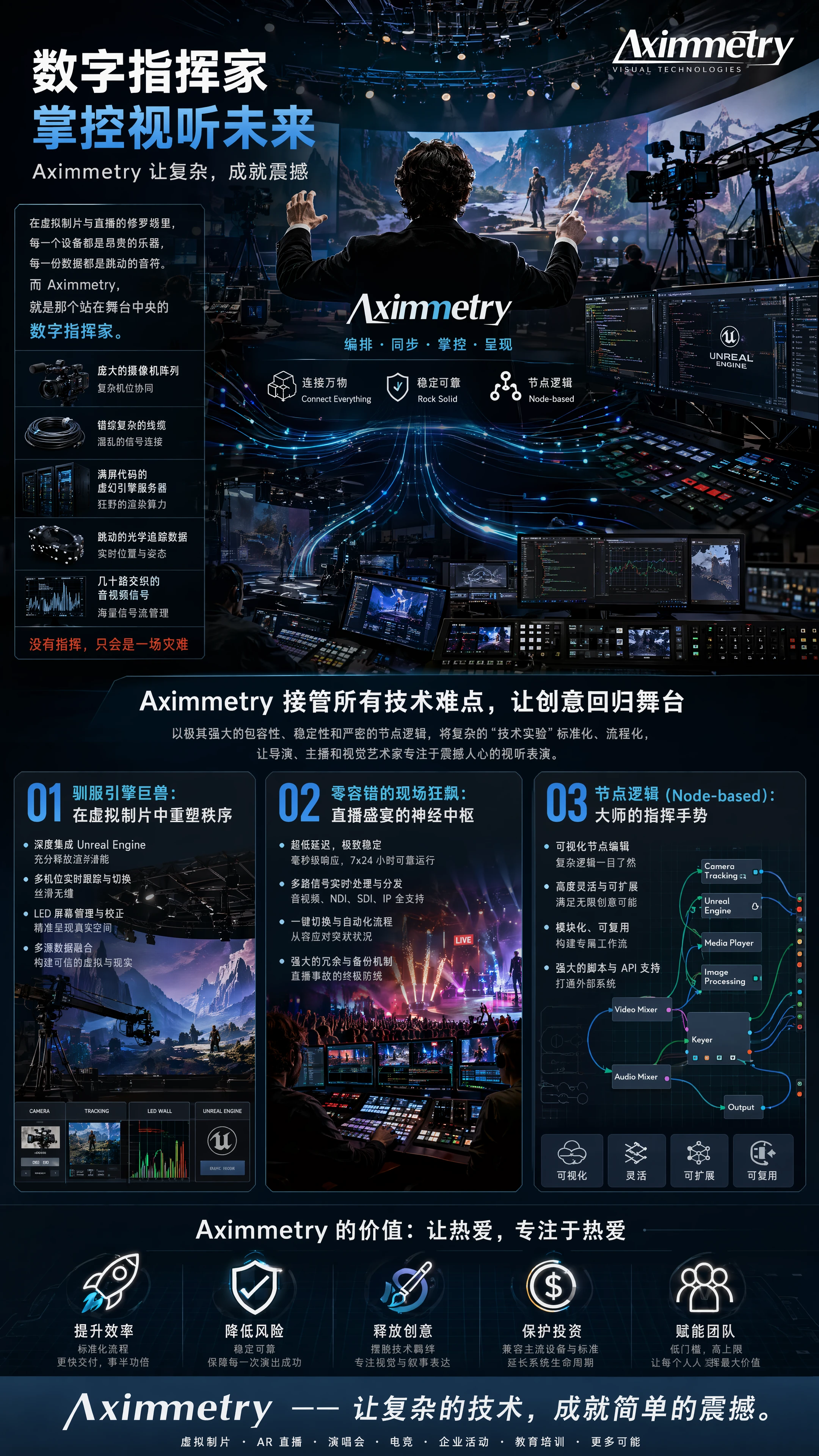
Step into any modern virtual production studio or large-scale AR live broadcast backstage, and you'll be met with an overwhelming scene of complexity: massive camera arrays, intricate tangles of cables, Unreal Engine servers filled with lines of code, constantly fluctuating optical tracking data, and dozens of interwoven audio and video signals.
This is like an orchestra without a conductor, where each instrument (device) is extremely expensive and powerful, but if they all play their own tune, the result can only be a disaster.
In this arena that severely tests real-time collaboration,Aximmetrypicked up the baton. It is not a sound-producing “instrument,” but the one standing at the center of the stage,“the ”Digital Conductor."It perfectly orchestrates the wild computing power of Unreal Engine, the lighting and camera positions of the physical world, and the massive real-time data, playing the strongest chord for virtual production and live broadcasting.
I. Taming the Engine Beast: Restoring Order in Virtual Production
Unreal Engine (UE) boasts stunning visual quality, but it was born for gaming and naturally lacks the timecode synchronization, multi-camera scheduling, and real-time field control logic required for broadcast and film production. The emergence of Aximmetry perfectly “tames” this performance beast.
Aximmetry DE: Seamlessly Interlocking Dual-Engine Gears As the chief conductor, Aximmetry has launched the highly forward-looking DE (Dual Engine) version. It treats UE as the musician specifically responsible for “playing” light and materials, while using its own powerful broadcast-grade control logic as the core hub. Directors don't need to face UE's complex underlying code; they only need to drag sliders on Aximmetry's intuitive interface to change the virtual world's day-night cycle, cloud thickness, and camera focal length in real-time on set.
Extreme Keying: Precision Noise Filtering Like a Scalpel In green screen shooting, light spill and rough edges are like noise in a symphony. Aximmetry has a built-in industry-leading Chroma Keyer. Without needing a massive render farm, it can precisely remove green light from hair strands and restore the refraction of semi-transparent glass in milliseconds. This “real-time denoising” capability, as precise as a scalpel, allows the crew to completely abandon heavy post-production cleanup, truly achieving “finished upon shooting.”
Spatial Extension: Conducting the Seamless Border Between Reality and Virtuality In XR (Extended Reality) LED shooting, Aximmetry receives the camera's spatial coordinates in real-time and directs the virtual scene to be accurately presented on the LED screen (frustum rendering). When the lens pans beyond the screen's boundaries, it instantly deploys AR technology to fill the real-world space outside the screen with virtual scenes (Set Extension). Under its direction, reality and virtuality merge seamlessly into one.
II. Zero-Tolerance Live Onslaught: The Nerve Center of the Live Broadcast Feast
If you can do a retake on a film set, then in a live broadcast of an esports final or a New Year's Eve gala watched by tens of millions, the margin for error is absolute zero. Here, Aximmetry demonstrates astonishing stability and field control capabilities.
The Dance of Data and Vision: Dynamic AR Packaging In live broadcast scenarios heavily reliant on data (such as financial news, sports events, election results), Aximmetry showcases a powerful “score-reading” ability. It can capture external API data in real-time (like instantly changing stock K-lines, real-time updated player kill counts) and instantly command virtual assets to transform this cold data into 3D charts floating beside the commentator or gorgeous AR particle effects.
Virtual Switcher: Cutting Camera Angles in Digital Space Traditional live broadcasts require multiple real cameras. But in a virtual studio built by Aximmetry, with just one fixed real camera shooting the host, the conductor can instantly generate a dozen “virtual cameras” in the virtual 3D space—a jib arm perspective, a drone bird's-eye view, a dolly tracking shot. The director can switch between multiple camera angles directly within Aximmetry, delivering an extremely grand and dynamic visual impact.
Remote Holographic Connection: A Duet Across Time and Space Leveraging its powerful signal encoding/decoding and latency compensation technology, Aximmetry can pull two people on opposite sides of the globe into the same virtual space simultaneously. It precisely coordinates the lighting direction, perspective proportions, and network latency between the two locations, making the audience see them talking naturally as if face-to-face during the live broadcast.
III. Node-Based Logic: The Conductor's Gestures
Why can not only engineers, but also visual artists with no coding experience, become proficient in using Aximmetry?
The answer lies in its“The ”node-based programming"interface. Aximmetry turns obscure C++ code into visual, draggable logic modules (nodes).
- Want the virtual door to open when the camera dollies in? Just connect the “Camera Distance” node to the “Door Animation” node.
- Want to change the virtual environment's light color based on the live audio volume? Just connect the “Audio Input” node to the “Light Material” node.
This intuitive “connection diagram” is like a conductor's gestures, extremely elegant and efficient in linking different hardware, software, trigger conditions, and visual effects into an unbreakable logical chain. Furthermore, Aximmetry is absolutely “hardware agnostic.” Whether it's the high-end optical tracking system Ncam or the consumer-grade HTC Vive, it can perfectly recognize and direct them to work together.
Conclusion: Let Technology Fade, Let Creativity Speak
An excellent conductor makes the audience forget the existence of the instruments, fully immersed in the grand narrative of the music.
Aximmetry plays exactly this role in virtual production and live broadcasting. With its incredibly strong inclusiveness, stability, and rigorous node-based logic, it takes over all the dirty work and technical difficulties. It standardizes and streamlines complex “technical experiments,” ultimately allowing directors, streamers, and visual artists to completely forget the constraints of software and hardware, pouring all their passion into the breathtaking audio-visual performance itself.

 简体中文
简体中文  English