
If you step into today's most cutting-edge XR virtual studios or large-scale esports broadcast centers, you'll be greeted by a scene straight out of cyberpunk: here, Unreal Engine servers churn through tens of billions of polygons like a beast, precision optical tracking cameras lock onto targets like compound eyes, and LED curved screens wrap around the stage like a giant skin.
We can think of such an extremely complex audiovisual production environment as a being in gestation“Giant Digital Organism”The engine is its muscles and bones, the lens is its eyes, and the screen is its skin. However, to truly bring this digital organism to life, enabling instant coordination of movement, lighting, and effects, its most urgent need is a set of latency-free, highly sensitive“Digital Nervous System”。
And in the global audiovisual industry,Aximmetryperfectly assumes the role of this central nervous system. It connects originally cold, fragmented hardware and code into an organic life form capable of real-time breathing and instantaneous reflexes.
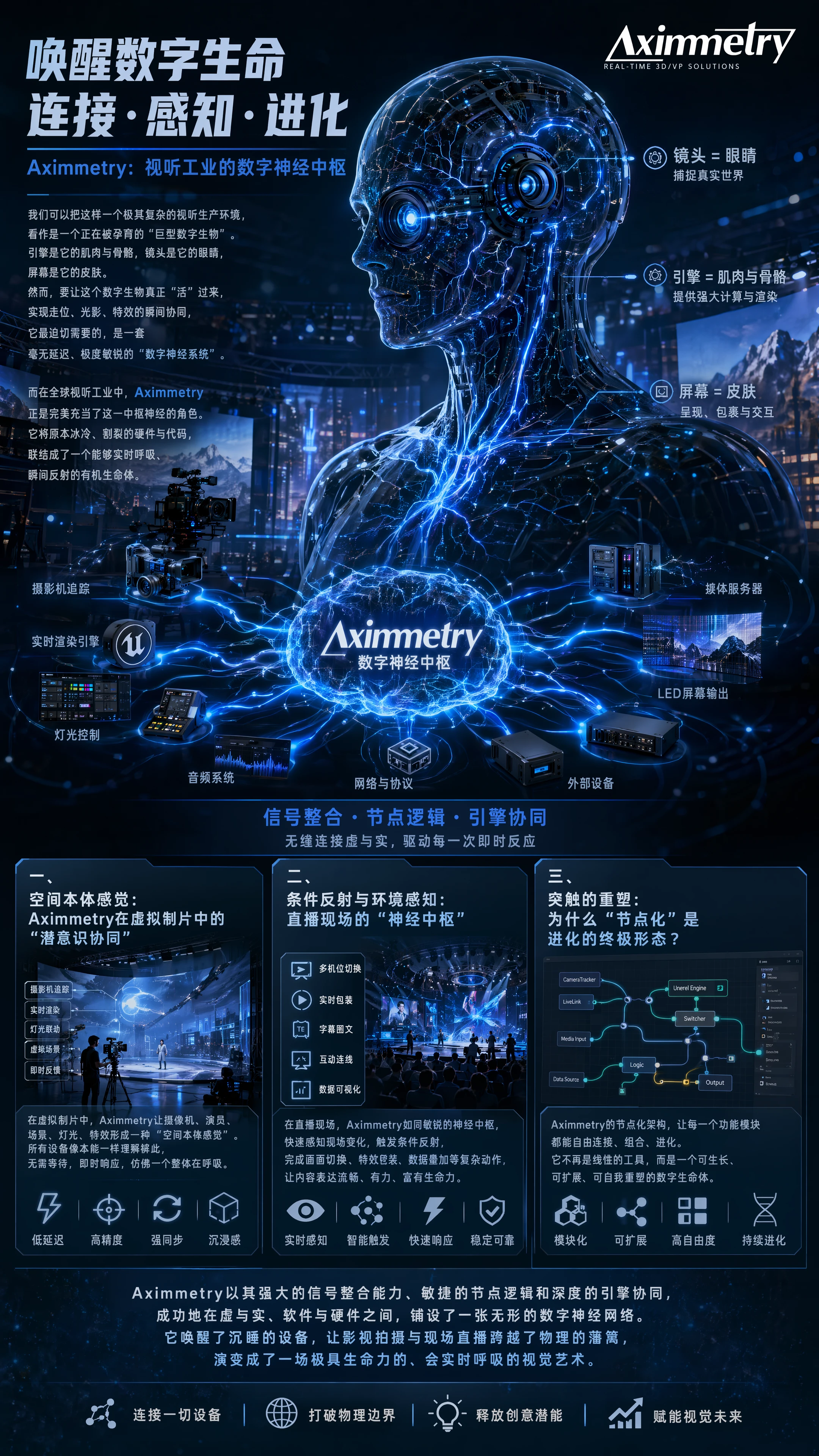
I. Spatial Proprioception: Aximmetry’s “Subconscious Coordination” in Virtual Production”
In biology, “proprioception” refers to the ability to know where our limbs are even with our eyes closed. In Virtual Production (VP), Aximmetry endows cameras and virtual environments with extremely precise “digital proprioception.”
Millisecond-Level Spatial Visual Synchronization (XR Extension) In an LED volume studio, every pan, tilt, and dolly move of the camera must cause pixel-accurate perspective changes in the 3D scene on the screen; otherwise, actors will feel dizzy, and the image will suffer from jarring disconnection. Aximmetry’s underlying architecture processes spatial coordinates (6DOF) from the camera with sub-frame latency. Like the cerebellum controlling balance, it instinctively commands the LED screen to render the correct “frustum” view and instantly uses AR technology to fill in the virtual world beyond the screen (Set Extension). The boundary between physical and digital space is completely erased under its subconscious coordination.
Photon-Level Sympathetic Nervous System (Dual-Engine Architecture) A real organism instinctively casts shadows and reflects light under sunlight. Aximmetry innovatively integratesDE (Dual-Engine) architecture, deeply coupling with Unreal Engine (UE5). When a lighting technician on the real set pushes up a spotlight, the control signal, transmitted through Aximmetry’s “neural center,” instantly reaches Unreal Engine. The angle of the digital sun in the virtual world changes accordingly, and the light and shadow on virtual characters’ faces shift in real time. This photon-level linkage between reality and virtuality occurs naturally, like a conditioned reflex, without manual intervention.
Precise Immune System Rejection (Real-Time Keying) For crews using traditional green screens, spill and noise from the green screen are like “viruses” invading the image. Aximmetry’s built-in advanced chroma keyer acts as a powerful “digital immune system.” It is extremely sensitive, instantly identifying and “devouring” excess green among millions of pixels while perfectly preserving semi-transparent glass refractions, subtle contact shadows, and wind-blown hair strands. This millisecond-level rejection delivers an ultra-pure, cinematic image quality.
II. Conditioned Reflex and Environmental Awareness: The “Neural Center” for Live Broadcasts”
Live broadcasting is an extremely high-pressure environment with no second takes. Here, Aximmetry demonstrates strong resilience and a “conditioned reflex” to external environments.
Data-Driven “Nerve Impulse” (Dynamic AR Graphics) In live broadcasts of esports tournaments, financial summits, or election results, data changes rapidly. Aximmetry’s node system can “listen” to external network API interfaces in real time. When a player’s economy curve reverses or a stock suddenly hits its daily limit, this data stream turns into a “nerve impulse,” instantly activating Aximmetry’s preset visual nodes. With a flash of light, a massive 3D holographic chart bursts from the studio floor, updating dynamically in real time. Data is no longer a static overlay but a “living organism” that interacts with its environment.
“Consciousness Fusion” Across Different Locations” Using the ultra-low-latency SRT video stream protocol, Aximmetry can connect two physical spaces half a world apart into the same “digital brain.” A guest in London and a host in Beijing—their body movements, perspective relationships, and even eye contact—are perfectly computed by Aximmetry within a unified virtual 3D coordinate system. In this digital dimension, the physical distance between them is completely eliminated by the neural center, achieving a fusion of consciousness as if they were on the same screen.
III. Synaptic Rewiring: Why “Node-Based” is the Ultimate Form of Evolution?
If the greatest aspect of the human brain is “neuroplasticity” (the ability to constantly form new synaptic connections), then what fascinates creators most about Aximmetry is its“Node-based Workflow”。
In the past, to make a virtual door in the engine open along with the real lights, programmers had to write hundreds of lines of complex C++ code. Once the set requirements changed, the code had to be rewritten from scratch, and the system was prone to crashing.
Aximmetry completely abandons this rigid model:
- Its interface is filled with various functional modules (camera input, materials, lighting, logic gates), which act like independent neurons.
- Visual artists don't need to understand code; they just need to drag lines with the mouse to connect different nodes.
- The process of connecting lines is building a new neural reflex arc. You can even connect a line so that the “volume level” of a microphone directly controls the “intensity of rain” in the virtual world.
Moreover, this nervous system is never “picky.” Whether it’s a professional film optical tracking system (like Ncam) costing hundreds of thousands of dollars or an HTC Vive tracker costing a few thousand, Aximmetry perfectly recognizes their electrical signals and converts them into a unified system language.
Conclusion: Awakening the Next Generation of Digital Life
The future of the audiovisual industry is destined not to be a lifeless construct of cold machinery, rigid green screens, and lengthy post-production rendering. The media of the future must be real-time, interactive, and alive.
With its powerful signal integration capabilities, agile node logic, and deep engine synergy, Aximmetry successfully lays an invisible digital neural network between the virtual and the real, software and hardware. It awakens dormant devices, allowing film production and live broadcasting to transcend physical barriers and evolve into a vibrant, breathing visual art form.

 简体中文
简体中文  English