
When you take apart the chassis of a high-performance off-road vehicle, you'll find an unassuming yet critical component—the Universal Joint. No matter how wildly the wheels twist and bounce through mud, it smoothly and losslessly transmits the engine's powerful torque.
If we consider the modernVirtual Production (VP) and Live Broadcast Systemsas a massive supercar: the Unreal Engineit is the V8 engine unleashing astonishing rendering horsepower; while thecameras, optical tracking systems, DMX lighting consoles, and camera cranes dashing around the setare the four constantly spinning wheels.
For a long time, the pain point of the audiovisual industry has been: the interface between this powerful engine (UE) and the four wheels (on-site physical devices) simply doesn't match. The engine speaks the language of code and blueprints, while the on-site devices speak the language of levels, Free-D data, and video baseband signals. Forcibly connecting them often results in system crashes, screen tearing, and explosive latency.
UntilAximmetryis installed right at the center of this supercar's chassis.
As a phenomenal real-time 3D graphics and control system, Aximmetry perfectly serves as the entire audiovisual industry's“Super Universal Joint”With its extremely robust compatibility and remarkably intelligent translation logic, it establishes a lossless power transmission mechanism between the virtual and the real.
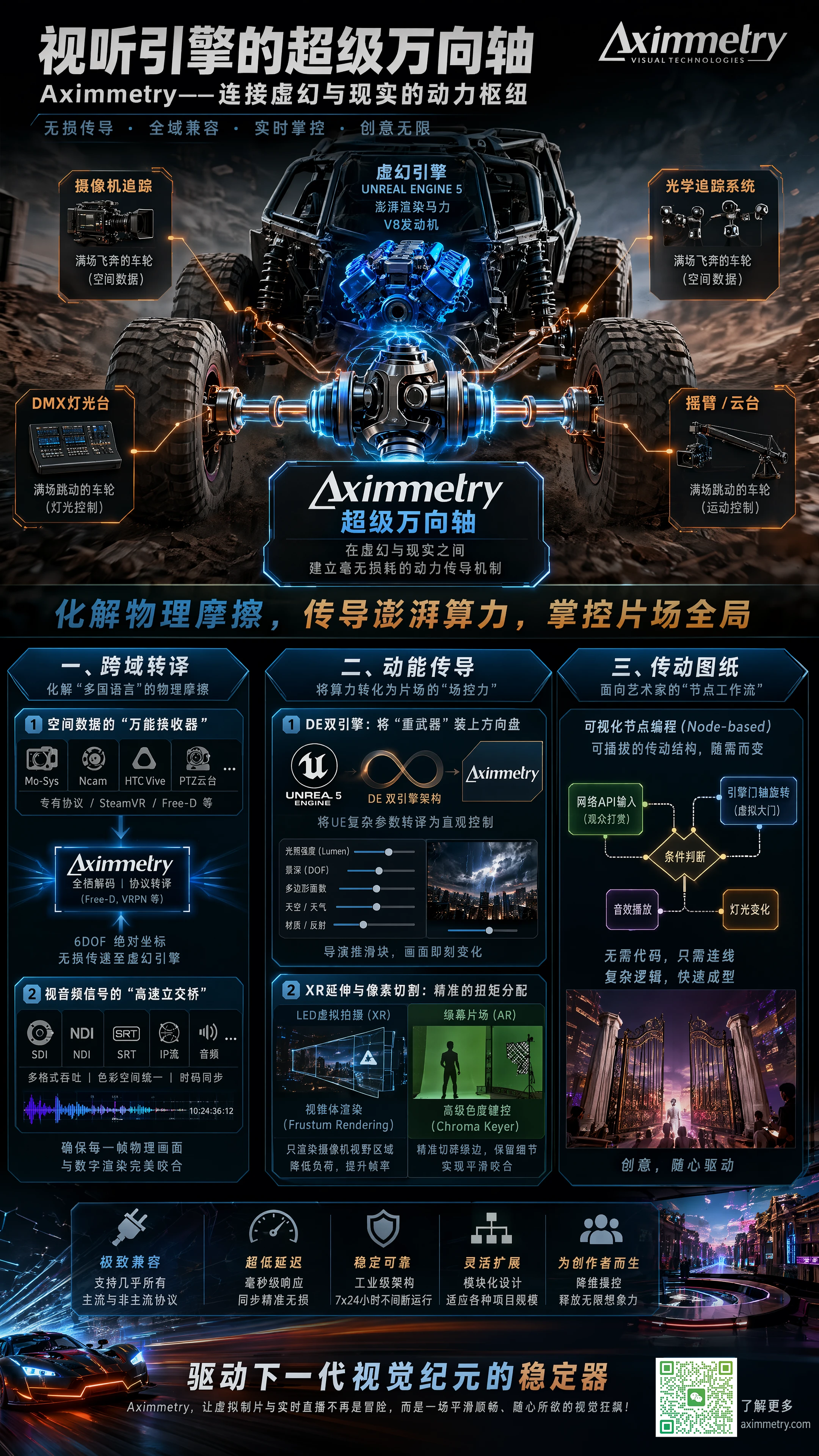
I. Cross-Domain Translation: Resolving the Physical Friction of “Multiple Languages”
In a standard virtual studio or advanced AR live streaming room, the device ecosystem is extremely “fragmented.” The universal joint attribute of Aximmetry is first reflected in its“All-Terrain Decoding”capability.
“Universal Receiver” for Spatial Data” Cameras must be precisely positioned in 3D space, but tracking hardware varies widely. High-end systems like Mo-Sys and Ncam use complex proprietary protocols; mid-range HTC Vive uses the SteamVR protocol; while PTZ pan-tilt heads commonly used in broadcasting have their own logic. Aximmetry acts like a universal interface that accepts all comers, natively supporting almost all mainstream and niche tracking protocols (e.g., Free-D, VRPN) without requiring tedious low-level development. No matter what “spatial gibberish” is input, Aximmetry instantly translates it into absolute coordinates (6DOF) that Unreal Engine can understand, transferring physical motion losslessly to the digital world.
“High-Speed Interchange” for Video and Audio Signals” The transmission of live video streams is equally chaotic: there are traditional SDI baseband signals, IP-based NDI, and low-latency SRT. Aximmetry can not only simultaneously handle massive volumes of different video formats but also perform real-time “color space unification” and “timecode sync” on them. It ensures that every frame of physical footage entering the engine perfectly meshes with the digitally rendered background within the same microsecond, completely eliminating frame-level physical friction.
II. Kinetic Transmission: Converting Computing Power into “On-Set Control Power”
Beyond receiving, the more powerful function of Aximmetry as a universal joint lies in smoothly converting Unreal Engine's “rendering computing power” into “on-site control power” in the hands of the director and technical director.
Dual Engine: Mounting “Heavy Artillery” on the Steering Wheel Unreal Engine (UE) offers unparalleled visual quality, but having a director tweak engine blueprints on set is like asking a driver to tighten engine screws. Aximmetry creatively introducedDE (Dual-Engine) architectureThe UE5 core is seamlessly embedded into Aximmetry's control framework. This universal joint translates UE's extremely complex rendering parameters (such as Lumen lighting, depth of field, polygon count) into simple, intuitive sliders on the Aximmetry interface. The director only needs to push a slider, like turning a steering wheel, to instantly see a stormy virtual sky on the monitor. Powerful computing power is perfectly reduced to ultimate on-site control.
XR Extension and Pixel Cutting: Precise Torque Distribution In LED virtual production (XR), Aximmetry precisely distributes computing torque to where it's needed most: through“Frustum Rendering”, it commands the engine to fully render only the screen area the camera is capturing, significantly reducing system load; when the camera pans out of the screen, it instantly mobilizes AR capabilities for“Set Extension”In traditional green screen studios, this universal joint concentrates computing power on its built-in advanced chroma keyer, precisely cutting green edges in milliseconds, preserving transparent materials and fine hair strands, achieving smooth meshing of physical pixels and digital images.
III. Transmission Blueprint: Artist-Oriented “Node Workflow”
A perfect universal joint must be able to reconfigure its transmission structure at any time based on different road conditions (project requirements). This brings us to Aximmetry's highly acclaimedNode-based Visual Scriptingsystem.
If traditional programming languages are compared to welded gears, then Aximmetry's “nodes” are like Lego bricks that can be freely plugged and unplugged.
- Visual artists don't need to write a single line of C++ code; they only face the “visual transmission blueprint” on the computer screen.
- Want the virtual door in the live stream to open because of a viewer's donation? Simply drag a line with the mouse to connect the node representing “network API input” to the node representing “engine door hinge rotation.”
- This extremely flexible “connection logic” greatly eliminates resistance in system setup. No matter how complex the broadcast logic or how imaginative the interactive effects, they can be quickly realized through simple connections.
Conclusion: The Stabilizer Driving the Next Visual Era
In today's era of rapid technological iteration, what the audiovisual industry lacks most is never clearer cameras or graphics cards capable of rendering more polygons. What the industry truly craves is the underlying hub that enables these “performance monsters” to work together.
Aximmetry has excellently fulfilled this historical mission. As the super “universal joint” of the audiovisual engine, it establishes a stable, efficient, low-loss kinetic transmission system among the complex hardware protocols, wild game-level engines, and demanding creators.
With its presence, virtual production and live streaming are no longer adventures full of interruptions and crashes, but have become a smooth, free-flowing visual joyride. On the fast track toward the metaverse and the all-real internet, Aximmetry will continue to sit firmly at the center of the chassis, steadily converting the creator's surging imagination into the most breathtaking digital wonders on the screen.

 简体中文
简体中文  English