
In the modern audiovisual industry, the most advanced visual deception is often accompanied by the strongest “rejection reaction.”
Imagine the most cutting-edge filming set today: In reality, there's only a few dozen square meters of LED stage (or green screen), but the director needs to display an alien desert spanning tens of thousands of kilometers on the monitor, or even conjure a fire-breathing dragon out of thin air beside the host. In cybernetic terms, this is equivalent to connecting the real world to a massive“Digital Phantom Limb”。
When the real camera moves, if the perspective change of this “digital phantom limb” (virtual background or AR effects) lags by even 0.01 seconds, or if the lighting is slightly misaligned, the audience's brain will instantly experience “dizziness” and “immersion break”—this is the rejection reaction of the visual system.
How to make the massive digital phantom limb respond as effortlessly as a real limb? The industry's top real-time 3D control hub—Aximmetry, offers a remarkably biologically elegant answer: It implants an extremely sensitive“Digital Proprioception” system。
I. Virtual Production: Taking Over the “Neural Center” of the Set”
In biology, proprioception allows us to know where our hands and feet are even with our eyes closed. Aximmetry, in the virtual set, achieves a complete “unity of body and mind” between reality and illusion by establishing this neural-level perception.
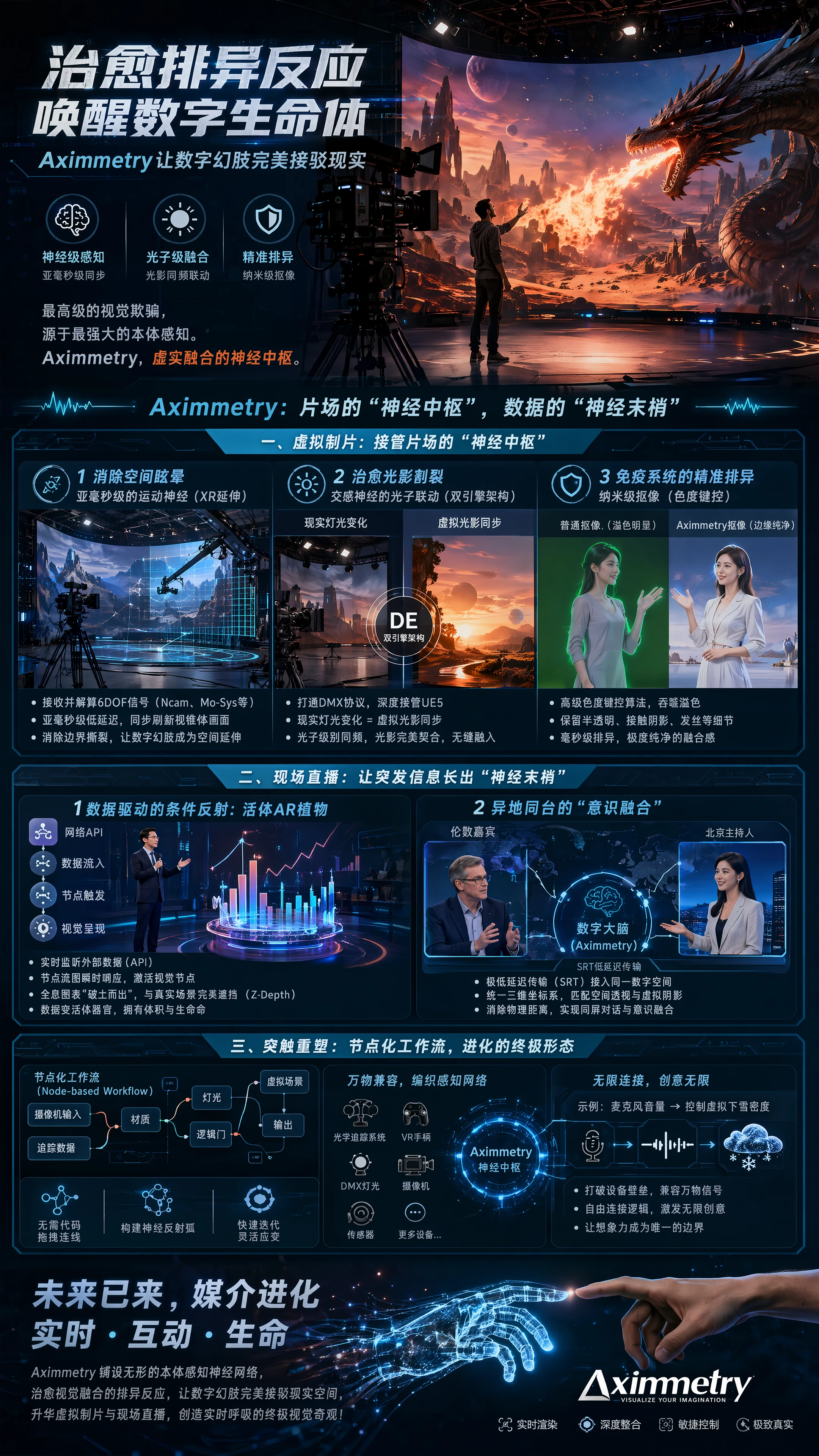
Eliminating Spatial Dizziness: Sub-millisecond Motor Nerves (XR Extension) In an LED volume stage, the screen is the boundary of reality, while the AR extension beyond the screen is the massive “digital phantom limb.” Once the camera moves, the boundary between the physical screen and the AR extension is prone to perspective tearing. Aximmetry receives and calculates 6DOF (six degrees of freedom) signals from optical tracking systems like Ncam and Mo-Sys with sub-millisecond low latency. Like the cerebellum controlling balance, it instinctively commands Unreal Engine (UE5) to synchronously refresh the frustum view. Any slight tremor in the physical camera position is instantly transmitted to the digital environment. This extreme spatial synchronization perfectly eliminates tearing at the boundary, making the digital phantom limb a true extension of real space.
Healing Light and Shadow Disconnection: Sympathetic Nerve Photon Linkage (Dual Engine Architecture) Real limbs cast shadows in sunlight. If the lighting of the virtual scene is out of sync with the real person, a rejection reaction occurs immediately. Aximmetry creatively incorporatesDE (Dual-Engine) architecture, deeply taking over UE5. It not only renders the image but also connects to the DMX protocol controlling real-world lighting. When a lighting technician dims a spotlight in reality, the control signal, transmitted through Aximmetry's neural center, instantly reaches the virtual world, causing the digital sunset to descend accordingly, achieving “photon-level synchronization” between the highlights on virtual characters and the shadows on real actors' faces. The perfect alignment of light and shadow makes the brain fully accept the authenticity of the virtual environment.
Precise Rejection by the Immune System: Nanometer-level Keying On a green screen set, green spill (green edges around the subject) is like a “virus” invading the image. Aximmetry's built-in advanced chroma keyer algorithm acts like a powerful “digital immune system.” It is extremely sensitive, instantly identifying and “devouring” excess green among millions of pixels while perfectly preserving semi-transparent water glass refractions, extremely fine contact shadows, and wind-blown hair strands. This millisecond-level rejection reaction results in an exceptionally pure sense of fusion in the image.
II. Live Broadcasting: Giving Emergent Information “Nerve Endings”
A live broadcast site is a constantly changing living organism. Aximmetry not only gives the live studio proprioception but also endows cold data with nerve endings, enabling “conditioned reflexes” to external stimuli.
Data-Driven Conditioned Reflex: Living AR Plants In e-sports events or financial summits, data is constantly fluctuating. Aximmetry's node-based flow graph can “listen” to external network API interfaces in real time. When a player's economy curve reverses or a stock suddenly hits the daily limit, this data stream turns into a “neural impulse,” instantly activating Aximmetry's preset visual nodes. Accompanied by a light effect, a three-dimensional holographic chart “bursts out” from the real studio floor, creating a perfect foreground-background occlusion relationship (Z-Depth) with the real host. Data is no longer a flat overlay but becomes a “living organ” with volume.
“Consciousness Fusion” Across Different Locations” Using ultra-low-latency transmission protocols (such as SRT), Aximmetry can connect two physical spaces half a world apart into the same “digital brain.” The video streams of a guest in London and a host in Beijing are fed into Aximmetry's 3D coordinate system. In this digital dimension, the physical distance between them is completely eliminated by the neural center. The system automatically matches them with the same spatial perspective and interwoven virtual shadows, achieving a “consciousness fusion” and dialogue as if they were on the same screen.
III. Synaptic Remodeling: Why “Node-based” is the Ultimate Form of Evolution?
If the greatest aspect of the human brain is “neuroplasticity” (the ability to constantly form new synaptic connections), then what fascinates creators most about Aximmetry is its“Node-based Workflow”。
In the past, to make a virtual door in the engine open along with the real lights, programmers had to write hundreds of lines of complex C++ code. Once the set requirements changed, the code had to be rewritten from scratch, and the system was prone to crashing.
Aximmetry completely abandons this rigid model:
- Its interface is filled with various functional modules (camera input, materials, lighting, logic gates), which act like independent neurons.
- Visual artists don't need to understand code; they just need to drag lines with the mouse to connect different nodes.
- The process of connecting lines is building a new neural reflex arc. You can even connect a line so that the “volume level” of a real microphone directly controls the “intensity of snowfall” in the virtual world.
Furthermore, this neural system is never “picky.” Whether it's an optical positioning system costing hundreds of thousands of dollars or a VR controller worth a few thousand, Aximmetry perfectly recognizes their electrical signals, weaving everything into this vast perception network.
Conclusion: Awakening the Ultimate Digital Life Form
The future of the audiovisual industry is destined not to be a lifeless construct of cold machinery, rigid green screens, and lengthy post-production rendering. The media of the future must be real-time, interactive, and alive.
With its powerful signal integration capabilities, agile node logic, and deep engine synergy, Aximmetry successfully lays an invisible “proprioceptive neural network” at the intersection of reality and illusion. It heals the rejection reaction of visual fusion, perfectly connecting the digital phantom limb to real space, ultimately elevating virtual production and live broadcasting into a highly vibrant, real-time breathing ultimate visual spectacle.

 简体中文
简体中文  English