
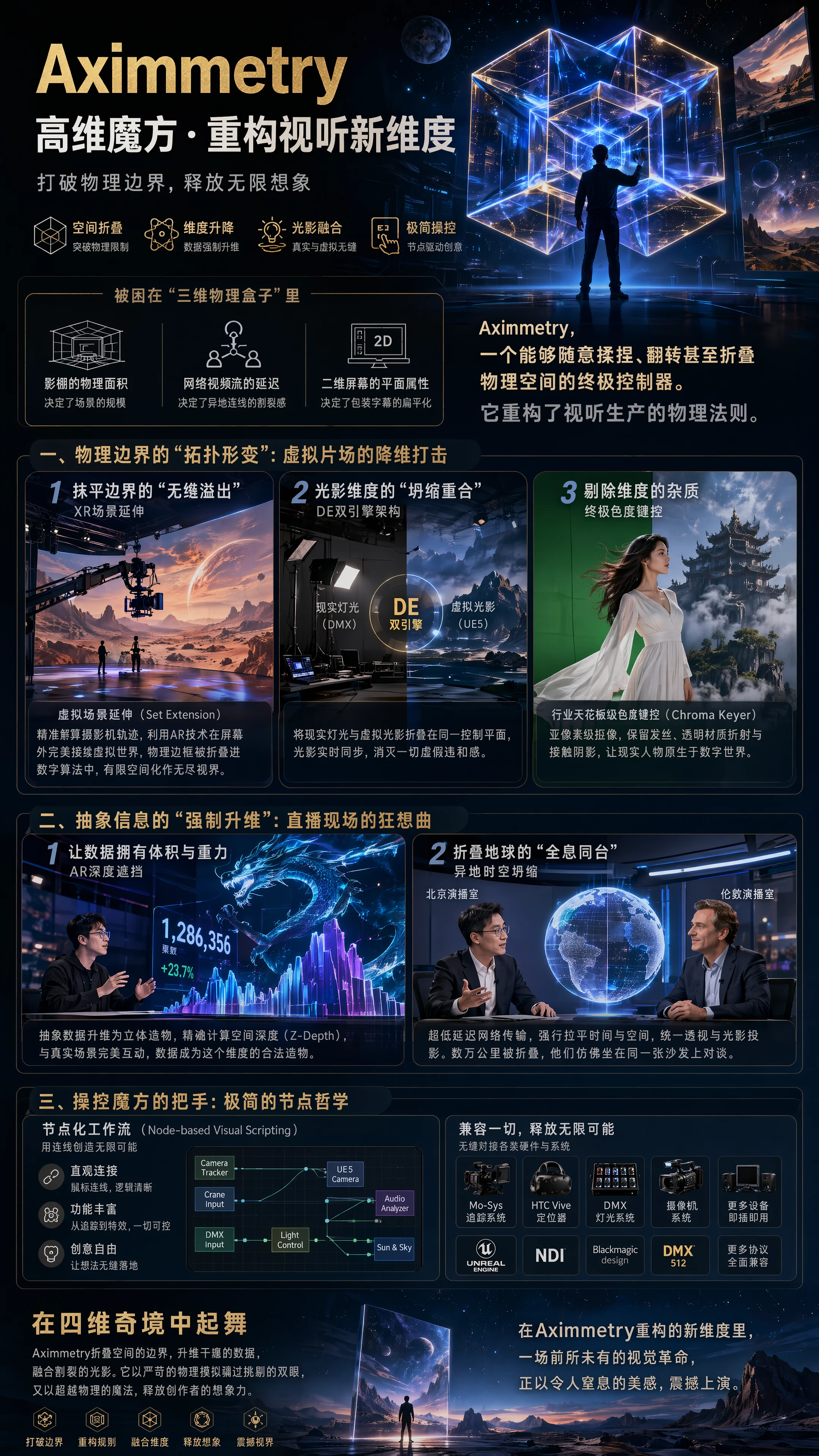
When we talk about the production of audiovisual content, we are often trapped in a very rigid “three-dimensional physical box”: the physical area of the studio determines the scale of the scene; the latency of the network video stream determines the sense of disconnection in remote connections; the flat nature of the two-dimensional screen determines the flatness of graphics and subtitles.
All of a creator's ideas must bump and compromise within this “box.” To break out of this box, relying solely on Unreal Engine is not enough; you also need an ultimate controller that can knead, flip, and even fold physical space at will.
This is precisely whyAximmetryit is regarded as a “god-tier tool” by top industry teams. It is not just a real-time graphics control hub, but more like a“Tesseract”that transcends the laws of physics. Through extremely complex underlying algorithms, it wields the magic of “space folding” and “dimensional elevation” on the sets of virtual production and AR live broadcasts, reconstructing the physical laws of audiovisual production.
I. Topological Deformation of Physical Boundaries: A Dimensional Reduction Strike on the Virtual Set
On a virtual production set, the most headache-inducing issue is often the “exhaustion of physical space.” No matter how large the studio, there is always a risk of the camera revealing the edges. Aximmetry, through space folding, allows an extremely limited physical area to burst forth with boundless visual volume.
Seamless Overflow That Erases Boundaries (XR Scene Extension) In an LED volume studio (XR shooting), when the camera pulls back and the edge of the physical screen is about to be exposed—the most tense moment for a traditional crew—this Tesseract from Aximmetry only needs a gentle twist to trigger its renowned“Virtual Scene Extension (Set Extension)”It precisely calculates the camera's motion trajectory, using AR technology to perfectly extend a three-dimensional virtual world identical to the one on the screen into the real void outside the LED screen. The physical frame is instantly folded into digital algorithms, transforming a few dozen square meters of studio into an endless alien desert on the monitor.
Collapse and Coincidence of Light and Shadow Dimensions (DE Dual-Engine Architecture) Lighting in reality and lighting in a 3D engine were originally two parallel dimensions. Aximmetry innovatively introducedDE (Dual-Engine) architecture, using the UE5 engine as the core of the Tesseract. Through protocols like DMX, it “folds” the lighting console of the real set and the virtual world's sun onto the same control plane. Pushing up a light in reality causes the shadows cast by virtual clouds to shift synchronously; the faint morning light of the virtual world maps perfectly onto the real actor's face. The collapse of the light and shadow dimensions eliminates any trace of false dissonance.
Removing Dimensional Impurities (Ultimate Chroma Keying) On a green screen set, the harsh green edges around characters are scars left by the compromise between physical and digital space. Aximmetry features an industry-leading chroma keying algorithm (Chroma Keyer). It no longer crudely “cuts out” the image but reduces the green screen pixels to complete transparency. It preserves flying strands of hair, refractions of translucent materials, and even faint contact shadows at the sub-pixel level. It makes real characters appear as if they were born in the digital environment, achieving a perfect fusion of two dimensions.
II. Forced Elevation of Abstract Information: A Rhapsody on the Live Broadcast Set
Television and web live broadcasts are often information-dense but visually flat. Aximmetry frantically rotates the Tesseract within the live studio, forcibly elevating dry information and distant distances.
Giving Data Volume and Gravity (AR Depth Occlusion) In esports tournaments or election result broadcasts, massive network data usually floats on the screen as 2D subtitles. Once Aximmetry's Flow Graph receives data fluctuations from an external API, it immediately activates its “elevation magic.” Abstract vote numbers instantly plunge into the studio, transforming into three-dimensional mountains rising from the floor; critical hit damage in a game becomes an AR dragon circling above the commentator's head. Even more astonishingly, Aximmetry precisely calculates spatial depth (Z-Depth). When this dragon flies over the physical studio desk, the desk perfectly occludes the lower half of its body. Data is forcibly granted the privilege of physical collision, becoming a legitimate entity in this dimension.
Folding the Earth with Holographic Co-location (Collapsing Time and Space Across Locations) The essence of cross-border connections is the fragmentation of time and space. Aximmetry, through an ultra-low latency network transmission protocol, forcibly pulls the video streams from two green screen studios in London and Beijing into the same virtual 3D coordinate system within the Tesseract. Network latency is smoothed out by algorithms, spatial perspective is forcibly unified, and virtual lighting even casts identical shadows on both individuals. Tens of thousands of kilometers of physical distance are completely folded; on screen, they appear as intimate conversationalists sitting on the same sofa.
III. The Handle to Control the Tesseract: The Philosophy of Minimalist Nodes
Does controlling a Tesseract that can freely fold space require extremely complex code instructions?
Aximmetry elegantly rejects this complexity. It provides creators with a system known as“node-based visual scripting”minimalist operation interface.
- Here, there is no tedious or obscure C++ code.
- Want the tracking crane to control the engine's perspective? Want the sound level on set to control a virtual blizzard? Everything is done by simply connecting “node modules” representing different functions with lines using the mouse.
- This highly intuitive connection logic is like grabbing the handle to rotate the Tesseract. It completely eliminates the friction between human creative ideas and the underlying logic of the computer.
Moreover, this Tesseract is compatible with everything. Whether it's a Hollywood-grade Mo-Sys tracking system or a consumer-level HTC Vive tracker, as long as it's plugged in, it is instantly swept into this storm of spatial reconstruction.
Conclusion: Dancing in the Fourth Dimension
As long as we are bound by the laws of physics, the wonders of audiovisuals will always hit a ceiling.
Aximmetry was born to shatter this ceiling. It lurks between the wild computing power of Unreal Engine and the complex array of studio equipment, like a tireless Tesseract, constantly folding the boundaries of space, elevating dry data, and merging fragmented light and shadow.
It uses rigorous physical simulation to deceive the discerning human eye, and with magic that completely transcends physics, it unleashes the creator's imprisoned imagination. In this new dimension without boundaries and beyond common sense, reconstructed by Aximmetry, an unprecedented visual revolution is unfolding with breathtaking beauty.

 简体中文
简体中文  English