
If you have ever used active noise-canceling headphones, you must have marveled at the magic of instant silence. The principle behind noise-canceling headphones is to precisely calculate the sound waves (phase) of external noise, and then emit a completely opposite sound wave to cancel out the noise.
On the set of top-tier virtual production (VP) or advanced AR live broadcasts, we also face an extremely severe“visual noise”problem.
On this set, two massive “visual sound waves” are roaring simultaneously: one isphysical reality(the physical movement of the camera, the live lighting hitting the actors, the real reflections of the green screen); the other isthe digital engine(the virtual perspective distortion in Unreal Engine, the rendering of hundreds of millions of polygons, the shadows of the digital sun).
If the “phases” of these two waves are not perfectly aligned—even if the camera's physical movement is 0.05 seconds faster than the virtual background's movement, or the warm light from the real world clashes with the cool light of the digital background—the audience's brain will instantly experience a strong sense of dizziness and an unbearable “break in immersion,” as if hearing the “piercing screech of phase cancellation.” This is what we often call “the special effects look fake.”
To perfectly merge these two raging waves, you need a master controller:“the ”Ultimate Phase Synchronizer"And across the global audiovisual industry,AximmetryAximmetry has indisputably taken on this role. It is not only an amplifier for the rendering engine but also the “visual noise cancellation center” for the entire virtual-real interaction system. On a microsecond scale of time, space, and light, it forcibly calibrates the phases of the physical and digital, filtering out all noise, leaving only an extremely pure immersive experience for the audience.
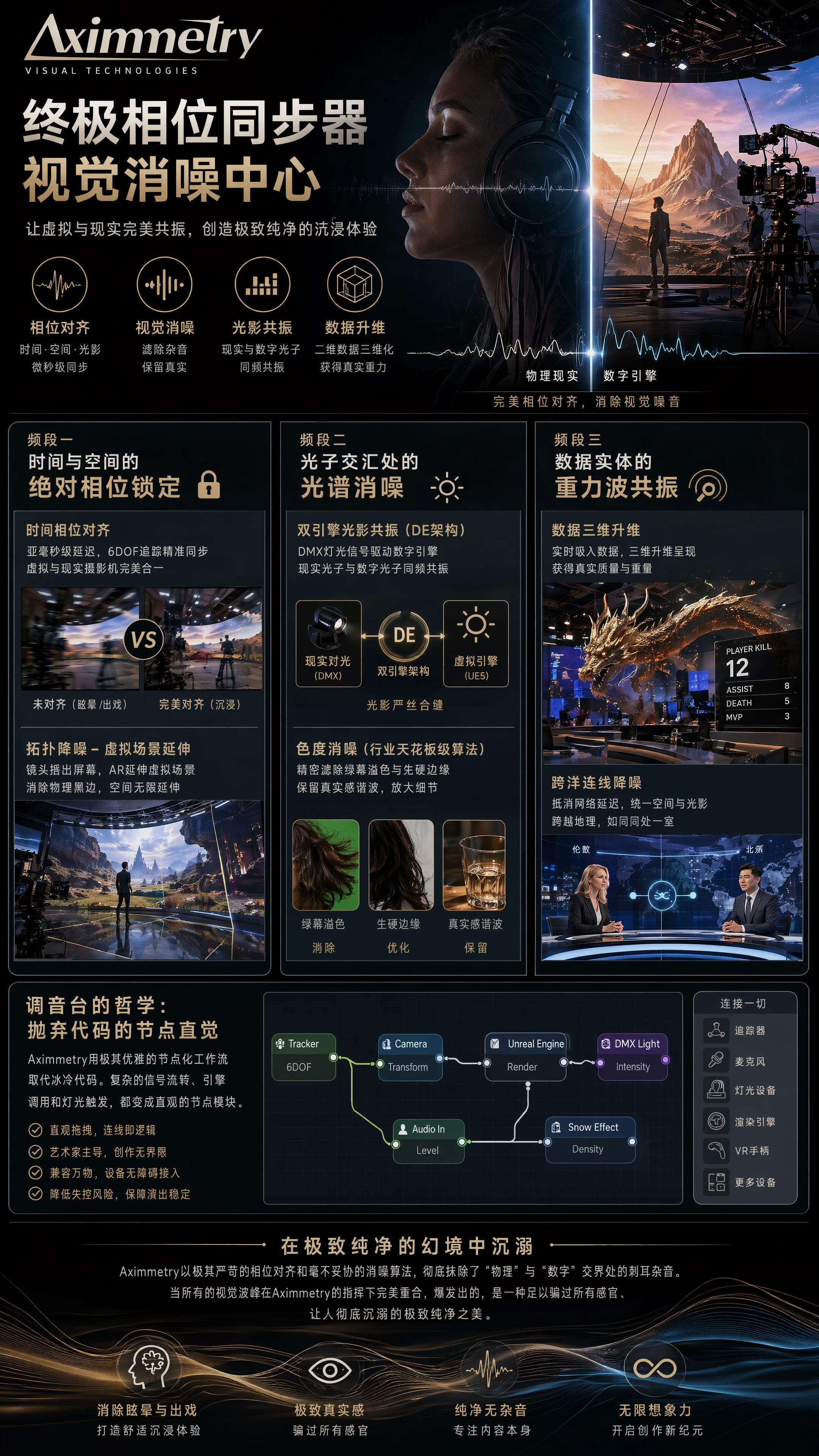
Band One: “Absolute Phase Lock” of Time and Space”
Humans have zero tolerance for spatial slippage. Once the visual perspective expected by the brain is out of sync with the image, dizziness follows like a shadow.
In LED volume stages (XR shooting), Aximmetry demonstrates its terrifying“time phase alignment”capability. It receives 6DOF spatial coordinates from Hollywood-grade trackers like Ncam and Mo-Sys with extremely low latency. In sub-millisecond calculations, it filters out jitter noise from the tracking signal and forcibly makes the virtual camera in Unreal Engine (UE5) and the real camera move within the same microsecond. Peaks align perfectly with peaks, and perspective is locked tight.
When dealing with spatial boundaries, Aximmetry performs an even more astonishing“topological noise reduction”When the lens inevitably pans beyond the physical LED screen, that glaring physical black edge becomes the biggest “visual noise.” Aximmetry's“Virtual Scene Extension (Set Extension)”capability activates instantly, using AR technology to seamlessly extend a virtual waveform with perfectly matched phase beyond the screen. The physical discontinuity is perfectly canceled, and the space gains infinite visual extension.
Band Two: “Spectral Noise Cancellation” at the Intersection of Photons”
Special effects without light-shadow interaction are like an unplugged guitar—producing only dry, plucked sounds.
To perfectly align the phases of light and shadow, Aximmetry pioneered a highly disruptiveDE (Dual-Engine) architectureIt forcibly connects the real and digital light into the same mixing console. Through the DMX protocol, when a lighting engineer pushes up a fill light in reality, its electrical signal is instantly converted into a digital waveform. As the warm light on the actor's face brightens, the digital sun in Unreal Engine simultaneously bursts with light, with virtual shadows and real highlights fitting seamlessly. Real photons and digital photons produce an extremely harmonious optical resonance at the same frequency.
For the most maddening “high-frequency noise” on green screen sets—green spill and harsh keying edges—Aximmetry features an industry-leadingChroma Keyer algorithmIt acts like an extremely precise bandpass filter, removing the disruptive green wavelengths while sparingly preserving those extremely subtle yet crucial “realism harmonics”: the complex refraction of a semi-transparent glass, the gaps in flowing hair, and the faint contact shadows. Noise is thoroughly filtered, and realism is infinitely amplified.
Band Three: “Gravitational Wave Resonance” of Data Entities”
In high-pressure live events like esports broadcasts or election result shows, abrupt 2D graphic overlays severely disrupt the overall visual coherence.
Aximmetry doesn't let data become noise; instead, it turns it into a visual climax. Its powerful node-based flow graph can ingest real-time network API data and perform “3D upscaling.” When kill data surges, it no longer floats as subtitles but is instantly forged into a 3D AR dragon casting shadows on the floor. Even more impressive, Aximmetry aligns the “gravity phase” through depth calculation (Z-Depth)—when the dragon flies over a real broadcast desk, the desk perfectly occludes its lower half. Data is forcibly integrated into the resonant frequency of physical space, gaining real mass and weight.
For cross-ocean live connections, Aximmetry forcibly pulls two video streams with different latencies from London and Beijing into the same virtual studio frequency. It cancels out the time difference noise of network latency and forcibly unifies the spatial perspective and lighting direction across multiple locations. Geographic distance is completely “noise-canceled,” making the two people feel as if they are in the same room.
The Philosophy of the Mixing Console: Abandoning Code for “Node Intuition”
If the control panel of this ultimate synchronizer were covered in obscure C++ code, the artists operating it would eventually break down.
Aximmetry deeply understands the importance of “intuition” in artistic creation. It replaces cold code with an exceptionally elegant“node-based visual scripting”workflow.
- Here, all complex signal flows, engine calls, and lighting triggers become intuitive “node modules.”
- Visual artists stand before a massive mixing console, simply dragging connections with the mouse to link trackers, microphones, and rendering engines. “Want the live volume to control the density of virtual snowflakes?” Just connect a line.
- This highly intuitive and logical operation method greatly reduces the risk of system failure, allowing everything from heavy equipment costing hundreds of thousands to consumer-grade VR controllers to seamlessly join this perfect symphony.
Conclusion: Indulging in an Extremely Pure Illusion
The human brain is an extremely precise instrument, always detecting lies in the slightest misalignment.
In today's audiovisual industry's frenzy for rendering power and polygon counts, Aximmetry does not blindly follow the trend. It lurks beneath the massive computing power, like a obsessive sound engineer, fixated on every gap, every frame of delay, and every inch of light and shadow between reality and the virtual.
With its rigorous phase alignment and uncompromising noise cancellation algorithms, it completely erases the harsh noise at the boundary between “physical” and “digital.” Ultimately, when all visual peaks perfectly align under Aximmetry's command, what bursts forth is an extremely pure beauty that can deceive all senses and make one fully indulge.

 简体中文
简体中文  English