
Imagine if you were equipped with a powerful mechanical arm, but when your brain sends the command to “raise your hand,” the mechanical arm responds 0.1 seconds late; or when you touch a hot stove, the mechanical arm cannot sense the temperature change. Your brain would instantly fall into confusion, triggering a strong rejection response and “phantom limb pain.”
In today's lavishly funded virtual production (VP) or top-tier AR live broadcasts, the entire crew is actually experiencing a similar “rejection reaction.”
In this cyberpunk-like studio, the massive Unreal Engine (UE5) and billions of digital polygons are the "digital prosthetics" forcibly grafted onto the real world by the crew.“digital prosthetics”If the neural conduction of this prosthetic is not fast enough—when the real camera shakes violently, the perspective of the virtual background slips half a beat behind; or when the real lighting warms up, the virtual shadows remain icy cold—the audience's brain will immediately detect this terrifying dissonance. Intense dizziness, immersion-breaking, and disgust at the crude effects strike instantly. This is the most fatal“visual phantom limb pain”。
Who can solve this severe rejection reaction? The answer is:Aximmetry。
As the most dominant real-time 3D graphics and control hub in the global audiovisual ecosystem, Aximmetry is not the factory that manufactures the prosthetics (that's Unreal Engine's job). It is the most core, deeply hidden“premium neural conduction interface”With its ruthlessly precise algorithms and sub-millisecond conduction speed, it perfectly sutures the real studio with the digital prosthetic, completely eliminating all visual phantom limb pain.
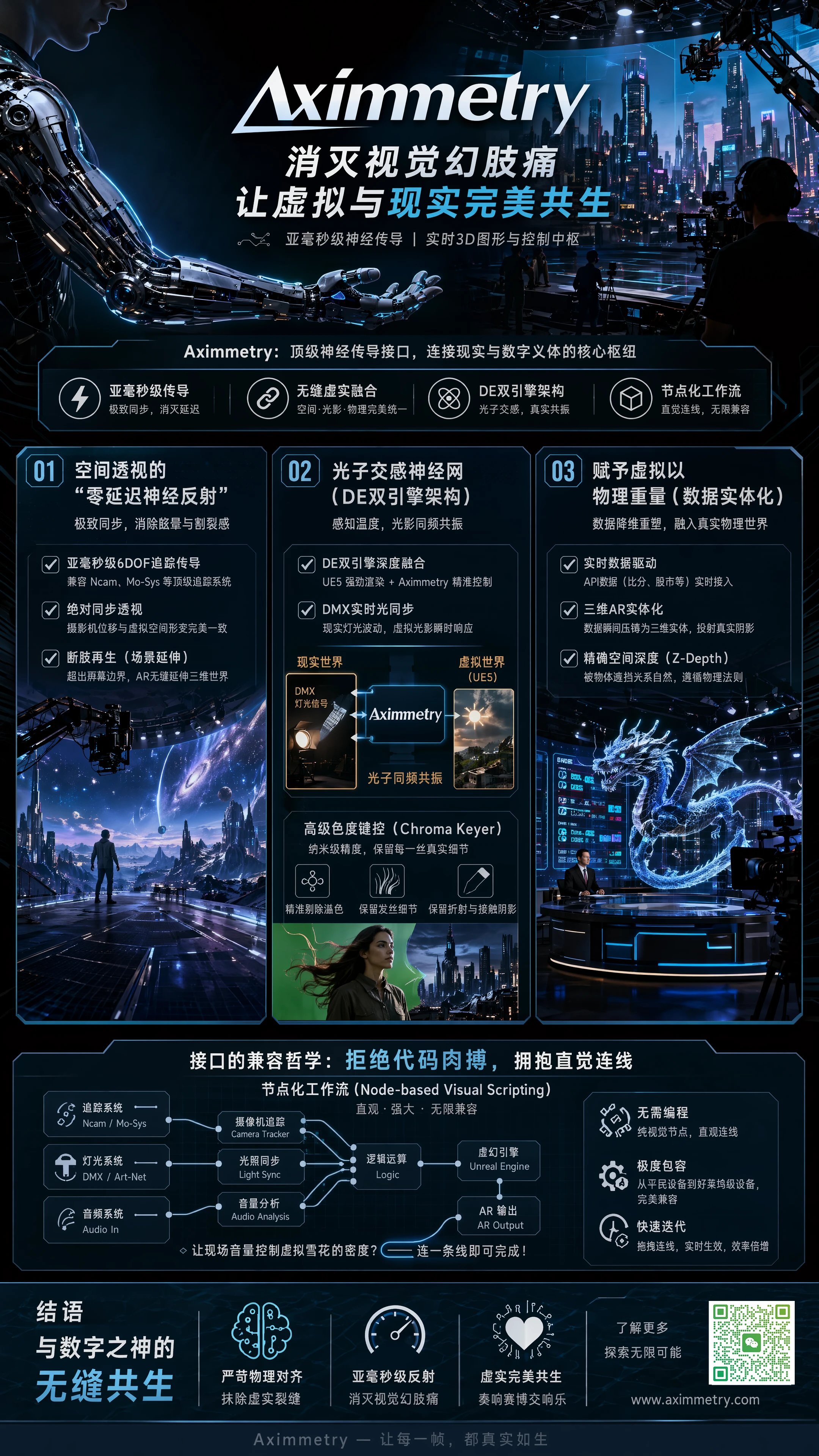
Conduction One: “Zero-Latency Neural Reflex” for Spatial Perspective”
The human brain is extremely demanding in its perception of space and balance; any slight visual delay can trigger a strong dizzying rejection.
Within the massive body of the LED volume stage (XR shooting), Aximmetry demonstrates its terrifyingly fast“neural reflex speed”It bypasses bloated middleware entirely, receiving 6DOF coordinate signals from top-tier optical tracking rigs like Ncam and Mo-Sys at sub-millisecond speeds. Like the most acute spinal nerve, it instantly transmits the physical displacement commands of the real camera to the virtual camera inside Unreal Engine without loss. When the real camera pushes in, pans, or even produces tiny jitters, the perspective deformation of the virtual space achieves absolute synchronization. Peaks align perfectly, with no margin of error, perfectly disarming the brain's air-raid siren.
Even more astonishing is its“Limb Regeneration (Scene Extension)”capability. When the camera inevitably pans beyond the physical LED screen's boundary (a fatal flaw that causes spatial fragmentation), Aximmetry instantly triggers its AR capability, seamlessly extending a three-dimensional world into the physical void outside the screen. The digital prosthetic grows freely at the edge of physical space, granting infinite continuity to the sense of space.
Conduction Two: Photon Sympathetic Neural Network (DE Dual-Engine Architecture)
A prosthetic without temperature perception is forever a dead piece of metal. If the lighting and shadows of the virtual scene cannot interact with the real environment, the image will be filled with a cheap “sticker-like” feel.
To allow the digital prosthetic to feel the temperature of reality, Aximmetry has uniquely created aDE (Dual-Engine) architecture, establishing an impenetrable “Photon Sympathetic Neural Network.” It deeply envelops the powerful heart of UE5 and monitors all lighting fluctuations in the real studio via the DMX protocol. When the real lighting technician pushes up the fill light, the electrical signal instantly activates the sunlight within the virtual engine along Aximmetry's neural synapses. The highlights hitting the actor's face in reality perfectly overlap with the dappled shadows cast by digital leaves in the virtual world within the same microsecond. Photons resonate in sync across two dimensions, granting the prosthetic a lifelike sense of breath.
When dealing with green screen studios, Aximmetry's built-inAdvanced Chroma Keyerdemonstrates nanoscale surgical precision. While accurately removing green spill (the lesion), it stubbornly preserves flying strands of hair, the refraction of a water glass, and that extremely faint contact shadow (capillaries). These tiny remnants of real physics allow the real person to be rooted naturally within the digital environment.
Conduction Three: Granting Virtual Objects Physical Weight (Data Materialization)
In high-pressure settings like live TV broadcasts, two-dimensional subtitles inserted out of thin air are usually “foreign objects” that cannot blend into the environment.
Aximmetry absolutely refuses to let this sense of foreignness ruin the overall immersion. Its Flow Graph acts like a sensitive tentacle; once it receives external network API data (such as esports scores or stock market surges), it immediately “deconstructs and reshapes” it. The data is no longer floating subtitles but is instantly forged into a three-dimensional AR dragon casting real shadows on the floor. Even more terrifyingly, Aximmetry can precisely calculate spatial depth (Z-Depth). When this dragon flies over a physical studio desk, the real desk can even perfectly occlude its lower half. The digital prosthetic is forcibly endowed with the physical weight and collision rules of reality.
The Interface's Compatibility Philosophy: Reject Code Wrestling, Embrace Intuitive Connections
An overly complex neural interface that requires major surgery (writing tens of thousands of lines of C++ code) every day to maintain will inevitably lead to systemic collapse.
Aximmetry elegantly abandons code wrestling, offering creators a control panel that is extremely intuitive to human instinct—“node-based visual scripting”。
- Here, there are no obscure commands. All hardware integration, engine calls, and logic triggers become intuitive “neuron nodes.”
- Visual artists don't need to know programming; they simply drag out connections with the mouse to link different neurons. “Want to let the live audio volume control the density of virtual snowflakes?” Just connect one line to build the neural pathway.
- This extremely inclusive plug-and-play logic allows everything from high-end Hollywood-grade heavy equipment worth hundreds of thousands to平民 tracking devices costing a few thousand to instantly connect to this neural interface, perfectly integrating into the storm of virtual-real fusion.
Conclusion: Seamless Symbiosis with the Digital God
We are pushing the boundaries of human audiovisual experience towards that fantastical, indistinguishable frontier at an unprecedented pace.
In this process, if we blindly pursue the accumulation of engine computing power while neglecting the precise conduction during virtual-real fusion, what we create will be nothing but a pile of dizzying, nauseating “cyber waste.”
Aximmetry has chosen the most difficult yet greatest path. Hidden beneath immense computing power, it erases every crack and every millisecond of delay between the virtual and the real with its rigorous physical alignment and sub-millisecond neural reflexes. It successfully eliminates the immersion-breaking “visual phantom limb pain,” ultimately allowing cold digital code to perfectly coexist with the real physical body, playing an impeccable cyber symphony together.

 简体中文
简体中文  English