
As a front-end or live broadcast TD (Technical Director), when taking on a large-scale esports XR broadcast or election vote-counting show, your biggest fear is not that “the visuals aren't realistic enough,” but rather“Loss of logical control”。
Imagine this scenario: During the live broadcast of the finals, the host presses a physical button (GPIO trigger); this needs to immediately call an external API to fetch player data (asynchronous network request HTTP); after the data is returned, it needs to drive an AR mech in UE5 to execute a combo animation (Sequence trigger); while the mech is moving, the on-site DMX lights need to flash (hardware linkage); if the director cuts to a close-up camera (video logic interruption) halfway through the animation, all animations and lighting effects must reset instantly.
If you plan to use UE5's nativeBlueprintto write this logic, welcome to“the ”Asynchronous Logic Meat Grinder"。
In Blueprint, when dealing with various Delays, Event Ticks, Timelines, and Async Callbacks, the node connections quickly expand into an unreadable mess of “spaghetti code.” More critically, UE5 is a Tick-based (frame-by-frame rendering) engine, and its execution state is often a“Black Box”Once an API request times out, or multiple logic paths create a race condition, the system will exhibit “ghost bugs”—the AR model gets stuck halfway, or the lights flash uncontrollably. In a live broadcast, such deadlocks are catastrophic and extremely difficult to debug.
Facing this system-level pain point that drives countless programmers crazy,Aximmetrythe solution provided is:Strip away the complex state machine inside the engine and establish an absolutely visible, strongly deterministic industrial-grade Flow Graph architecture externally.
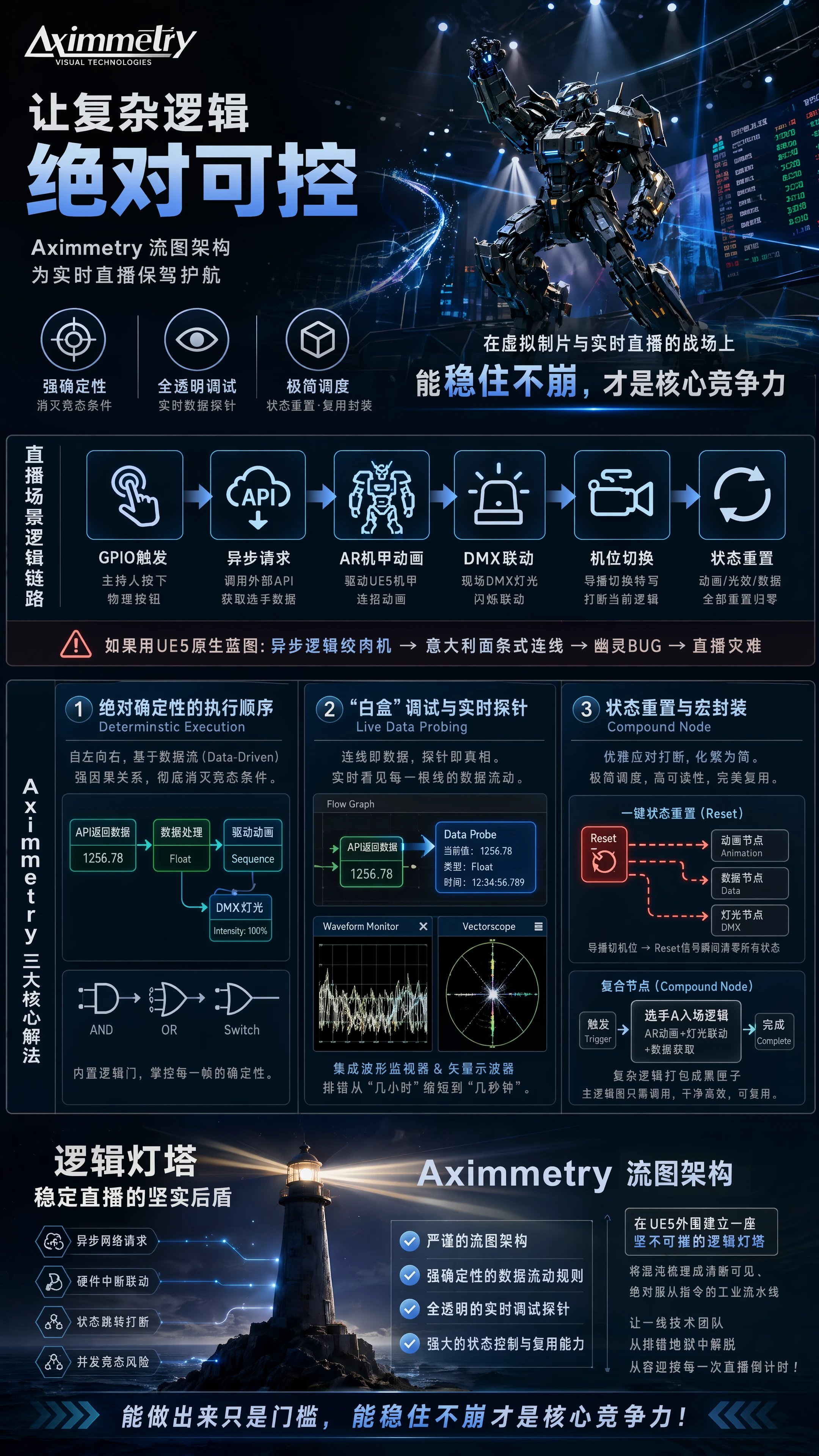
Core Solution One: Absolutely Deterministic Execution Order
The biggest difference between Aximmetry and UE Blueprint is that its execution logic follows an extremely strictleft-to-right, data-driven trigger mechanism.
In UE Blueprint, many events are triggered via Event nodes, and the order of multiple events can sometimes be difficult to control absolutely. In Aximmetry, however, all logic follows extremely clear data flow rules. Only when the upstream node has finished computing (e.g., the API returns complete Float data) does this data flow like an electric current along the connection to the next node, triggering the next action (e.g., driving a model to rotate).
This“Strong Causal Relationship”Completely eliminates race conditions. As a TD, you can add various logic gates (e.g., AND, OR, Switch) to Aximmetry's connections. The data flow for each frame is deterministic, with no ambiguous concurrent conflicts.
Core Solution Two: “White Box” Debugging and Live Data Probing
Debugging in a native pipeline often requires sifting through tedious Print String logs. If a visual issue occurs, it's hard to instantly pinpoint whether it's a network drop, data error, or animation freeze.
Aximmetry turns the logic system into a fully transparent“White Box”。
- In its Flow Graph,every connection is alive。
- During a live broadcast, you can simply hover your mouse over any data connection line, and it will immediately display aData Probeshowing the real-time value flowing through that line (e.g., the current stock index from the API, or the specific rotation angle of the current camera).
- Moreover, Aximmetry directly integrates a Waveform Monitor and Vectorscope into the interface. You can drag any node's output onto the monitor to view the result at any time.
If an external data format is wrong, you can instantly see in Aximmetry's node graph which node's output is “0” or garbled, reducing debugging time from “hours” to “seconds.”
Core Solution Three: State Reset and Minimalist Scheduling with Compound Nodes
To handle sudden interruptions during a live broadcast (e.g., the camera cut interrupting the animation mentioned earlier), Aximmetry provides extremely elegant “state control.”
- Painless State Reset: In Aximmetry, you can easily connect a trigger signal to the “Reset” pins of all animation and data nodes. When the director presses the switch button, this Reset signal instantly propagates through the circuit like an electrical current, clearing all chaotic states in one clean sweep.
- Simplifying Complexity with Compound Nodes: For extremely complex logic, Aximmetry allows you to package dozens of nodes into a single “Compound,” similar to wrapping a function. You can bundle all the complex logic for “Player A's AR entrance animation + lighting linkage + data acquisition” into a black box with only “Trigger” and “Complete” pins. Then, in the main logic graph, you only need to call this clean black box. This not only maintains high system readability but also allows perfect reuse of these logic modules across different projects.
Conclusion: The Core Competence of Industrial-Grade Control—“Anti-Chaos”
On the battlefield of virtual production and advanced live broadcasting, “being able to make it work” is just the threshold; “keeping it stable without crashing” is the true core competitiveness.
The UE5 engine provides stunning visual expressiveness, but asking it to also manage the complex asynchronous hardware control, network concurrency, and state transitions of a large studio is like asking a painter to conduct a thousand-person symphony—it easily falls into chaos.
Aximmetry deeply understands the “chaotic nature” of real-time systems. It doesn't interfere with UE5's rendering but instead forcefully extracts all system-level control.
It uses a rigorous flow graph architecture, strongly deterministic data flow rules, and fully transparent real-time debugging probes to build an unbreakable “Logic Lighthouse” around UE5. This lighthouse transforms the asynchronous network requests, hardware interrupts, and state deadlocks that would otherwise cripple the system into a clear, obedient industrial assembly line. With Aximmetry's support, frontline technical teams can finally escape the “debugging hell” and confidently face every live broadcast countdown.

 简体中文
简体中文  English