
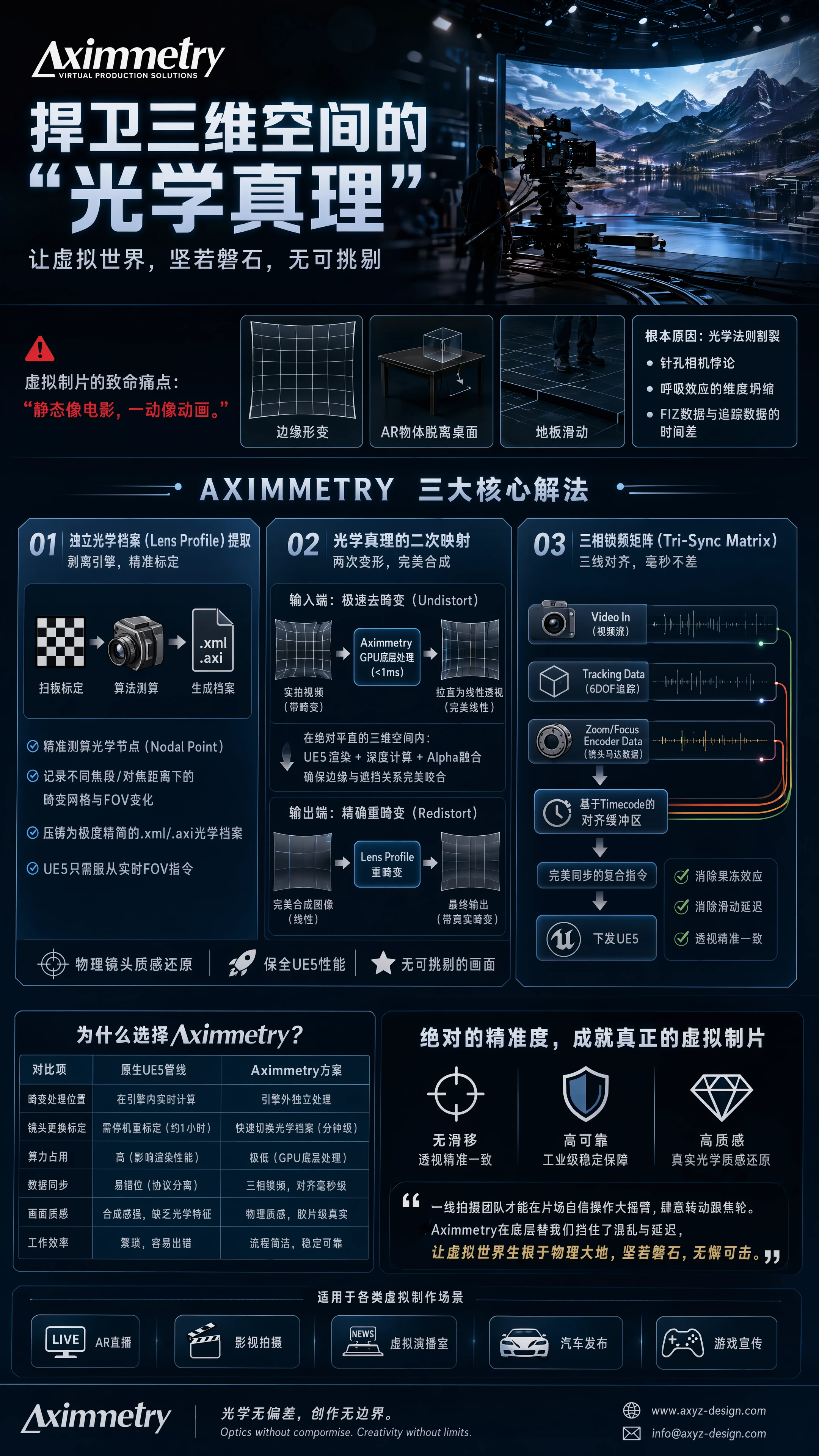
In high-end virtual production studios, TDs (Technical Directors) have a brutally cold saying:“Static like a film, moving like an animation.”
As long as the camera stays still, the UE5-rendered image is always flawless. But as soon as the director calls “Dolly In” or the focus puller starts to “Pull Focus,” disaster strikes: the edges of the virtual background warp eerily, AR-composited objects detach from the physical desktop, and the virtual floor slides a few centimeters beneath the live actor's feet.
The root cause of this disaster isthe fundamental rift in “optical laws” between the real and virtual worlds:
- The Pinhole Camera Paradox: The virtual camera inside Unreal Engine (UE5) is a perfect “Pinhole Camera,” with absolutely straight frustum edges. In contrast, real-world cinema lenses (even top-tier ARRI Master Primes) inevitably exhibit barrel/pincushion distortion and chromatic aberration.
- The Dimensional Collapse of Breathing Effect: When the focus puller changes the focal length of the physical lens, not only does the focus shift, but the lens's physical field of view (FOV) also undergoes a slight zoom (this is the breathing effect). If the engine is unaware of the FOV change, perspective immediately misaligns.
- The Time Lag Between FIZ Data and Tracking Data: The FIZ (Focus, Iris, Zoom) encoder data from the lens and the 6DOF spatial tracking data typically travel via different protocols, often arriving at the engine with microsecond-level misalignment.
If you rely on the native UE5 pipeline to handle these issues, you'll have to wrestle with the cumbersome Lens Component, manually map various polynomial distortion parameters in Blueprints, and whenever you swap a physical lens, the entire crew may need to halt for an hour to redo checkerboard calibration.
Faced with this industry-wide painful “sliding” deadlock,Aximmetrythe trump card deployed is:Aximmetry completely decouples optical calibration from the engine, establishing an independent optical archive and a fully automated distortion compositing pipeline.
Core Solution One: Decoupled Independent “Lens Profile” Extraction from the Engine
Aximmetry deeply understands that having a game engine compute complex physical lens distortion polynomials in real time is not only inefficient but also highly error-prone.
Therefore, Aximmetry has developed a completely independentAximmetry Camera Calibrator。
- Before formal shooting begins, TDs no longer need to open UE5. Instead, they directly use Aximmetry's calibration software to scan the camera with high-precision algorithms.
- This tool not only accurately measures the camera'sNodal Point(the absolute center point where light rays cross inside the lens; the tracking system must use this point as the coordinate origin, or sliding is inevitable), but also records all distortion grids and FOV changes of the lens at different focal lengths and focus distances.
- Aximmetry compresses these massive nonlinear optical characteristics into an extremely streamlined proprietary
.xml或.axiLens Profile。 - During live broadcasts or shooting, UE5 doesn't need to know these complex distortion parameters at all; it only needs to absolutely obey the final FOV instructions that Aximmetry calculates in real time from these profiles.
Core Solution Two: Reconstructing the “Undistort/Redistort” Compositing Pipeline
In AR live broadcasts or green screen compositing, should the engine adapt to the distorted live footage, or should the live footage adapt to the perfect engine image?
Native pipelines often get stuck in a dilemma between computational power and image quality. Aximmetry, in its underlying image pipeline, forcibly establishes the“Two-Pass Distortion Pipeline”rule:
- Rapid “Undistort” at the Input: When the live video stream (with lens barrel distortion) enters Aximmetry, before it reaches the core keying and compositing modules, Aximmetry uses the pre-generated Lens Profile to forcibly“straighten”the live footage into a perfect linear perspective identical to UE5, all in under 1 millisecond at the GPU level. In this “absolutely flat” 3D space, UE5-rendered AR elements and live actors undergo Z-Depth calculations and Alpha blending, ensuring all edges and occlusion relationships mathematically interlock perfectly, with no edge misalignment caused by distortion.
- Precise “Redistort” at the Output: After compositing, the perfectly flawless composite image looks “fake” to the human eye because it lacks the optical imperfections of a real lens. Before the final output node (Video Out), Aximmetry recalls the Lens Profile again, re-applying barrel distortion, vignetting, and even slight chromatic aberration identical to the real lens onto the entire composite image.
By completely isolating this complex deformation operation from UE5, not only is the engine's rendering performance preserved, but the image also gains an impeccable physical film texture.
Core Solution Three: The “Tri-Sync Matrix” for FIZ, Tracking, and Video”
No matter how accurate the optical calibration is, if the data arrives at different times, sliding will still occur. When zooming, the encoder data (FIZ) from the zoom motor must take effect simultaneously with the physical scaling of the image, within the same nanosecond.
In its underlying I/O scheduler, Aximmetry establishes a“Tri-Sync Matrix”As a TD, you can clearly see three independent data streams in the Flow Graph:
- Video In
- Tracking Data (6DOF spatial tracking data)
- Zoom/Focus Encoder Data (lens motor data)
Aximmetry natively supports FIZ sub-channels embedded in protocols like Free-D, Mo-Sys, and Stype, or independent encoder hardware. Before engine computation, it forces these three data streams into a Timecode-based alignment buffer. Based on preset latency parameters, it ensures that “the moment of lens focal length change,” “the moment of spatial position movement,” and “the moment of physical image change” are precisely riveted onto the same data frame. This perfect composite command is then sent to UE5. This completely eliminates the dizzying “jelly effect” and “sliding delay” caused by data desynchronization in the virtual background during pans, tilts, and zooms.
Conclusion: Defending the “Optical Truth” of 3D Space”
In the arena of virtual production, the most expensive thing is never the GPU's computing power, but“absolute precision”。
If you can't solve lens distortion and perspective sliding, no matter how realistic the ray-traced reflections rendered in Unreal Engine are, to the audience, it's just a 2D background plate clumsily moving behind the live actor.
Aximmetry demonstrates an extremely rigorous industrial spirit toward this hardcore pain point. It doesn't rely on UE5's built-in components designed as compromises for gaming; instead, it uses an independent, military-grade camera calibration system and distortion compositing pipeline to forcibly build an error-free mathematical bridge between the physical lens and the virtual frustum.
Precisely because Aximmetry shields us from those chaotic nonlinear polynomials and intricate data delays at the underlying level, the on-set shooting team can confidently operate large camera cranes and freely turn the follow-focus wheel. The virtual world on the monitor, as if rooted in physical ground, remains rock-solid and flawless.

 简体中文
简体中文  English