
In the film and commercial production circle, there is a group of “light chasers.”
To capture the most aesthetically pleasing and poetic images, Directors of Photography (DPs) and directors are often willing to pay an exorbitant price: assembling the entire crew at 3 AM, waiting in the cold for the first rays of dawn on the horizon; or, at dusk, staring intently at the monitor, waiting for what is called the“Golden Hour” (Golden Hour/Magic Hour), that fleeting 20-minute window just before the sun sets.
It is nature's most generous gift—the light is soft and warm, the sky saturated with rich pinks, oranges, and deep blues.
But for a film crew,“the ”Golden Hour“ is also the ”Anxiety Hour"Because you only have 20 minutes. If an actor forgets their lines, a piece of equipment is visible, or an uncooperative cloud drifts by, the day's efforts are wasted.
“If only we could control the sun.”
Today, this seemingly mythical desire is being turned intothe daily reality ofreality. It grants creators the power to control the “God Light,” fundamentally alleviating the creative anxiety of cinematographers and directors.
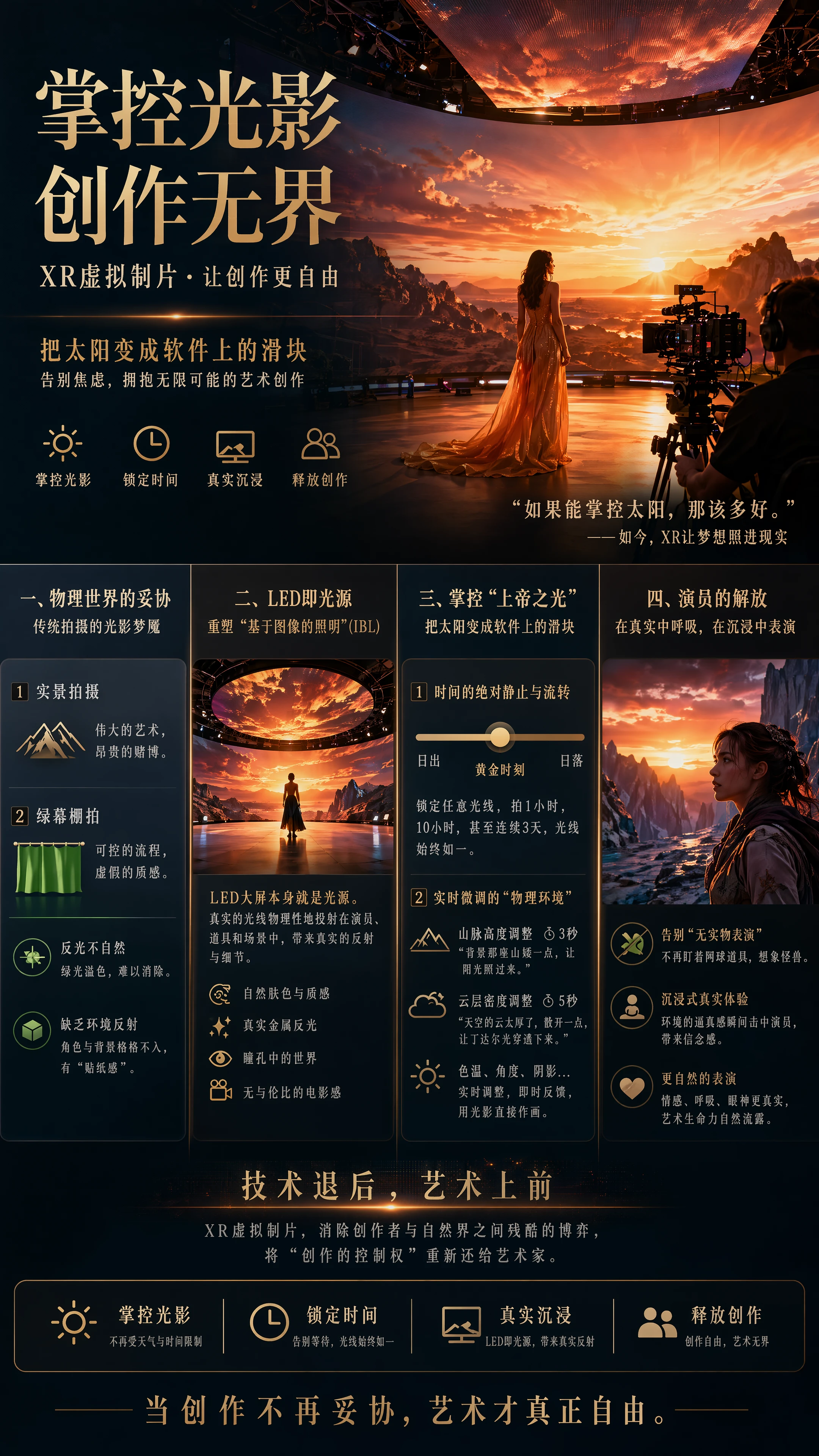
I. Compromises in the Physical World: The Light and Shadow Nightmare of Traditional Filmmaking
Before the advent of XR technology, creating cinematic light and shadow was always a dilemma.
Location Shooting: Great Art, Expensive Gamble
For artists like director Terrence Malick (*The Tree of Life*) or cinematographer Roger Deakins (*Blade Runner 2049*), who have an ultimate pursuit of natural light, location shooting is their first choice. But this aesthetic height is built uponextremely high waste rates, over-budget schedules, and the near-breakdown waiting of actors and key crew members.
Green Screen Studio: Controllable Process, Artificial Texture
For controllability, many crews choose to “simulate” a sunset with artificial lighting inside a green screen studio. But the biggest Achilles' heel of green screen is“Lighting Mismatches”:
- Unnatural Reflections: Metal props, actors' skin, even the edges of hair strands, reflect a faint, hard-to-remove green light (spill) under green screen.
- Lack of Environmental Reflections: If a character is in a resplendent palace, their pupils and skin should reflect golden and red ambient light. But in front of a green screen, these details can only be painted in, bit by bit, by the VFX artists“ ”craftsmanship“ in post-production. The result is often a character that feels disconnected from the background, a ”sticker effect."
II. LED as Light Source: Redefining Image-Based Lighting (IBL)
The core of XR virtual production lies in its complete subversion of the “lighting” logic.
In an XR studio, what envelops the actor is not just the background screen, but often alsoCeiling LED (Ceiling LED)和Side LED Ring ScreensThese screens display high-precision 3D scenes rendered in real-time by Unreal Engine.
This introduces a revolutionary technical feature:The LED wall itself is the light source.
This technology is calledImage-Based Lighting (IBL)。
- When the large screen plays a sunset scene, the diffuse glow of the sky isphysically and realisticallycast onto the actor's cheeks, the silk texture of a haute couture gown, and the metallic reflections of prop guns.
- What reflects in the actor's pupils is no longer cold professional stage lights and green fabric, but an entire expanse of a brilliant starry sky or blazing battlefield fire.
For the cinematographer, this kind of true physical reflection is a “cinematic quality visible to the naked eye” that no post-production VFX or digital keying can match.
III. Controlling the “God Light”: Turning the Sun into a Slider in Software
Inside an XR studio, directors and cinematographers truly possess the artistic freedom of a “creator.”
Absolute Stillness and Flow of Time
“The ”Golden Hour" is too short? In an XR system, the cinematographer simply needs to gently drag a slider in the Unreal Engine consoleto lock the sun in the “15 minutes before sunset” position. You can shoot for 1 hour, 10 hours, or even continuously for 3 days, and the light's angle, color temperature, and shadow length will remain absolutely consistent. The DP can calmly adjust camera positions, and actors have ample time to immerse themselves in their emotions, no longer racing against time.
Real-time Adjustable “Physical Environment”
In location shooting, if a building in the background blocks the sun, or the angle of a tree is unappealing, the cinematographer has to compromise. But inside an XR studio, the director, cinematographer, and production designer can engage inon-site “instant sculpting”:
- “Make that mountain in the background a bit lower so the sunlight comes through.” — 3 seconds later, the engine lowers the height of the 3D mountain.
- “The clouds in the sky are too thick. Let them disperse a bit so the crepuscular rays can shine through.” — 5 seconds later, the cloud density in the virtual sky is reset.
This kind of on-site, instant feedback greatly unleashes the creative imagination of the artists. They are no longer writing descriptions for the VFX team in post-production, but rather “painting directly with light and shadow” on set.
IV. Actor's Liberation: Breathing in Reality, Performing in Immersion
Besides the behind-the-scenes team, XR virtual production also savesthe actor's performance anxiety。
In the green screen era, the most common line an actor heard from the director was: “Look here, there's a monster, it's breathing fire at you, look terrified.” The actor could only stare at a wooden stick with a tennis ball on it, depleting their suspension of disbelief.
But in an XR studio, when the actor stands on the stage, they are surrounded by towering glaciers, hear realistic sound effects, and see the magnificent rays of the setting sun before them. The immersion of the environment instantly strikes the actor. Light and shadow have temperature. When actors are placed in a real visual context, their breathing, gaze, muscle tremors, and emotional outbursts become incredibly natural. What the cinematographer captures is no longer an industrial assembly line “acting to nothing,” but truly vital and impactful artistic moments.
Conclusion: Technology Steps Back, Art Steps Forward
The renowned cinematographer Vittorio Storaro (known for *The Last Emperor*, *Apocalypse Now*) once said:“Writing with light is writing the story.”
Technology always serves art. The greatest achievement of XR virtual production is not the use of advanced chips or high-resolution screens, but that iteliminates the brutal struggle between the creator and nature, returning “creative control” to the hands of the artist.
When the cinematographer no longer worries about the “sun going down,” when the director no longer compromises on “green screen mismatches,” and when the actor is no longer confused by a “tennis ball prop”—
art can truly begin to breathe freely.

 简体中文
简体中文  English