
In top-tier commercials, high-tech product launches, and cinematic virtual production (ICVFX) sets, the ultimate goal of blending virtual and real is “optical indistinguishability.”
Imagine an extreme shooting scenario: an actor wearing highly reflective metal armor stands in a green screen or LED volume. In the 3D virtual world, a futuristic virtual car with high-beam headlights drives towards them. At this moment, the audience should clearly see in the final image:
- First Entanglement (Virtual Reflects Real): The paint of the virtual car must reflect the metallic texture of the real actor's armor and the actor's live movements in real-time with high dynamic range.
- Second Entanglement (Real Reflects Virtual): The edges, shoe tops, and helmet of the actor's armor must refract the flare from the virtual car's headlights and the colored diffuse reflections from the ground in real-time.
- Third Entanglement (Energy Alignment): The light sources on both the virtual and real sides must be calibrated in a 1:1 ratio based on physical energy (Luminance/Radiance). There must be no optical disconnect where the virtual scene is bright as day while the live-action subject is dimly lit.
When a Technical Director (TD) attempts to implement this Bidirectional Radiance Transfer innative Unreal Engine 5 (UE5), they immediately encounter the painful limitations of the underlying rendering architecture.
Unreal Engine's Lumen global illumination and Hardware Ray Tracing heavily rely on BVH (Bounding Volume Hierarchy) 和 and Lumen Surface Cache.In the engine's view, the live-action video is merely a 2D transparent card placed in virtual space. Because it has no volume in 3D space and lacks mesh topology, it cannot be included in the ray tracing intersection calculations. Consequently, any reflective materials (mirrors, metal, water) in the virtual scene cannot reflect the live-action actor at all; simultaneously, the radiant energy from virtual light sources cannot generate any physically accurate secondary bounce light on the live-action actor.
Aximmetry , with its GPU Bidirectional Radiance Mapping Pipeline specifically designed for broadcast and film,“reconstructs the ray intersection and energy transformation matrix at the GPU memory level, completely ending the isolated state where virtual and real lights do not interact.”I. The Virtual World "Sees" Reality: Aximmetry's Dynamic Proxy Mesh Injection and Ray Tracing BVH Reconstruction
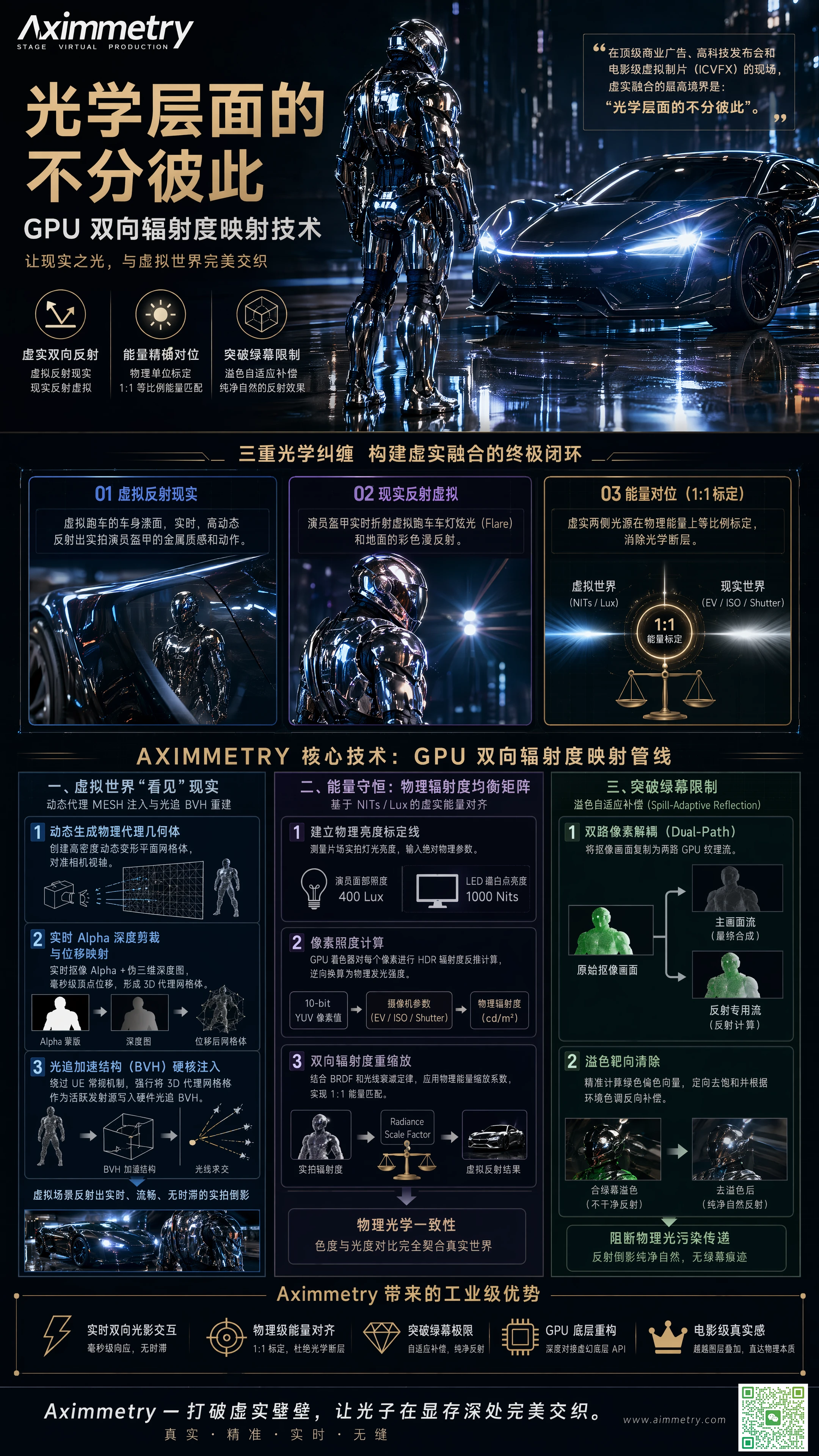
For UE5“s Lumen or Path Tracing to reflect the live-action actor in front of the green screen, the 2D video pixels must be ”upgraded" in real-time during rendering and forcibly inserted into the ray tracing computation pipeline.
Aximmetry employs an efficient
"Dynamic Proxy Mesh and Radial Texture Injection"“solution:”Dynamically Generate Physical Proxy Geometry
Aximmetry creates a high-density Dynamic Displacement Grid in Unreal Engine, placing it at the equivalent physical position of the live-action actor in 3D space. This grid is aligned as a Camera-facing Billboard in space.
Real-Time Alpha Depth Clipping and Displacement Mapping
One microsecond before rendering begins, Aximmetry writes the real-time keyed actor image (with precise edge and hair-level Alpha channel) as an Opacity Mask into the grid's material. Simultaneously, using the aforementioned Pseudo-3D Depth Map algorithm, it performs millisecond-level Vertex Displacement on the grid's vertices, instantly extruding a 3D proxy mesh in space that roughly matches the actor's physical contour.
Hardcore Injection of Ray Tracing Acceleration Structure (BVH)
This is the most critical step. Native UE5 does not perform high-frequency BVH rebuilding for dynamic material changes by default, as this causes severe GPU stuttering. Aximmetry bypasses UE's standard material update mechanism. By deeply interfacing with Unreal's underlying API, it forcibly writes this 3D proxy mesh (assigned a high-emissive property) as an "Active Emissive Mesh" directly into the hardware ray tracing acceleration structure during GPU runtime.
When Lumen casts rays through the space, the rays successfully intersect and collide with this proxy mesh, reading the color and radiance of the actor's live-action pixels. The audience sees a real-time, smooth, and lag-free reflection of the live-action actor on the virtual car body or metallic marble floor.
II. Energy Conservation: A Virtual-Real Radiance Equalization Matrix Based on Physical Units (NITs/Lux)
After aligning virtual and real reflections, a senior VFX supervisor will scrutinize another detail: the brightness of the reflection is physically incorrect. Virtual world lighting parameters are calculated using physical photometric units (e.g., Lumens, Lux), while the camera-captured live-action footage is recorded based on exposure values (EV, ISO, Shutter Speed). Without converting these two completely different energy systems, the synthesized reflection intensity will be severely distorted, resulting in a "plastic" look.
Aximmetry constructs an
"Absolute Radiance Converter"“:”:
Establish a Physical Luminance Calibration Line
Before shooting, the system uses Aximmetry's dedicated chromatic calibration tools to measure the actual brightness of the live-action set lights (e.g., the physical illuminance on the actor's face is 400 Lux, the white point luminance of the LED wall is 1000 Nits). These physical parameters are input as absolute values into Aximmetry's energy transformation matrix.
Pixel Luminance Estimation
When the live-action video enters the system, Aximmetry's GPU shader performs a high dynamic range (HDR) radiance back-calculation for each pixel of the live-action image. It converts the pixel's 10-bit YUV values, combined with the camera's current lens aperture, shutter speed, and ISO parameters, back into the physical world's actual luminous intensity.
Bidirectional Radiance Rescaling
When injecting the live-action actor's texture onto the proxy mesh used for reflection, Aximmetry's flow logic multiplies it by a“Radiance Scale Factor”This means that if the virtual car's body is a highly reflective mirror surface and the car is in a strong lighting environment, the reflected light intensity of the actor on the car body will be strictly scaled according to the Bidirectional Reflectance Distribution Function (BRDF) and physical light attenuation laws. This physical-level energy alignment ensures that the chromaticity and luminance contrast of highlights and shadows in the reflected image perfectly match real physical optics, eliminating subjective bias from manual color grading.
III. Breaking Green Screen Limitations: Real-Time “Spill-Adaptive Reflection” for Multiple Reflections”
In traditional chroma key studios, the worst optical disaster is “green screen spill.” The green screen acts like a giant green floodlight, casting green light onto the actor's skin and armor edges.
If, in Aximmetry's reflection pipeline, the live-action pixels contaminated with green spill were directly reflected onto a virtual white marble floor, the floor would render with a dirty green tint. This would instantly make the audience realize the scene was shot in a green screen studio.
Aximmetry introduces“Reflection-Pass Spill Suppression”, an algorithm with profound industrial insight:
Dual-Path Pixel Decoupling
Aximmetry duplicates the keyed live-action image into two parallel GPU texture streams.
- First Path: Main Stream. Processed by the advanced keyer with gentle desaturation, preserving the actor's healthy skin tone and costume details for the final composite.
- Second Path: Reflection-only Stream. This texture stream is exclusively supplied to the aforementioned 3D proxy mesh for calculating reflections within the virtual world.
Targeted Spill Color Removal
In the reflection-only stream, Aximmetry deploys a more aggressive Chroma Desaturation Matrix. It precisely calculates the green color deviation vector (Green Vector Delta) of each pixel. Once it detects spill color on the actor's skin edges caused by physical green screen reflection, the algorithm selectively removes the color saturation in this frequency band and applies a reverse color cast compensation based on the virtual environment's average ambient color.
When the marble floor reflects the actor, the edges of the reflected image are clean and natural, free from any green stray light originating from the physical green screen. This underlying design of blocking “physical light pollution transfer” in the digital space allows Aximmetry to deliver flawless industrial-grade results even when dealing with highly challenging reflective materials.
Conclusion: The Ultimate Closed Loop of Virtual and Real Symbiosis
In the highest echelons of real-time audiovisual production, the physical interaction of photons is an uncompromisable truth. Any attempt to simulate dynamic reflections using post-production color grading or static textures will appear clumsy and full of flaws in the face of a moving film camera.
Unreal Engine 5, with its Lumen and ray tracing, has sparked a lighting revolution in the digital space; but it inherently possesses a boundary that blocks photons from the real world outside its 3D acceleration structures.
Aximmetry Aximmetry's greatness lies in breaking this cold barrier between virtual and real, transforming into a“Super Transformation Matrix for Spacetime Light”。
By cleverly upgrading 2D live-action pixels into 3D dynamic proxy meshes, forcibly reconstructing the GPU's hardware ray tracing BVH acceleration structure at the underlying level, performing 1:1 proportional calibration of virtual and real energy on a physical photometric scale, and adaptively cleaning the spill contamination from the physical green screen, Aximmetry allows photons from reality and rays from the virtual world to perfectly intertwine and embrace in the deepest layers of GPU memory.
This seamless synthesis, which transcends the concept of layer compositing and delves into the level of physical radiance, endows the final image with an almost sacred sense of realism. It is this ultimate reverence for the laws of optics that keeps Aximmetry firmly seated on its unshakable throne in the wave of real-time virtual production technology.

 简体中文
简体中文  English