
At large-scale immersive stages, interactive AR studios, or virtual launch events, directors often pursue a “wall-breaking” visual effect: when an actor waves on stage, the golden particle stream rendered by the virtual engine produces physically accurate diffusion and ripples; or when an actor walks in front of a green screen, the smoke, fire, or flowing water (Niagara particle system/fluid dynamics) in the virtual scene generates realistic physical repulsion and turbulence.
This “flesh-driven virtual physics” interaction is the ultimate means of achieving deep immersion.
However, when a Technical Director (TD) attempts tonative Unreal Engine 5 (UE5)When this pipeline is implemented, system stability instantly collapses. Achieving interaction requires introducing depth sensors (such as infrared LiDAR, Kinect Azure, or optical motion capture systems). These sensors output high-frequency, large-volumeraw point clouds or depth maps.。
Under the native UE5 architecture, this high-frequency peripheral data typically needs to be deserialized and parsed via CPU-side Blueprints or C++ plugins. For the Niagara particle system to recognize collisions, the engine must convert this depth data into 3D collision meshes or generate signed distance fields (SDFs) on the CPU in real time.
This triggers devastating CPU-to-GPU read-write stalls.When the CPU reconstructs collision geometry at high frequency, it causes severe thread waiting and frequent VRAM reallocation, causing the rendering frame rate to instantly drop below 30fps. Meanwhile, due to the asynchrony between the sensor sampling clock and the engine rendering clock, the particle's physical response to the actor's movements produces a 3 to 5 frame“time lag”(i.e., half a second after the actor swings their hand, the particles begin to scatter), resulting in extremely laggy visual effects.
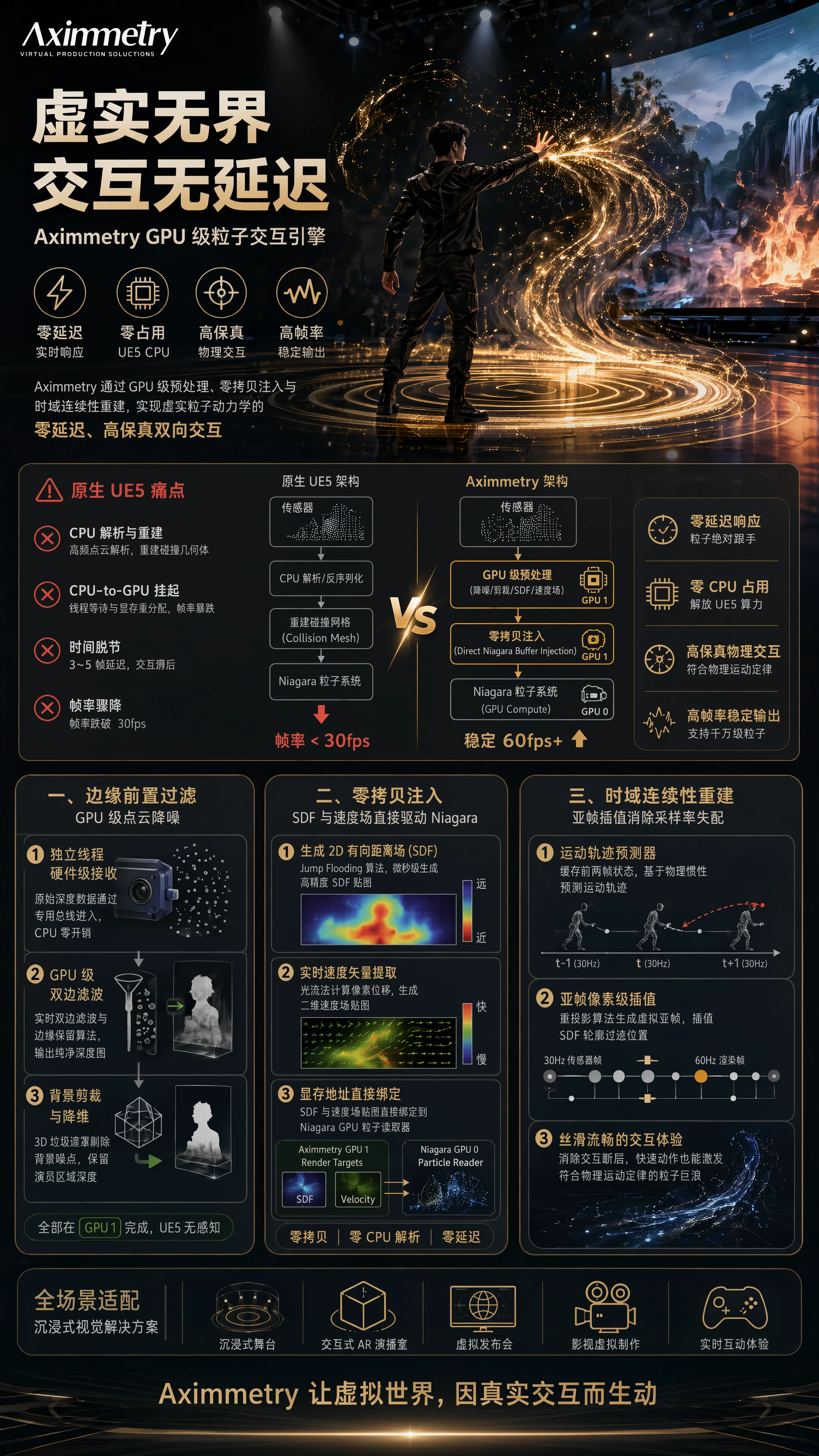
Aximmetry With its unique“GPU-level sensor preprocessing and particle buffer injection pipeline (Direct Niagara Buffer Injection)”achieves zero-latency, high-fidelity bidirectional interaction of virtual-real particle dynamics without consuming UE5 CPU resources.
I. Edge Pre-filtering: GPU-level Point Cloud Denoising within the Aximmetry Sandbox
Raw depth maps or point clouds output by sensors are often contaminated with high-frequency noise due to ambient light interference, green screen reflections, and sensor physical limitations. Feeding this “dirty data” directly into the particle system causes virtual particles to exhibit unnatural high-frequency jittering and flickering at the edges of the actor's body.
Aximmetry establishes a“data stays on GPU, cleaned at the very front end”decoupling solution:
Independent Thread Hardware-Level Reception
Raw sensor data (e.g., Kinect's 16-bit depth stream) enters the workstation via a dedicated physical bus. Aximmetry's underlying asynchronous I/O thread takes over the data packet directly at the driver layer, bypassing the OS kernel protocol stack, ensuring zero CPU overhead.
GPU-Level Bilateral Filtering
The moment the data packet enters VRAM, Aximmetry invokes a dedicated shader on the GPU to perform real-timebilateral filtering and edge-preserving algorithms. This algorithm smooths depth noise while firmly locking the physical edge contours of the actor's body, converting it into an extremely clean high dynamic range (HDR) depth grayscale map.Background Clipping and Dimensionality Reduction
Aximmetry uses a 3D garbage matte within the GPU to remove stage background noise, retaining only the clean depth of the actor's activity area. This entire preprocessing sequence is completed on Aximmetry's independent GPU 1 physical chip, while UE5's GPU 0 remains completely unaware of this heavy denoising process.
II. Zero-Copy Injection: Direct Niagara Drive Based on 2D Signed Distance Fields (SDF)
How can UE5's internal Niagara particle system read the cleaned actor depth with zero frame delay and generate interactive collisions? Aximmetry completely rejects the inefficient approach of "reconstructing 3D collision meshes" and adopts a
“direct injection of signed distance fields (SDF) and 2D velocity vector fields”“technical topology:”Real-Time Generation of Signed Distance Fields
Aximmetry's compositing engine, within GPU VRAM, directly converts the cleaned actor depth map into a high-precision 2D signed distance field texture using the Jump Flooding algorithm in microseconds. This texture records the absolute physical distance and directional gradient from any pixel in the scene to the edge of the actor's body.
Real-Time Velocity Vector Extraction
Aximmetry uses optical flow to calculate the pixel displacement of the actor between consecutive frames, generating a
2D physical velocity field mapthat quantifies the speed direction and energy magnitude of the actor's gestures and movements.Direct Memory Bind
This is Aximmetry's killer feature. It does not pass parameters through UE5's conventional Actor properties. Aximmetry's underlying rendering pipeline opens two persistent Render Target slots in VRAM, directly binding the aforementioned SDF texture and velocity vector texture to the GPU Particle Reader address of Niagara particles.
During rendering, Niagara's GPU Compute Shader, when executing particle behavior calculations, directly reads collision and thrust data from these two VRAM addresses. This eliminates all overhead from CPU parsing, VRAM reallocation, and geometry reconstruction, allowing hundreds of thousands or even millions of Niagara particles to produce razor-sharp, absolutely responsive real-time physical collision feedback to the actor's movements without any frame rate penalty.
III. Temporal Continuity Reconstruction: Sub-frame Interpolation Technology to Solve Sensor Sampling Rate Mismatch
In practical working conditions, the technical team must also face a physical limitation:
frame-rate mismatch between sensor and engine rendering.For example, the physical output frequency of LiDAR sensors is typically locked at 30Hz, while broadcast-grade rendering output requires 50Hz/60Hz.If interaction is performed directly, due to a "data blank zone" of up to 16.7 milliseconds between two frames, when the actor waves their hand quickly, the fast-moving limb will directly "penetrate" the virtual particle swarm, causing severe stuttering and clipping in particle interaction.
“Temporal continuity reconstruction and sub-frame interpolation”
Aximmetry introduces“engine:”Establish Motion Trajectory Predictor
Aximmetry's flow graph logic not only reads the current SDF and velocity field but also caches the sensor states of the previous two frames on the timeline. Based on physical inertia formulas, the algorithm constructs a high-precision curved trajectory prediction model between the 30Hz sensor data frames.
Sub-frame Pixel-Level Interpolation
During each frame interval of the 60Hz rendering, Aximmetry automatically generates a
virtual sub-frame.It uses a reprojection algorithm to perform sub-pixel-level smooth displacement interpolation of the actor's SDF contour. This allows the Niagara particle system to read the "expected" transitional position of the actor's limbs during the intermediate moment between two rendering engine frames.This temporal smooth reconstruction completely eliminates the “interaction gap” caused by low physical peripheral frame rates, allowing any fast physical dance or martial arts movement to trigger silky-smooth, physically law-abiding virtual particle waves.
In the artistic landscape of real-time virtual production, the interaction of virtual particles is not a cold mathematical model but an extension of real-world physical energy into the digital universe. Without underlying efficient I/O decoupling and VRAM direct-pass technology, this extension would be torn apart by high computational costs, severe thread blocking, and lagging time differences.
Unreal Engine 5's Niagara grants us the miracle of manipulating particles and fluids, but it cannot directly withstand the chaotic, dirty data flood from physical sensors.
The technical value of Aximmetry lies precisely in its role as the
Aximmetry "GPU-level computing clearing and routing center"“in this virtual-real interaction. It cleans point cloud noise in the underlying sandbox, directly drives GPU particles with SDF and velocity fields deep in VRAM, and smooths frame rate gaps with sub-frame interpolation on the timeline. It is precisely because of this zero-copy, zero-stall dynamics interaction pipeline built by Aximmetry that every ounce of physical energy in the real world can be unreservedly transformed into magnificent waves in the digital universe, allowing virtual-real interaction to truly cross the barriers of technology and flow with unshakable physical reality and aesthetic power.”。
In large-scale immersive stages, interactive AR studios, or virtual launch events, directors often pursue a "wall-breaking" visual effect: when an actor is on stage [...]

 简体中文
简体中文  English