
In the visual effects (VFX) industry, there is a physical phenomenon that terrifies countless post-production compositors and is even jokingly called the industry's “chronic poison” —Green Spill。
In traditional green screen or blue screen studios, to achieve clean keying edges, the crew uses strong lights to evenly illuminate the green fluorescent backdrop. However, according to the laws of optical reflection in physics, these highly saturated green photons, after hitting the backdrop, indiscriminately bounce to every corner of the set:
- The edges of an actor's golden hair take on an eerie “green glow”;
- A Jedi's shiny metal armor, reflective sunglasses, and even the surface of their eyeballs become stained with an indelible green tint;
- Champagne in a tall glass and translucent gauze instantly lose their original texture under the refraction of green light.
To remove this “green poison,” post-production compositors must spend hundreds or thousands of hours on frame-by-frame keying and color balancing (Despill), often at the cost of losing details in the actor's hair and the realistic texture of the image.
Until the daily reality ofWith the arrival of , the film industry finally used“fighting light with light”to completely end this decades-long green nightmare.
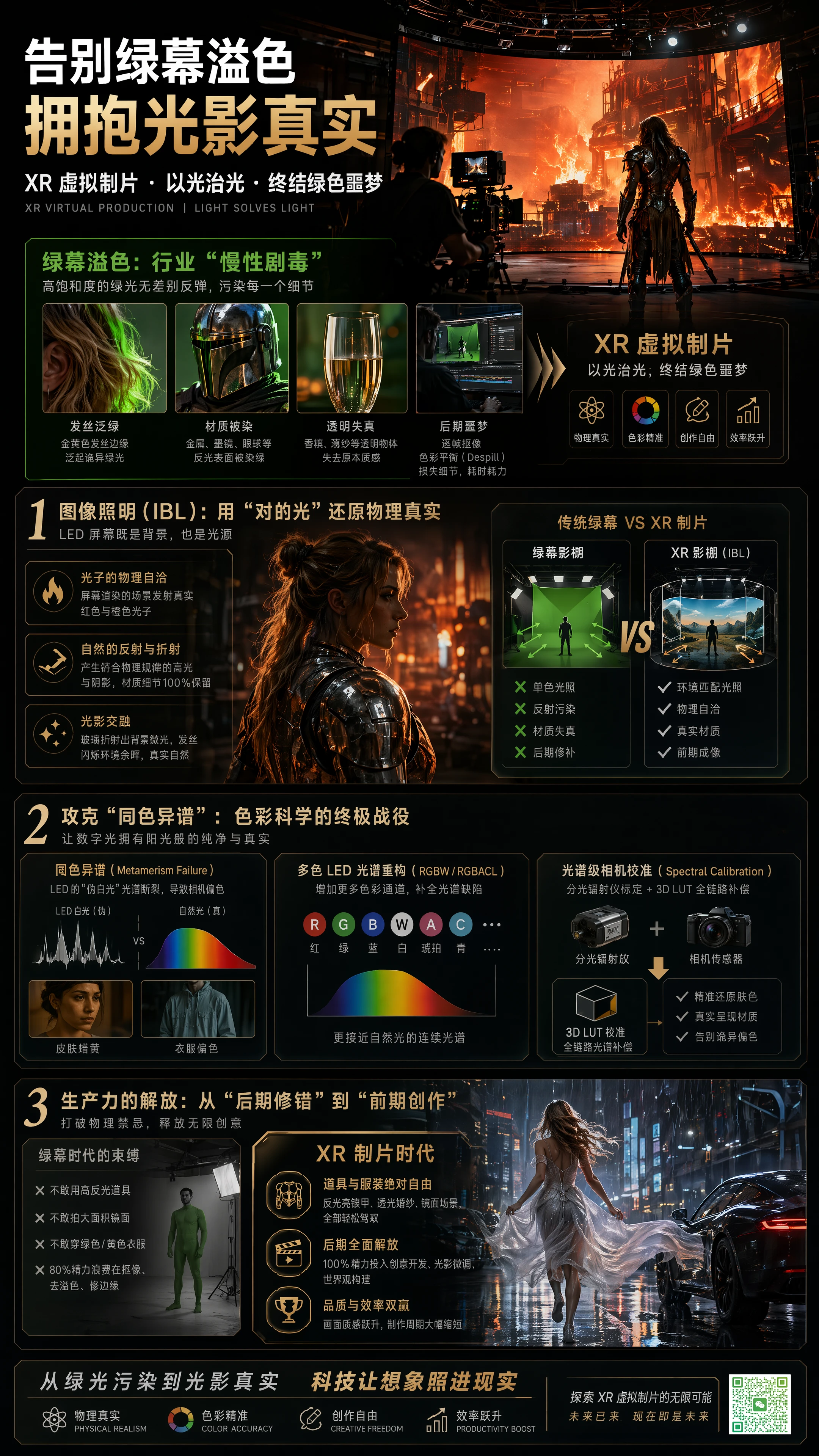
Image-Based Lighting (IBL): Using the “Right Light” to Restore Physical Reality
The most fundamental way to eliminate “spill” is toavoid using unnatural monochromatic light sources。
In an XR studio, the massive LED ring screen and ceiling surrounding the actor play a dual role: they serve as both the “background backdrop” and the“lighting source”This technique is professionally known asImage-Based Lighting (IBL)。
- Physical Self-Consistency of Photons: If a character is in a steel mill ablaze with fire, the LED screen renders rolling lava and red-hot steel. The pixels emit real, high-temperature red and orange photons.
- Natural Reflection and Refraction: These warm photons hitting the actor's metal armor, sweat, and props produce physically accurate golden highlights and dark shadows. Without the interference of a green screen, the material's optical properties are 100% preserved. A glass refracts the ambient light from the background, and the edges of blonde hair shimmer with the surrounding environment's glow. This natural “blending of light and shadow” is something no post-production keying algorithm can simulate.
Tackling “Metamerism Failure”: The Ultimate Battle of Color Science
However, with the elimination of the green screen, XR production faces its own optical challenge:Metamerism Failure。
This is a classic problem in color science. Simply put, LED screens are typically composed of red (R), green (G), and blue (B) light-emitting chips. While they can mix to fool the human eye into seeing “white light,” this “white light” has a broken, spiky spectrum that is completely different from the continuous spectrum of sunlight.
When this spectrally complex “pseudo-white light” hits the actor's skin or clothing and is captured by the camera's sensor (CMOS), the camera often produces severe color shifts (e.g., skin appearing sallow, or clothing taking on a strange purplish-red hue).
To achieve absolutely precise color reproduction in an XR studio, film technology companies have launched a technological breakthrough:
- Multi-Color LED Spectral Reconstruction (RGBW/RGBACL): A new generation of virtual production LED lights and screens is introducing additional color chips like White, Amber, and Cyan to fill in spectral gaps, simulating a continuous spectrum that truly approaches natural light.
- Spectral-Level Camera Calibration: Technicians use spectroradiometers to jointly calibrate the on-site LED screens and camera sensors. By embedding a3D LUT (Color Lookup Table)tailored to the specific camera within Unreal Engine, they mathematically compensate for the entire chain from photon emission to camera reception.
In this high-precision color battle, computational technology has successfully given the light emitted by digital pixels the purity and realism of sunlight.
Productivity Liberation: From “Post-Production Correction” to “Pre-Production Creation”
“The disappearance of ”spill" not only enhances image quality but also triggers a“tectonic shift”。
in film production productivity.
In the green screen era, fearing spill, the Director of Photography (DP) faced significant creative limitations on set. They dared not use highly reflective props, shoot large reflective surfaces, or even dress actors in green or yellow clothing.
- In an XR studio, these physical taboos are completely shattered: Absolute Freedom in Props and Costumes:
- Directors can freely design sci-fi warriors in shiny silver armor or have the lead actress run in the rain wearing a light, translucent wedding dress. Post-Production Liberation:
Conclusion
VFX teams no longer need to waste 80% of their budget and energy on tedious, meaningless manual labor like "keying, despilling, and edge repair." Instead, they can devote 100% of their effort to macro-level creative development, fine-tuning lighting, and building the world's narrative.
In the history of film technology, the green screen was a great compromise—trading actors' physical discomfort and heavy post-production labor for boundless imagination.The rise of XR virtual production, however, represents anuncompromising revolution
It uses the physical principle of “pixels as light sources” to dispel the "green haze" that has hung over film sets for years, returning the purest, most natural photons to the lens.
When the "green poison" recedes, filmmakers can finally declare with confidence:

 简体中文
简体中文  English