
On a film set, there is a standard workflow that has long been industry common sense—Multi-Cam Shooting。
To efficiently capture an actor's fleeting improvisation, the director typically sets up three or even more cameras simultaneously:
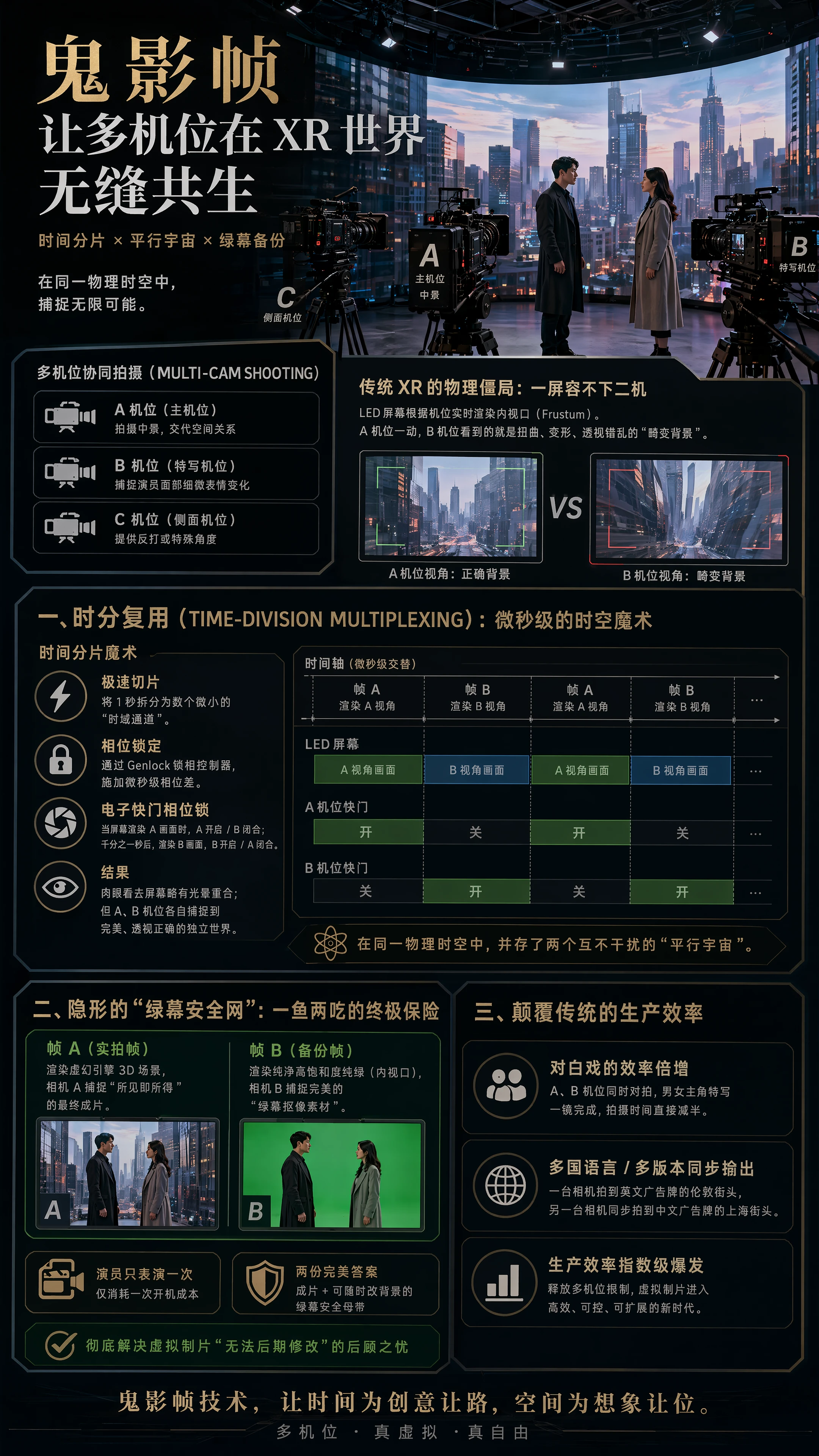
- Camera A (Main Camera): Captures medium shots to establish spatial relationships;
- Camera B (Close-up Camera): Captures subtle facial expressions of the actor;
- Camera C (Side Camera): Provides reverse shots or special angles.
However, when the multi-camera workflow encountered early the daily reality of, the entire crew instantly fell into an awkward physical deadlock.
Because in an XR studio, that massive LED screen renders afrustumwith correct perspective in real time based on the camera's spatial position. If Camera A moves, the screen background follows Camera A; at that moment, on Camera B's monitor, you would see acompletely distorted, warped, and perspective-messed “distorted background”。
“One screen cannot accommodate two cameras” was once an insurmountable physical barrier for virtual production. Until “the ”GhostFrame" technology emerged, carving out an incredible “parallel universe” for filmmakers in the microscopic gaps of time.
I. Time-Division Multiplexing: A Microsecond-Level Spatiotemporal Magic
To solve the problem of multiple cameras sharing one screen, scientists and engineers did not alter space but insteadsought answers from time。
The limit of the human eye's “persistence of vision” is about 24 frames per second, while the refresh rate of modern industrial-grade LED screens has reached 7680Hz or even higher. This means that in one second, the LED screen has ample capacity to “flicker” hundreds or thousands of times, completely undetectable by the human brain.
“The ”GhostFrame“ technology is essentially a high-precision ”time-slicing magic":
- Ultra-Fast Slicing: The rendering engine splits one second into numerous tiny “time-domain channels.” On odd frames, the LED screen renders the correct background for Camera A's perspective; on even frames, the screen instantly switches to render the correct background for Camera B's perspective.
- Electronic Shutter Phase Lock: Using a high-precision Genlock controller, the electronic shutters of Camera A and Camera B are given a microsecond-level phase difference.
- When the screen renders the A frame, Camera A's shutter is open, and Camera B's is closed;
- a thousandth of a second later, the screen renders the B frame, Camera B's shutter instantly opens, and Camera A's closes.
[Result]: On set, when the director looks with the naked eye, the LED screen, due to the rapid alternation, shows a slightly overlapping halo; but on the monitors of Cameras A and B, they eachcapture a flawless, perfectly perspective-correct independent world。
Within the same physical time and space, two non-interfering “parallel universes” coexist.
II. The Invisible “Green Screen Safety Net”: The Ultimate Two-for-One Insurance
“The miracle brought by ”GhostFrame" goes far beyond enabling multiple cameras to shoot simultaneously. It also solves a long-standing commercial problem for producers:The “one-shot” nature of virtual production—what if changes are needed in post-production?
In traditional XR shooting, the background is rendered in real time and “burned” into the footage. If the producer suddenly decides during editing that the building in the background looks bad or wants to change the weather, the cost of modification is nearly catastrophic.
“GhostFrame” provides a“backup safety net”:
- in an almost cheekily clever way: Frame A (Live Frame):
- The LED screen renders a perfect Unreal Engine 3D scene, and Camera A captures the "what you see is what you get" final shot. Frame B (Backup Frame):In the very next frame, the LED screen renders apure, high-saturation solid green block (frustum)
behind the actor, while Camera B simultaneously captures a perfect "green screen keying footage." [Revolutionary Experience]:The actor only needs to perform once, and the crew incurs only one shooting cost. But in the footage card, the post-production VFX team receives two perfect answers:
One is a near-complete 90% finished shot, and the other is a “green screen safety master” with perfect real-world environmental lighting, ready for re-keying and background changes at any time.
This completely eliminates the concerns of investors and producers about the "inability to modify in post-production" in virtual production.
III. Disruptive Production Efficiency
- When "time-slicing" removes the limitations of multiple cameras, the production efficiency of virtual production studios experiences exponential growth. Efficiency Boost for Dialogue Scenes:
- In film and TV, two-person dialogue scenes take up a large portion. In the past, in an XR studio, after shooting the male lead, you had to stop, readjust the screen frustum, and then shoot the female lead. Now, with Cameras A and B shooting simultaneously in one take, close-ups of both the male and female leads are completed at the same time, cutting shooting time in half. Multi-Language/Multi-Version Simultaneous Output:
Conclusion
For international co-productions or commercials, using GhostFrame, one camera can capture a London street with English billboards in the background, while another camera at the same moment captures a Shanghai street with Chinese billboards in the background.
In the film era, a frame was just a frame—a single trace of photochemistry on a physical medium.In today's digital spatial computing, "GhostFrame" proves that:
Within a single frame, there are still infinite microscopic dimensions that can be encoded.
By slicing time into microsecond fragments at the intersection of the physical and digital worlds, it weaves a dual net of efficiency and safety for creators. This is no longer just movie magic; it is a technological monument to humanity's use of algorithms to tame photons and reshape the dimension of time.

 简体中文
简体中文  English