
In the past two years, if you've been following virtual production, you might have heard directors or audiences offer this tactful criticism:
“This scene is impressive, but... why does it always have a bit of a video game feel?”
This lingering “game-like feel” or “CG plastic look” was an unspoken pain point of early XR virtual production.
Even when using the industry's top-tier Unreal Engine, those 3D virtual scenes built polygon by polygon and texture by texture by digital concept artists still appear overly neat, cold, and mechanical when faced with nature's most delicate creations—the translucent refraction of sunlight through leaves, the reflections in puddles on cobblestone paths, fine dust particles, and spider webs.
In the face of the infinite details of the physical world, the computational and labor costs of traditional 3D modeling hit an invisible iron wall.
However,The explosion of generative AI and neural rendering technologiesis infusing soul into XR virtual production in an unimaginable way.
From NeRF (Neural Radiance Fields) to 3DGS (3D Gaussian Splatting), AI is helping the film industry skip the “modeling” stage and directly clone the real “light field” onto LED screens.
I. The Limits of Traditional 3D Scanning: The “Mortal Ceiling” of Polygons”
Before AI stepped in, to recreate realistic scenes on set (like Notre-Dame de Paris or the Stone Forest in Zhangjiajie), crews typically usedPhotogrammetrytechnology: using thousands of photos from different angles, algorithms calculate a 3D point cloud of the object, then generate polygon meshes and textures.
But this highly mature industrial workflow instantly “freaks out” when encountering the following physical materials:
- Highly reflective and refractive materials: Glass, metal, water surfaces, luxury car paint. Traditional scanning algorithms cannot understand “reflected light that moves as the viewpoint shifts,” resulting in severe distortion and fragmentation in the scanned models.
- Extremely complex microstructures: Dense bushes, actors“ hair strands, floating dust. Because these structures are smaller than the scanning sampling limit, they end up shrinking into a blurry ”lump of faces" in the 3D engine.
To patch up these flaws, concept artists spend weeks manually reconstructing the models. This compromise is the source of the “game feel” and “artificial traces.”
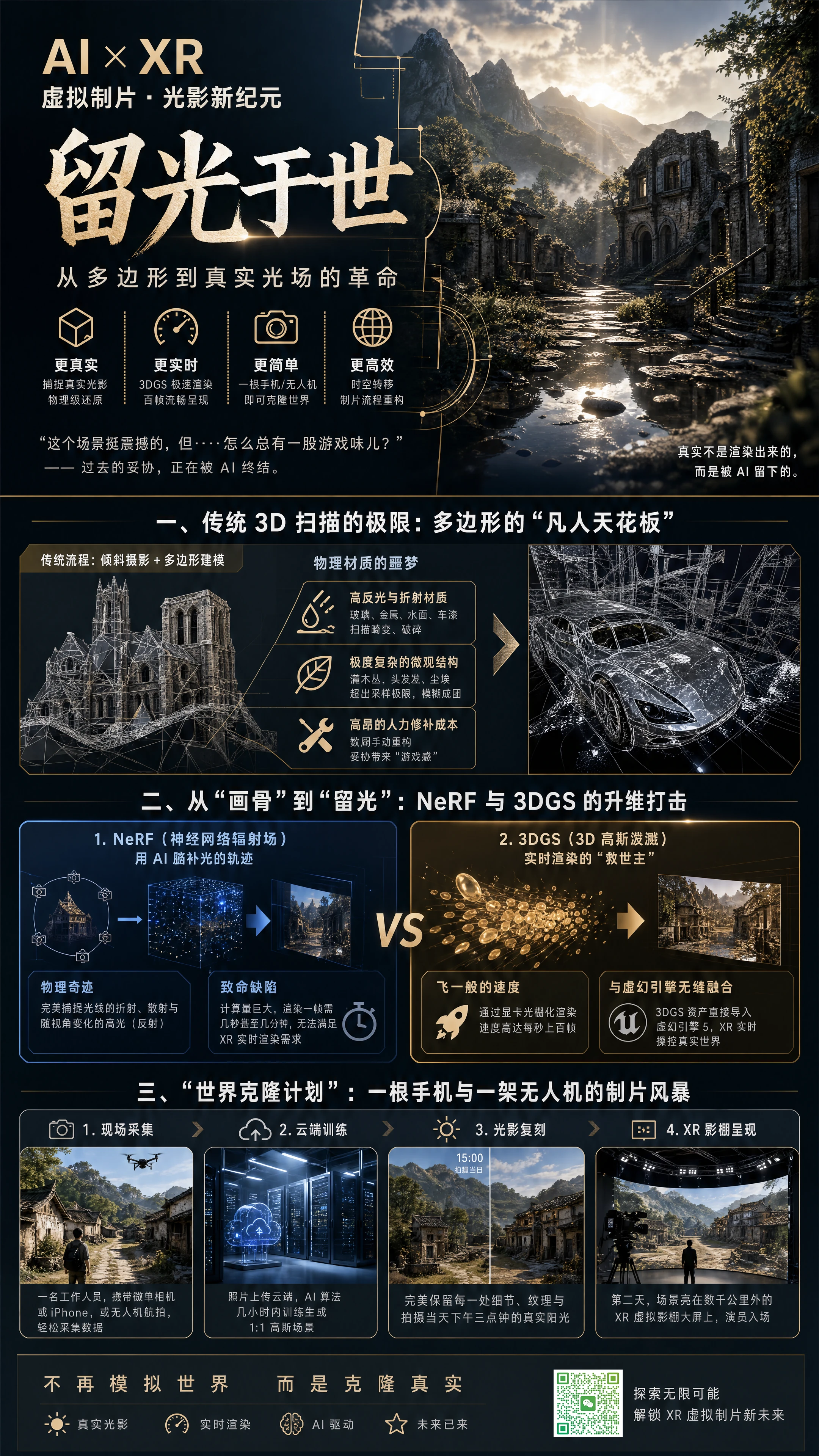
II. From “Drawing Bones” to “Capturing Light”: The Dimensional Leap of NeRF and 3DGS
The underlying logic of AI neural rendering technology completely overturns the tradition of “building the world with polygons.”It no longer calculates where the physical surface of an object is, but instead calculates the flow of light in space.
NeRF (Neural Radiance Fields): Using AI to Brainstorm Light Trajectories
NeRF turns a 3D space into a continuous probability field. When you feed it dozens of photos of a scene, the AI neural network starts intense training. It can calculate what color and brightness of photons would be emitted from any 3D coordinate point (X, Y, Z) at any viewing angle (θ, φ).
- Physical miracle: It perfectly captures the refraction, scattering, and flow of light as the viewpoint changes, known asView-Dependent Reflections。
- Fatal flaw: The computational load is terrifying. Rendering a single frame takes seconds or even minutes, making it impossible to meet the real-time rendering requirement of at least 24 frames per second for XR screens.
3DGS (3D Gaussian Splatting): The “Savior” of Real-Time Rendering”
Born in 2023 and quickly sweeping the film industry, 3DGS (3D Gaussian Splatting)perfectly solves NeRF's latency pain point. It abandons the heavy neural network and instead uses millions or even tens of millions ofsemi-transparent “3D Gaussian ellipsoids” with color, opacity, and directionality”to reconstruct the space.
- Blazing speed: 3DGS can perform ultra-fast “rasterization” rendering via the graphics card, reaching speeds of hundreds of frames per second.
- Seamless integration with Unreal Engine: Today, 3DGS assets can be directly imported into Unreal Engine 5. This means that on XR LED screens, directors can manipulate in real-time a real scene generated by AI with absolute physical realism in lighting.
III. “World Cloning Project”: A Production Revolution with a Phone and a Drone
When AI rendering merges with XR virtual production, the film industry's production workflow undergoes incredible simplification:
- Vanishing “astronomical art budgets”: In the past, recreating a real wilderness village in a virtual studio required a team of dozens of artists working for months. Now, the production team only needs to send one staff member with a standard mirrorless camera or even an iPhone to walk around the village twice or fly a drone along a route.
- “Time-space transfer” in hours: Photos are uploaded to the cloud, and AI algorithms train a 1:1 Gaussian scene within hours. This scene not only retains every rust stain and every patch of moss in the village but also perfectly replicates the real sunlight slanting at three o'clock on the shooting day—something impossible to simulate with manual software. The next day, this scene appears on the XR studio screen thousands of kilometers away, waiting for the actors to enter.
Conclusion
In the movie *Inception*, dream architects build magnificent cities from imagination, but often see their dreams collapse because they cannot perfectly replicate the physical details of reality.
Early XR virtual production was like those immature dream architects, barely supporting the illusory dream with polygons.
而 The introduction of AI and Gaussian Splatting technologyis like a “recorder” for nature's light and shadow. It doesn't care about geometry or topology; it only records light, recording the most real, roughest, and warmest breath of the world at that moment.
When AI redefines the generation method of digital assets, XR virtual production finally crosses the “game feel” gap and truly enters the film-level“Physical Reality Era”。
We no longer create realistic worlds; we simply cut a piece of time and space from nature's light and shadow, allowing filmmakers to set up camp there.

 简体中文
简体中文  English