
In industrial-grade production of virtual production (ICVFX) and extended reality (XR),“Camera Tracking System”is the absolute link connecting the virtual and the real.
Whether using infrared optical motion capture (e.g., OptiTrack, Vicon), mechanical arm encoders (e.g., Mo-Sys, Stype), or LiDAR and inertial hybrid tracking, the system continuously sends the camera's six degrees of freedom (6DOF) spatial coordinates to the rendering engine.
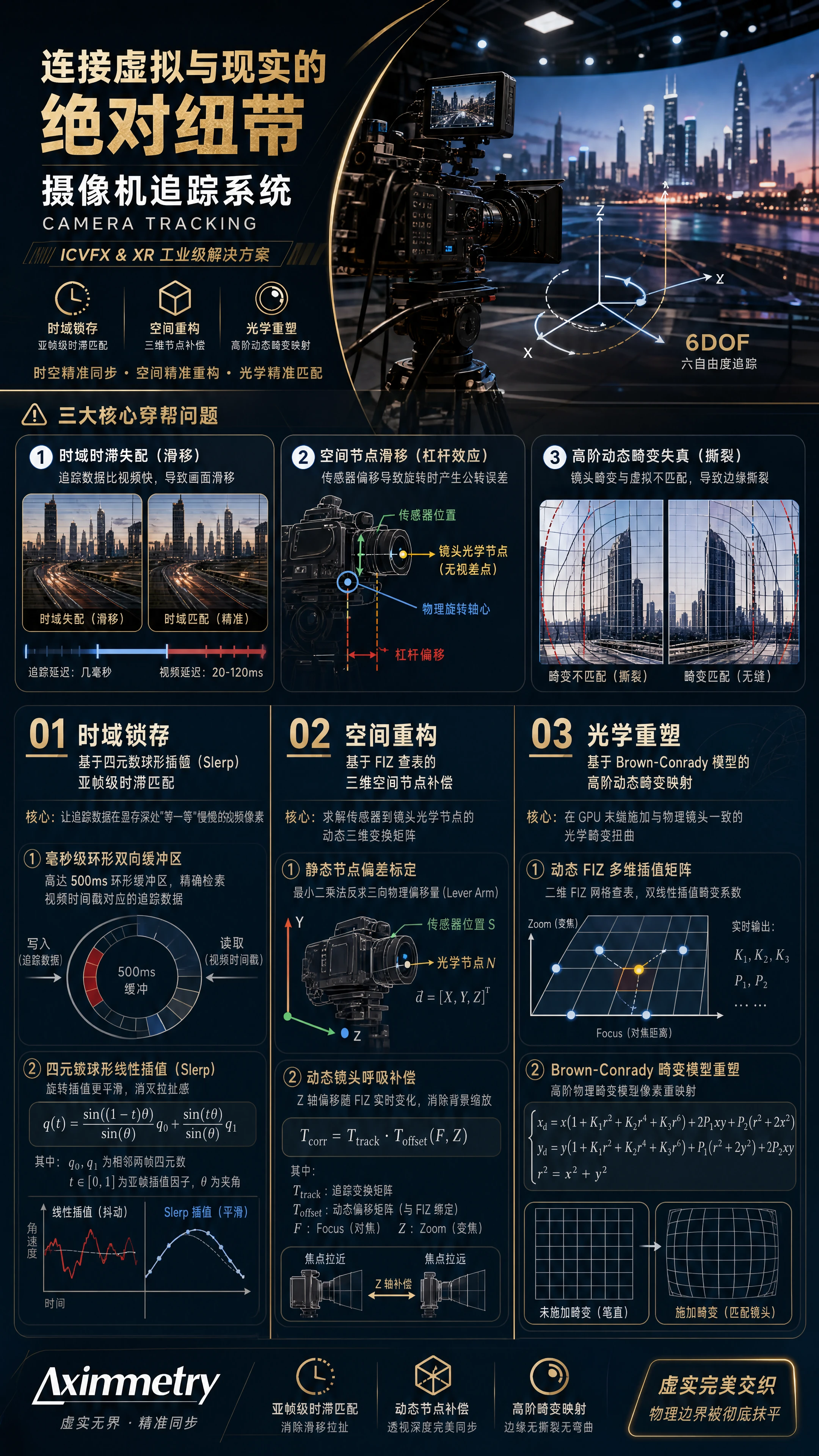
However, when the camera performs rapid pans, zooming, or focus pulling on set, technical teams often encounter the fatal issue of“Parallax Breaks”:
- Temporal Desynchronization: Tracking data transmitted via UDP protocol typically has a latency of only a few milliseconds; while the live video, passing through the lens, CMOS sensor, encoder, and capture card, has a latency of several frames (20-120 milliseconds). Without precise “latency matching” in the time domain, the virtual background will move prematurely during camera rotation, causing severe“Image Sliding”。
- Spatial Nodal Slip: The tracking sensor is usually mounted on the camera body, while the physical rotation axis of the camera is the lens'sParallax-Free Optical Nodal PointDue to the physical offset between these two points, when the camera rotates, the sensor orbits around the lens, causing a lever arm error in the rendered image.
- High-Order Dynamic Optical Distortion: Physical lenses inherently have radial and tangential distortion. More challenging is that when the camera zooms or pulls focus, the lens's physical field of view (FOV) and distortion coefficients drift non-linearly in real-time with the FIZ (Focus, Iris, Zoom) data (i.e.,Lens Breathing Effect). The virtual camera inside Unreal Engine 5 (UE5) uses a perfect pinhole camera model with absolutely straight perspective lines. The mismatch in distortion at the junction of the virtual and real causes severe “edge tearing.”
Aximmetry With its specially designed spatial geometry correction“Spatiotemporal Dual-Domain Latching and FIZ Multi-Dimensional Interpolation Pipeline”establishes a perfect virtual perspective model at the lowest level of the GPU.
I. Temporal Latching: Sub-frame Latency Matching Based on Quaternion Spherical Linear Interpolation (Slerp)
The core solution to sliding is to make the fast-moving tracking data “wait” for the slower video pixels deep in the video memory.
Aximmetry introduces“High-Precision Temporal Buffer and Adaptive Sub-frame Interpolation”Establish Motion Trajectory Predictor
Millisecond-Level Circular Bidirectional Buffer
Aximmetry allocates a circular buffer of up to 500ms in the video memory for high-frequency tracking data. When a frame of live video arrives, the system reads its accompanying physical timestamp (or Genlock count) and precisely retrieves the tracking data packet corresponding to that time point within the buffer.
Quaternion Spherical Linear Interpolation (Slerp)
Since the tracker's sampling rate (e.g., 120Hz) and the video frame rate (e.g., 59.94Hz) are rarely perfectly divisible, the precise time alignment point often falls between two tracking data frames. Aximmetry abandons linear interpolation, which can introduce jitter, and uses Quaternion Spherical Linear Interpolation (Slerp) to calculate the rotation component:

This algorithm ensures that when the camera rotates in 3D space, the interpolated virtual camera trajectory has physically smooth acceleration, completely eliminating the “pulling sensation” between the virtual and real images caused by temporal misalignment.
II. Spatial Reconstruction: 3D Spatial Nodal Compensation Based on FIZ Lookup Table
To eliminate the “lever arm effect” caused by the offset in sensor mounting position, the system must solve for theDynamic 3D Transform Matrix。
from the "sensor physical position" to the "lens optical nodal point" in real-time.“Aximmetry deploys an extremely precise”:
"Dynamic 3D Nodal Calibration Algorithm"
Static Nodal Offset Calibration
Using Aximmetry's dedicated lens calibration tool, the engineer rotates the camera around its physical axis at multiple angles. The algorithm uses the Least Squares Method to precisely reverse-solve the three-dimensional physical offset (Lever Arm) [X, Y, Z] between the sensor and the lens's optical nodal point in 3D space.
Dynamic Lens Breathing Compensation
During zooming and focus pulling, the physical movement of the internal focusing lens group causes the lens's optical nodal point to slide forward and backward along the optical axis (Z-axis) inside the lens barrel. Aximmetry binds the calibrated Z-axis offset with the real-time FIZ encoder data, dynamically fine-tuning the Z-axis offset matrix during runtime. This ensures that the perspective depth of the virtual scene is perfectly synchronized with the live-action lens during focus pulls, eliminating the "background scaling" artifact.
III. Optical Remapping: High-Order Dynamic Distortion Mapping Based on the Brown-Conrady Model
Aximmetry introduces“To cure the ”breaking" and "bending" of lines at the junction of the virtual and real, the linear image output by Unreal Engine must be subjected to the same optical distortion as the physical lens at the very end of the GPU rendering pipeline.”technology:
"High-Order Dynamic Distortion Calibration and Real-time Remapping"
Dynamic FIZ Multi-Dimensional Interpolation Matrix The distortion coefficients of a lens are completely different at different focal lengths (Zoom) and focus distances (Focus). Aximmetry establishes a two-dimensional grid-basedFIZ Distortion Lookup Table
When focus and zoom change, the system performs real-time, adaptive bilinear interpolation of the high-order radial distortion coefficients ([K_1, K_2, K_3]) and tangential distortion coefficients ([P_1, P_2]) inside the GPU.
Classic Physical Distortion Model Remapping (Brown-Conrady Model)

Aximmetry's pixel shader invokes the Brown-Conrady distortion model to re-address and warp the undistorted image pixels rendered by UE5:
This causes any straight line in the virtual background (e.g., the edge of a virtual building, a virtual pillar) to exhibit physically accurate bending and chromatic dispersion at the edges of the frame, identical to the real lens glass.
The lines of the virtual and real parts are perfectly interwoven, and the physical boundary is completely erased at this moment.
Conclusion: Rebuilding the Physical Coordinate System of Light and Shadow
In the vast system of virtual production, high-precision lens calibration and tracking alignment are the underlying logic hidden beneath the dazzling visuals. If you cannot lock the latency on a microsecond-level timeline or correct the nodal offset on a micrometer-level spatial axis, even the grandest digital world is just a shaky castle in the air.
Aximmetry Unreal Engine 5 focuses on rendering the perfection of 3D geometry, but it is powerless against the "imperfections" of physical lenses under glass refraction (distortion, nodal movement, latency).“The technical value of Aximmetry lies precisely in its role as the”。
"Calibration Expert and Spacetime Judge"

 简体中文
简体中文  English