
When The Mandalorian sparked the first wave of XR virtual production in 2020, the unsung technical hero behind the scenes was Unreal Engine 4. Yet, a quiet anxiety still hung over the set.
That anxiety came from the 3D artists and lighting technicians.
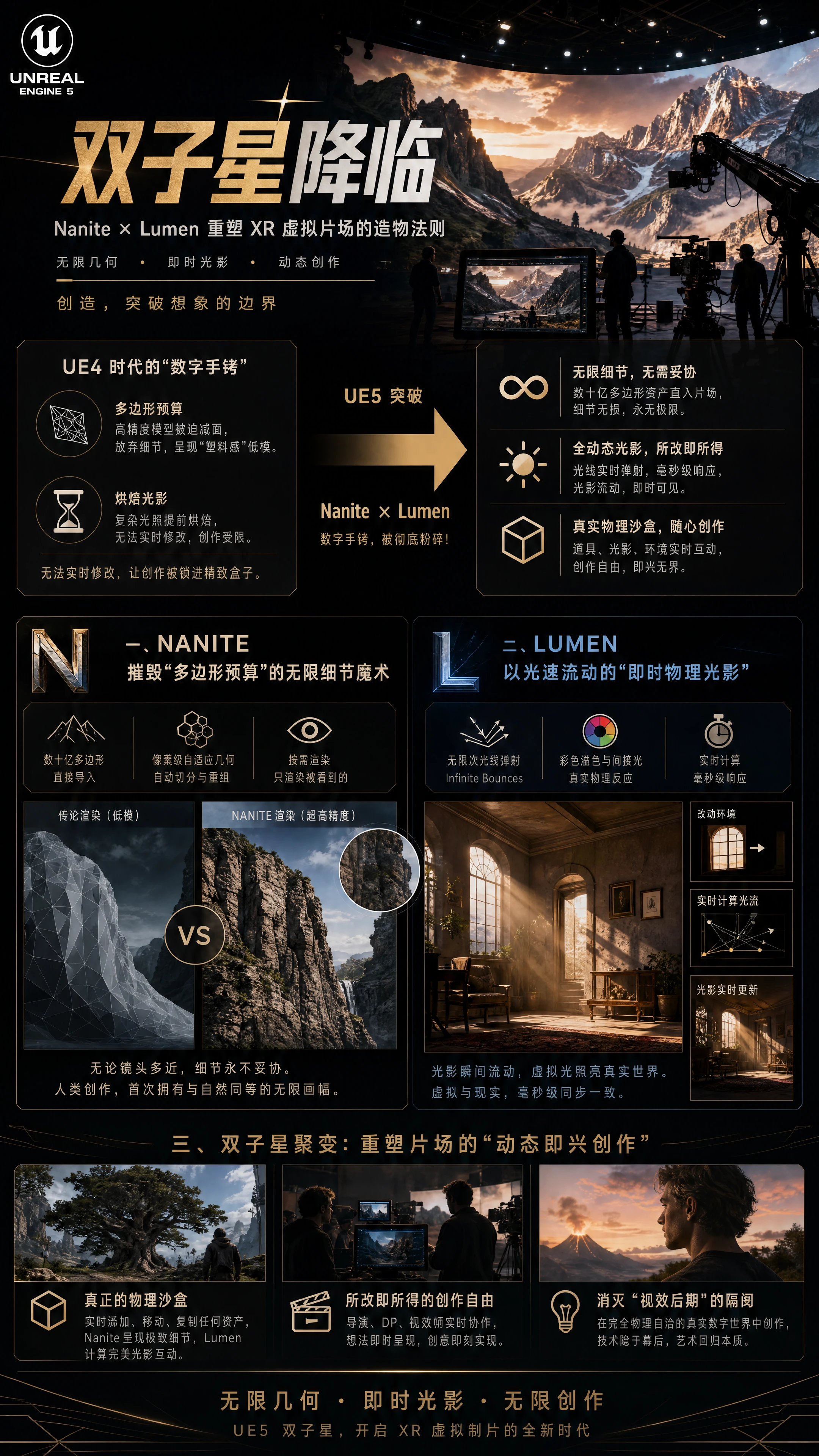
In the UE4 era, to ensure the LED wall could render in real-time at over 24 frames per second, the entire crew had to wear invisible “digital handcuffs”:
- Polygon Budget: Artists were forced to ruthlessly reduce the polygon count of high-precision, tens-of-millions-of-polygon cinematic models, bake normal maps, and compress them into low-poly, “plastic-feeling” models with only a few hundred thousand faces.
- Baked Lighting: To avoid stuttering, complex global illumination (indirect reflections, ambient shadows) had to be “baked” into static textures hours or even tens of hours in advance. This meant that if the director said on set:“I want to move that mountain a bit to the left, and also speed up the sunset.” The only answer would be:“Sorry, Director, we'll have to wrap for today. Re-baking the lighting will take all night.”
This limitation of “no real-time changes” made early virtual production feel like a beautifully locked box.
UntilUnreal Engine 5Arrived with its revolutionary “Twin Creations”—Nanite (Virtualized Micro-Polygon Geometry System)与Lumen (Fully Dynamic Global Illumination System)—and smashed those digital handcuffs to pieces.
They didn't just change the gaming industry; they rewrote the very laws of creation for XR virtual sets on a physical level.
I. Nanite: The Infinite Detail Magic That Destroys the “Polygon Budget”
In traditional 3D rendering, there's an unbreakable physical rule: the more detailed the model, the more polygons (triangles) it has, the heavier the GPU's computational load, and the more the frame rate plummets.
Nanite completely eliminates the concept of a “polygon budget.”
It allows artists to directly drag and drop cinematic models with billions of polygons, ZBrush high-poly models, or even uncompressed, ultra-high-precision laser-scanned assets (CAD/LiDAR) into the virtual set scene without any reduction or optimization.
How does Nanite achieve this miracle? Its underlying logic is“Pixel-Scale Adaptive Geometry”:
- Infinite Subdivision and Reassembly: Nanite automatically divides the model into millions of incredibly tiny triangle clusters.
- Drawing Only What Is Seen: Crucially, the geometric detail rendered by Nanite isbound to the screen's pixel resolutionIf a cliff in the background is far from the camera and only occupies 10 pixels on the LED screen, Nanite will render only 10 polygons. When the camera rapidly pushes in, and the cliff fills the entire screen (millions of pixels), Nanite will instantly and smoothly ramp up the rendered polygon count to millions.
[On-Set Experience]: On the camera's monitor, no matter how close the lens gets, the rock crevices in the digital background, the weathered bricks on the ancient city wall—all exhibit the infinite, microscopic detail of the physical world.The “edges” and “aliasing” caused by low-poly models never appear.”。
For the first time, human creativity has gained an infinite canvas in the geometric dimension, equal to nature itself.
II. Lumen: “Instant Physical Lighting” Flowing at the Speed of Light”
If Nanite solved the problem of “form,” then Lumen Lumen completely solved and liberated “light.”
Lumen is afully dynamic global illumination and reflection systemIts ultimate mission is to make the bouncing of light in the virtual world obey the same dynamic physical laws as the real universe—and do itcompletely in real-time.。
- Infinite Bounces: In nature, a beam of sunlight hitting a red carpet causes red light to bounce onto a white wall, tinting it slightly red. Lumen uses an efficient software/hardware hybrid ray tracing algorithm to calculate this complex indirect lighting (bounce light) and color bleeding in milliseconds.
- WYSIWYG Light Flow: Because the calculation is real-time, Lumen completely abandons the “baking” process. On set, if the Director of Photography (DP) feels the environment is too dark, the VFX artist simply clicks a button in the software to open a virtual window. Lumen instantly calculates the complete light flow of sunlight entering through the window, hitting the floor, and bouncing to the ceiling.
[On-Set Experience]: If the director says, “I want a shaft of Volumetric light piercing through the clouds,” or “Tilt the sunset angle down by another 5 degrees,” the light and shadow on the giant screen change dynamically in an instant.
Even more magical, this real-time virtual light flow is emitted through the pixels of the LED wall,simultaneously illuminating the actors' skin and physical props on set.Virtual light and physical light achieve absolute synchronization on a millisecond timescale.
III. The Fusion of the Twins: Reshaping the Set with “Dynamic Improvisation”
The combination of Nanite and Lumen creates a wonderful “chemical fusion” in the XR studio. It transforms cold digital code into a piece of "playable clay" that directors and cinematographers canmold in real-time.“。
- A True Physics Sandbox: In the past, due to optimization and baking limitations, props on the virtual set couldn't be moved once filming started. Now, the Art Director can, during a take, instantly duplicate a Nanite-level ancient tree with millions of leaves and place it in the center of the scene. Lumen will then calculate, in a fraction of a millisecond, the tree's real-time shadow with perfect translucent scattering, cast on the ground, the walls, and reflected in a puddle.
- Eliminating the Psychological Barrier of “Post-Production VFX”: In the past, the creative team needed a powerful imagination to envision the final composited lighting. On a UE5-driven XR set, the creators work within a “real digital world” that is fully physically consistent and interacts with light in real-time. The presence of technology is minimized, and artistic intuition is maximized.
Conclusion
In the long river of film technology evolution, we have always strived to use machines to simulate the Creator's masterpiece.
Unreal Engine 5“s Nanite and Lumen are like ”gravity“ and ”the speed of light" in the digital universe, using algorithms to reshape the fundamental physical constants.
When infinite detail meets instantaneous light and shadow, XR virtual production finally breaks free from all technical constraints. The LED wall on set is no longer a background playing a 3D animation; it is a real-time, flowing portal to a parallel universe.
Behind this portal, polygons have no budget, light and shadow need no waiting, and the imagination of filmmakers finally gains the right to roam freely at the speed of light.

 简体中文
简体中文  English