
In front of every monitor in an XR virtual studio, pairs of highly vigilant eyes are fixed intently.
Whenever the first assistant camera slowly rotates the follow-focus ring, shifting the focal plane from the foreground actor's figure backward, just as it is about to touch the massive LED wall in the background, the entire director's team tenses up instantly.
They are on guard against a “visual demon” lurking at the intersection of light and electronics.
Once this demon appears, the screen suddenly erupts with large, eerie, wave-like colored stripes. They frantically race across the frame as the camera moves, instantly reducing a set costing hundreds of thousands per day and its exquisite virtual world back to the crude reality of “people acting in front of an LED screen.”
In physics and optics, this phenomenon is called“the ”Moiré Pattern."It is the most stubborn physical inevitability of the digital photography era and the last mile that XR virtual production must conquer for practical implementation.
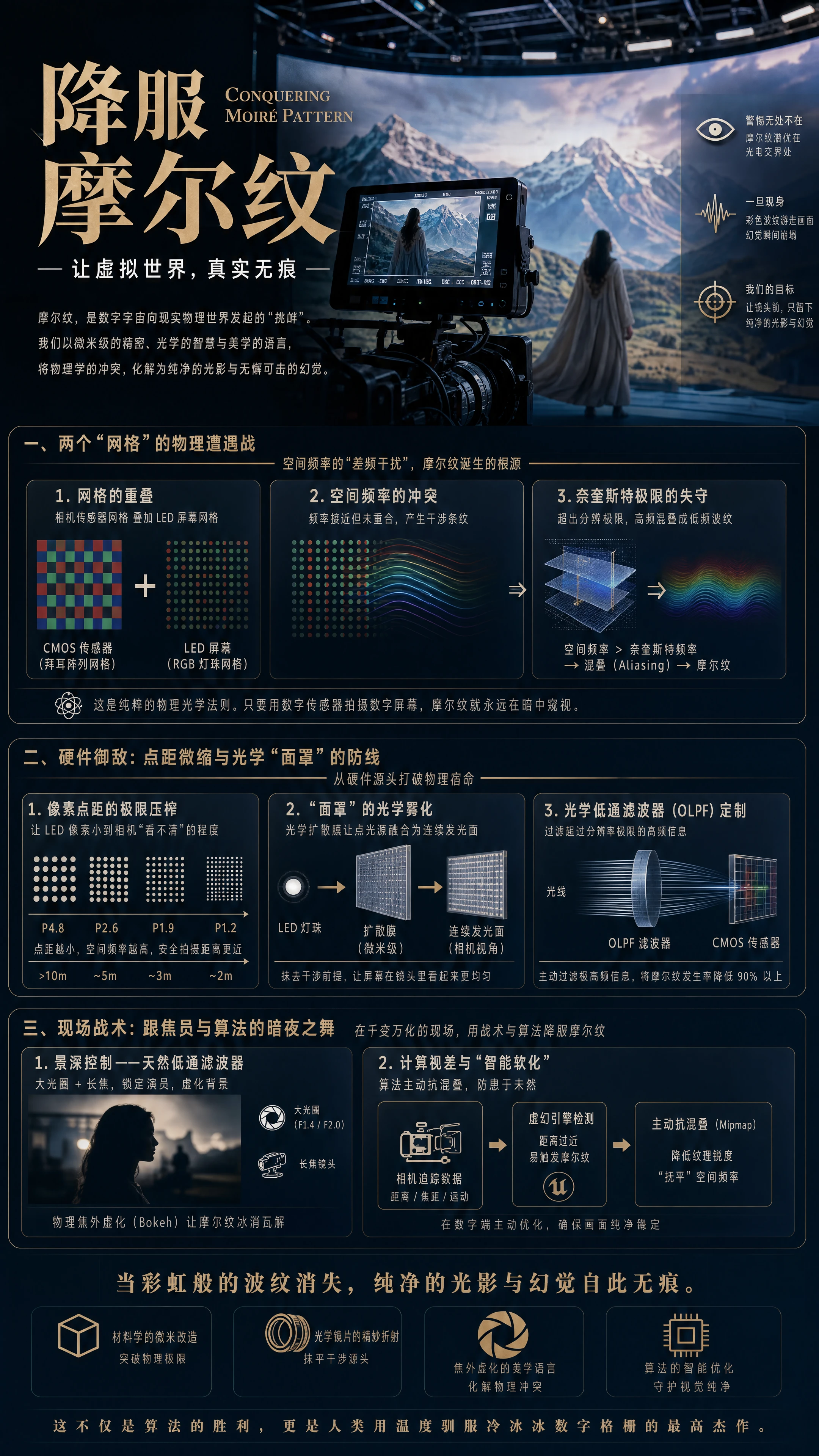
I. The Physical Clash of Two “Grids”
To tame moiré, one must first understand its physical origin. It is essentially a“beat frequency interference” of spatial frequencies.”。
In digital photography, our imaging device is not continuous film but a CMOS sensor(typically arranged in a Bayer filter grid) covered with tiny photosensitive pixels.
In an XR studio, the background wall is also aphysical grid。
- Grid Overlap: When a camera shoots an LED screen, it is essentially using one microscopic “grid” (the camera sensor) to capture another microscopic “grid” (the LED screen).
- Spatial Frequency Conflict: If the geometric arrangement frequencies of these two grids are very close but not perfectly aligned, light passing through them creates interference. This is like stacking two very fine combs and slightly rotating one; your eyes will see thick, dark bands that don't originally exist.
- Violation of the Nyquist Limit: When the spatial frequency of LED pixels imaged on the camera sensor exceeds the sensor's maximum resolution limit (Nyquist frequency), high-frequency image signals are “aliased” into low-frequency ripples, resulting in those glaring rainbow-like stripes on the monitor.
This is a pure law of physical optics. As long as you try to shoot a digital screen with a digital sensor, moiré is always lurking in the shadows.
II. Hardware Defense: Pixel Pitch Reduction and Optical “Mask” Barriers
To break this physical fate, film equipment engineers have launched a years-long “micro-scale breakthrough” at the hardware source.
Extreme Reduction of Pixel Pitch
The most direct way to eliminate moiré is to make the LED screen's pixels so small that the camera sensor cannot “see” them clearly. In the early days of virtual production, the industry commonly used P4.8 (4.8mm pitch) or P2.6 screens. Today, mainstream XR studios have fully entered the era of P1.9, P1.5, and even P1.2(with lamp bead spacing as small as 1.2mm) ultra-high precision. A smaller pitch pushes the screen's spatial frequency to an extremely high range, reducing the camera's “safe shooting distance” (the closest distance without moiré) from over ten meters to just two or three meters.
Optical Diffusion Mask
Besides reducing pitch, LED manufacturers also cover the lamp bead surface with a micron-leveloptical diffusion layer.This layer acts like an extremely fine frosted glass. It causes the originally sharp-edged point light emitted by a single LED lamp bead to scatter slightly within a tiny space, blending together. From the camera lens's perspective, the screen transforms from “a collection of countless luminous points” into a “continuous, uniformly emitting surface,” physically eliminating the prerequisite for interference.
Custom Optical Low-Pass Filter (OLPF)
Cinema camera manufacturers (such as RED, ARRI, Sony) also offer customized OLPFs (Optical Low-Pass Filters)for virtual production. This extremely precise optical lens, installed in front of the CMOS sensor, actively and subtly filters out extremely high-frequency spatial information that exceeds the sensor's resolution limit. It introduces a very slight, nearly imperceptible physical blur to the image while reducing moiré occurrence by over 90%.
III. On-Site Tactics: The Dance of the Focus Puller and Algorithms in the Dark
However, the physical defense of hardware still has its limits. In the ever-changing shooting environment, the burden of taming moiré ultimately falls on the on-set creative team's “demon-subduing tactics.”
- Depth-of-Field Control (The Depth-of-Field Trap): An experienced Director of Photography (DP) will never allow the background LED screen to be in critically sharp focus. They will usea wide aperture (e.g., F1.4 or F2.0)and a telephoto lens, locking focus firmly on the actor while keeping the LED screen in the background in a state of soft, physical bokeh. This optical blur acts as a natural low-pass filter, instantly dissolving the moiré.
- Computational Parallax and “Intelligent Softening”: What if the director insists on a deep focus shot with both foreground and background sharp? Modern virtual production systems activatedynamic camera tracking anti-shake algorithms.The Unreal Engine receives the real-time physical distance between the camera and the screen, along with the lens focal length. When it detects the camera is too close to the screen, making moiré highly likely, the rendering engine automatically initiates anactive anti-aliasingmechanism. It digitally reduces the texture sharpness (Mipmap level) of the corresponding area on the LED screen, actively “smoothing out” the spatial frequencies about to collide on the algorithm side.
Conclusion
Moiré is a “provocation” from the digital universe against the physical world. It proves that when two artificially created digital grids, both pursuing absolute precision, meet, they produce the most unnatural visual chaos.
The process of taming moiré in virtual production is an elegant “art of compromise.”
Filmmakers did not try to erase it with brute computational force. Instead, through micron-level material science modifications, the subtle refraction of optical lenses, and the classic cinematic language of bokeh, they resolved the sharp conflict of physics into the warm, natural film texture seen through the lens.
When that rainbow-like ripple completely disappears from the monitor, only pure light, shadow, and an impeccable illusion remain before the lens. This is not just a victory of algorithms but the ultimate masterpiece of humanity using warmth to tame the cold digital grid.

 简体中文
简体中文  English