
Throughout the history of theater and film, humanity has made countless brilliant attempts to create “infinite space” on a limited stage. From the perspective paintings of ancient Greek theaters, to the hand-painted backdrops of Hollywood's Golden Age, and on to today's the daily reality of。
However, no matter how technology evolves, a ghostly presence has always lingered in visual art“The Fatal Boundary”——
The right-angle line where the physical stage floor meets the vertical backdrop (Backdrop/LED wall).
In the real world, aside from some extreme modern architecture, we rarely see a wilderness, a desert, or a street in nature that abruptly turns toward the sky at a harsh 90-degree angle .
If the audience sees this “intersection line” in the shot, no matter how realistic the 3D rendering on the LED screen is, the sense of space will collapse instantly, exposing the scene with a strong “stage play feel.”
How to seamlessly blend physical props with digital pixels, making this right-angle line completely “invisible”? This is an incredibly sophisticated "suture magic" in XR virtual production, integrating materials science, scenic art, and computational geometry.“Suture Magic”。
I. Physical Defense: The Untouchable “LED Safety Zone”
On the virtual production set, the first challenge facing the Production Designer is quite dramatic:The direct conflict between physical materials and fragile electronic devices.
To make the scene feel real, the floor often needs to be covered with numerous physical props: real sand, gravel, fallen leaves, and even puddles. However:
- Physical Damage: The LED screens installed on set are composed of millions of tiny, exposed photodiodes (Diodes). These screens, costing tens of millions, are extremely fragile. A single hard piece of gravel dragged across them can scratch an entire row of lamp beads.
- Electronic Contamination: Dust kicked up from real sand and soil, once it drifts into the LED's internal circuit boards and cooling fans, can cause fatal short circuits or color deviation.
Therefore, a 30 to 50 centimeter “No-Man's Land” safety buffer。
must be maintained between the physical floor and the LED wall.
How to bridge this untouchable chasm?“Scenic artists invented the"Ramp/Cove" (The Ramp/Cove)
They custom-build a curved wooden or foam ramp that gently slopes upward from the physical floor, forming an elegant tangential transition as it approaches the LED screen. On this ramp, scenic artists use extremely lightweight spray foam, eco-friendly artificial turf, or highly realistic plastic rocks for physical dressing.
This curve physically blurs the existence of the 90-degree angle.“
II. Digital Suture: 3D Projection Mapping & “Pixel Feathering”
The physical ramp solves the safety distance, but how do you make the "physical sand" perfectly match the "digital sand" on the large screen in terms of texture and color?“This is where Unreal Engine's"Virtual-Real Hybrid Rendering System" (Set Extension & Projection Mapping)
- comes into play: 3D Digital Twin:
- Before shooting, the visual effects team uses high-precision laser scanners to create a 1:1 digital model of the physical props on set (e.g., a pile of oddly shaped volcanic rocks). 3D Projection Mapping (Camera Projection):
- Using the camera tracking system, Unreal Engine knows the exact perspective of the physical camera. The engine then precisely projects the texture of the just-scanned "digital volcanic rocks" onto the very bottom of the LED screen, making it perfectly align with the "physical volcanic rocks" on the floor from the camera's line of sight. Fading & Blending:In the software, the artist draws adynamic gradient band (Feather Mask)
Below the intersection line, it is 100% real physical rock; as the height increases, the image gradually transitions to a mixed zone where physical and digital each account for 50%; finally, above the intersection line, it completely transitions to a 100% digitally rendered background generated in real-time by the engine. [Visual Miracle]:
On the camera's monitor, the audience sees one half of a rock as a physical object, while the other half extends into the large screen. As the camera moves, thanks to the correct calculation of 3D parallax, the physical part and the digital part of this rock present a perfect, non-detached sense of wholeness.
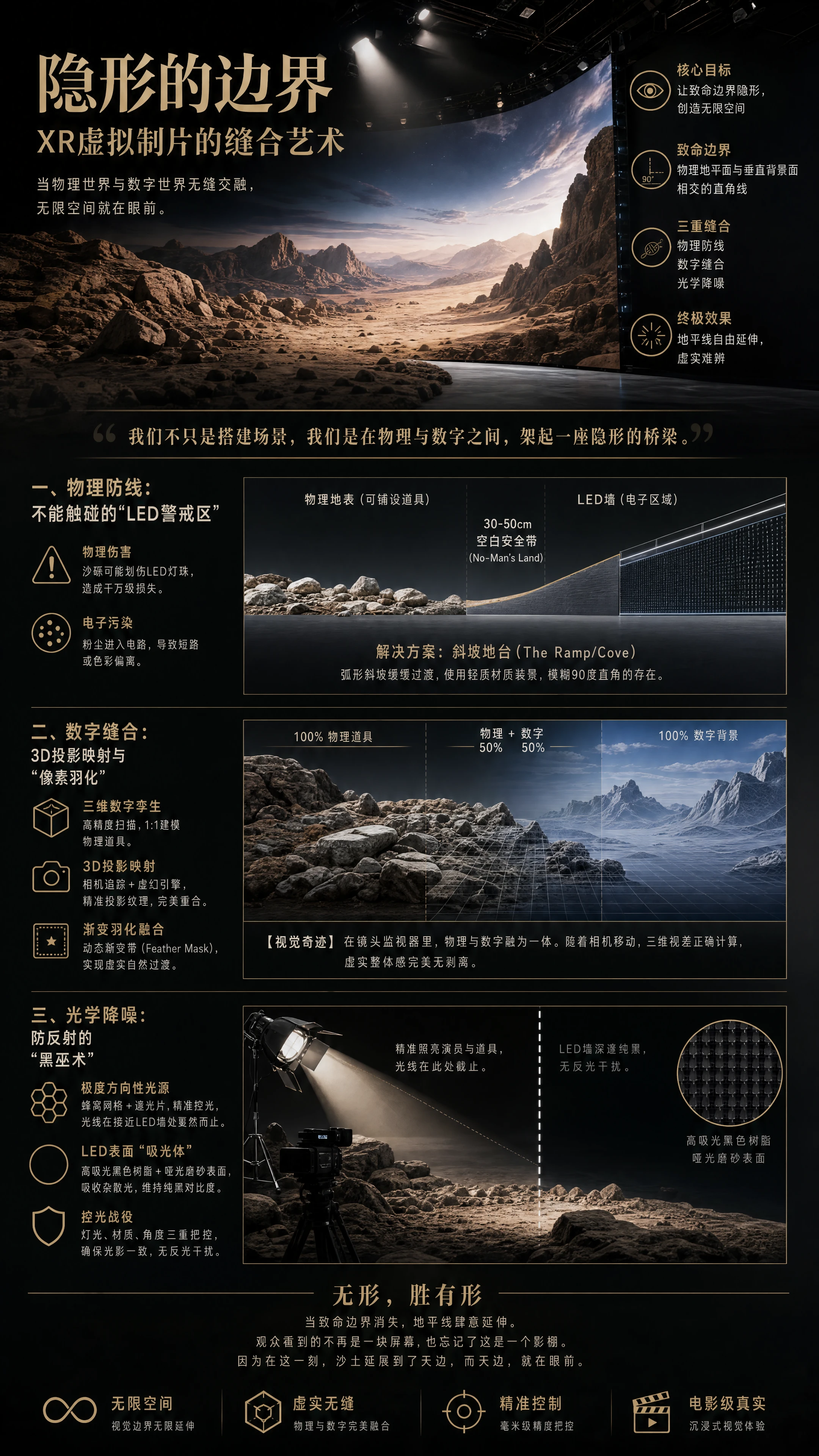
This fatal intersection line, woven by algorithms, is gently dissolved.“
III. Optical Noise Reduction: The "Black Magic" of Anti-ReflectionHaving solved the form and position, the final stronghold is。
Light Consistency
To illuminate the foreground actors and physical props, lighting technicians set up numerous physical lights (e.g., softboxes, spotlights) overhead and from the sides. However, if the light from these physical fixtures accidentally spills onto the LED screen, it creates reflections on the screen's surface, turning its originally deep black background into a gray, hazy "fog," instantly exposing the boundary between reality and illusion.
- To suture the boundary in terms of light and shadow, a light control campaign unfolds on set: Highly Directional Light Sources:Lighting technicians equip all physical lights with和Honeycomb Gridsand extra-long Snoots/Barn Doors
- These accessories restrict the light beam's angle to a very narrow range, allowing the light to precisely hit the actors and props on the floor while stopping abruptly just a few dozen centimeters from the LED wall. LED Surface “Light Absorbers”:
Conclusion
High-end virtual production LED screens fill the gaps between lamp beads with highly absorbent black resin material and use a matte, frosted surface. They act like a "light black hole," greatly absorbing stray ambient light from the environment, ensuring the large screen maintains a high-contrast "pure black" even under strong lighting, thus perfectly connecting with the shadows of the physical floor.“In the art of XR virtual production, the ultimate success is often”。
"Invisibility"
When the creative team spends days on set, using physical sand, foam ramps, 3D projection algorithms, and precise light blocking to erase that right-angle intersection line without a trace, they are essentially building an invisible bridge between the physical world and the digital world.
When this fatal boundary disappears, the horizon can finally stretch unhindered into deep space. The audience no longer sees a screen, nor remembers this is a studio.

 简体中文
简体中文  English