
On the set of Extended Reality (XR) and LED Virtual Production (ICVFX), to make the audience completely lose perception of the “boundary between virtual and real,” beyond geometric spatial alignment, the more advanced and difficult physical challenge lies in“Photometric Consistency”。
This requires the system to establish abidirectional light-shadow closed loop:
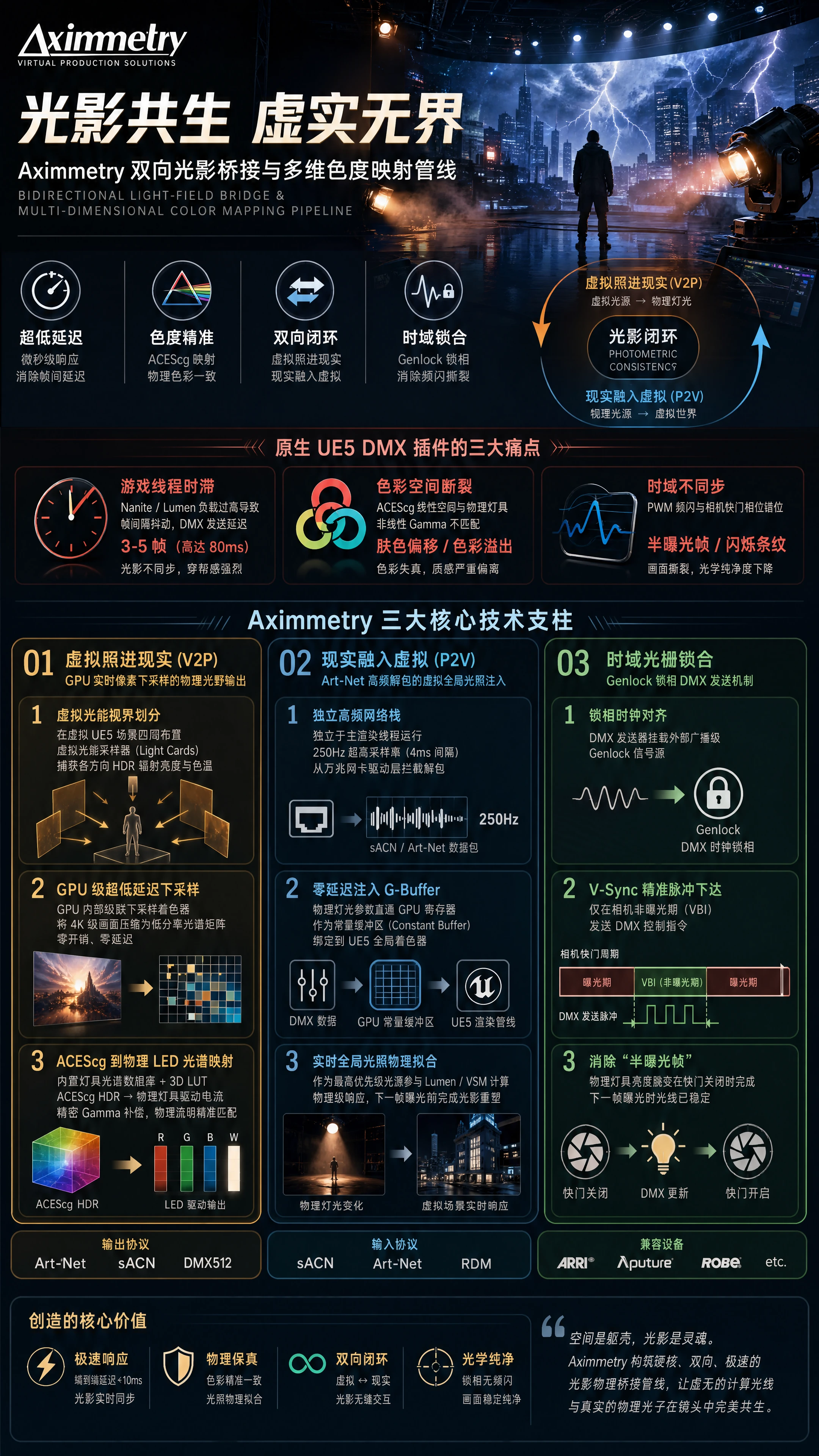
- Virtual to Physical (V2P): When a lightning bolt erupts in the virtual scene, or a car speeds through a virtual tunnel, the physical lights (LED moving heads, panel soft lights, LED fill strips) illuminating the physical actors on set must synchronize their changes withinmicrosecondsin brightness and color temperature, allowing the light sources from the virtual world to truly “illuminate” the actors in reality.
- Physical to Virtual (P2V): When on-set props (such as a physical flashlight held by an actor) move, or when a spotlight sweeps across the physical stage, the global illumination (GI) in the virtual 3D world must also respond in real-time to the injection of these physical photons.
However, when the technical team attempts to usedeploy Genlock in native Unreal Engine 5 (UE5)the DMX plugin to maintain this light-shadow closed loop, they immediately encounter severetiming and colorimetric discontinuities:
- Game Thread Scheduling Latency: The UE5 DMX plugin runs on the main game thread. When the scene contains extremely complex Nanite geometry and high Lumen real-time ray tracing loads, the game thread's frame time can jitter severely. This causes an uncontrollable delay of 3 to 5 frames (up to 80 milliseconds) in DMX signal transmission—meaningby the time the virtual explosion's flash has already extinguished, the physical strobe light on set only belatedly fires up, creating a glaringly obvious disconnect.
- Nonlinear Color Space Conversion Disaster: Unreal Engine 5's rendering operates entirely in a wide-gamut linear space (ACEScg Linear), while the LED chips (RGBW or RGBL) of physical lights on set (e.g., Arri Skypanel, Creamsource) have nonlinear photoelectric response curves (Gamma). Without precise color mapping when outputting DMX data, the skin tones of actors illuminated by physical lights can appear severely reddish, greenish, or exhibit color clipping in highlights.
Aximmetry Leveraging its specially reconstructed architecture for spatial light field alignment,“the ”Bidirectional Light-Field Bridge & Multi-Dimensional Color Mapping Pipeline"forcibly establishes an ultra-low-latency, high-physical-fidelity light-shadow conveyor belt between the GPU memory layer and the DMX I/O driver layer.
I. Virtual to Physical: Physical Light Field Output Based on GPU Real-Time Pixel Downsampling
To instantly and losslessly transfer complex light-shadow changes from the virtual world to physical lights on set, Aximmetry abandons inefficient CPU-side property reads and instead executes directly within GPU memory a“Light Field Energy Compression Algorithm”:
Virtual Light Cards Division
In its 3D compositing flow graph, Aximmetry allows engineers to place any number of “Virtual Light Cards” or virtual cameras around the virtual UE5 scene. These samplers are specifically used to capture, in real-time, the high dynamic range (HDR) radiance and color temperature projected from various directions in the virtual background.
GPU-Level Ultra-Low-Latency Downsampling
To convert 4K-level virtual images into DMX channel data recognizable by lighting controllers (e.g., Art-Net / sACN nodes), Aximmetry deploys an efficient set of GPU-level cascading downsampling shaders:

This algorithm requires only one or two Render-Passes within the GPU to instantly merge and compress millions of pixels of a 3D scene into a set of ultra-high-frequencylow-resolution spectral matrices (Luminance/Chrominance Matrix)representing light intensity and chromaticity from different spatial directions. This entire operation is completed in a closed loop within GPU memory, with zero overhead and zero latency.
Spectral Conversion from ACEScg to Physical LED Chips
Aximmetry possesses an extensive physical lighting fixture spectral database. It converts the downsampled ACEScg HDR color vector, via a built-in 3D LUT, in real-time into thephysical drive current ratiosfor the corresponding fixture (e.g., ARRI LED RGBW / RGBL chips). This algorithm applies a precise nonlinear Gamma compensation curve, ensuring that when the brightness of a virtual sunset drops by 50%, the physical lumen output of the on-set LED light also strictly follows a 50% physical logarithmic attenuation law, completely eliminating the common issues of “grayish” skin tones and color deviation.
II. Physical to Virtual: Virtual Global Illumination Injection Based on High-Frequency Art-Net Unpacking
To allow real stage lights, flashlights, or physical light-emitting props to “enter” the UE5 virtual world in real-time, the system must achieve extremely sensitive reverse injection of physical signals.
Aximmetry establishes a“Hardcore Physical I/O to GPU Register Direct Pipeline (Direct DMX-to-GPU Pipeline)”network:
Independent High-Frequency Network Stack (sACN / Art-Net 250Hz)
Aximmetry's underlying network engine runs independently of the main rendering thread. It intercepts and unpacks sACN or Art-Net data packets directly from the 10GbE network card driver layer at an ultra-high sampling rate of 250Hz (4ms interval) .
Zero-Latency State Serialization and Injection into G-Buffer
The unpacked physical light parameters (e.g., real-time 3D angle, aperture value, color of a physical follow spot) bypass multi-level relay through UE5's Blueprint system and are directly bound asConstant Bufferdata to UE5's global shaders via Aximmetry's shared memory channel.
Real-Time Global Illumination (GI) Physical Fitting
During Unreal Engine 5's rendering, these physical light parameters participate as highest-priority light source entities (Direct Light / Spot Light) directly in Lumen's real-time ray tracing or Virtual Shadow Map (VSM) calculations. When a lighting technician pushes a fader on a physical lighting console, the building shadows and water reflections in the virtual world undergo physical deflection and brightness reshapingbefore the next frame is exposedThis “imperceptible to the naked eye” physical response speed achieves true light-shadow integration between the physical actor and the virtual environment.
III. Temporal Raster Locking: Eliminating Physical Light PWM Flicker and Shutter Desynchronization
In high-speed, high-quality virtual production sets, technical teams must also face a fatal optical underlying flaw—the temporal phase difference between the Pulse Width Modulation (PWM) flicker of physical LED lights and the camera shutter exposure cycle。
When physical LED lights dim or flash (e.g., simulating gunfire, lightning), if their emission frequency is phase-misaligned with the camera shutter's opening and closing, the camera may capture “half-stripes” with the top of the frame bright and the bottom dark, or high-frequency flicker.
Aximmetry introduces“Genlock-Aligned DMX Transmission Mechanism”:
Genlock Clock Alignment
Aximmetry forcibly locks the working clock of its DMX signal transmitter to an external broadcast-grade hardware Genlock signal source.
Precise Pulse Delivery During V-Sync
By precisely calculating the camera shutter cycle, the system sends DMX control commands to Art-Net nodes and physical lighting fixtures only during the camera'snon-exposure period / vertical blanking interval (VBI).
Eliminating “Half-Exposed Frames”
This ensures that every brightness transition and color pulse of the physical lighting fixture occurs during the gap when the camera shutter is closed. When the next frame's shutter opens, the physical light has already stabilized at the latest brightness value. This completely eliminates the occasional “half-face bright, half-face dark” physical exposure tearing disaster on the monitor during high-speed dynamic flash shooting.
Conclusion: Merging Physical Photons with Digital Light
In the high-level visual illusion art of virtual production, perfect spatial alignment is merely the shell; the symbiotic resonance of light and shadow is the essence that gives this shell its soul. If a virtual fire cannot leave flickering orange-red glows on an actor's face, or if a physical flash cannot illuminate the glass refraction of a virtual building, then the virtual-real fusion image will forever remain a lifeless, thin composite sticker.
Unreal Engine 5, with its Lumen technology, achieves near-perfect optical simulation within the virtual 3D world, but it lacks rigid control over high-frequency I/O scheduling of external physical devices and cannot self-decode complex physical spectra.
Aximmetry Aximmetry's excellence lies in its role as the“photoelectric conversion hub”。
in this cross-boundary symphony of light and shadow. It uses downsampling and spectral mapping within GPU memory to allow virtual light energy to flow losslessly to the physical stage; it uses high-frequency DMX passthrough at the forefront of the network stack to allow physical light energy to instantly feed back into the virtual space; and it uses Genlock-aligned transmission in the temporal domain to defend the optical purity of every frame. It is precisely because of this hardcore, bidirectional, ultra-fast light-shadow physical bridging pipeline built by Aximmetry that we can perfectly merge ethereal silicon-based computational light with real carbon-based physical photons, unleashing the most breathtaking and undeniable light-shadow tension in fast-paced shots.

 简体中文
简体中文  English