
In the eyes of the vast majority of audiences and non-technical people, XR virtual production seems like a kind of “magic”: an actor walks onto an empty space, the huge screen behind them lights up, the camera starts rolling, and a cinematic blockbuster is born.
But for technical directors (TDs) and system architects who spend years stationed deep inside the studio, they know full well that there is no magic here—only extremely rigorous modern video and computer engineering that tolerates not the slightest error.
Virtual production is not a toy that can run just by piecing together a few commercial advertising screens and hooking up a computer with a game engine installed. When the camera aims at the screen with a high-speed shutter at 24 frames or 120 frames per second, a microsecond of signal jitter invisible to the human eye, a one-percent color drift, or even a two-frame image delay will instantly destroy the entire film's sense of realism.
What hardcore systems actually constitute a top-tier XR virtual studio capable of consistently delivering theatrical-grade final cuts? Let us peel away the dazzling visual shell and delve into the core skeleton of this “dream-making machine.”
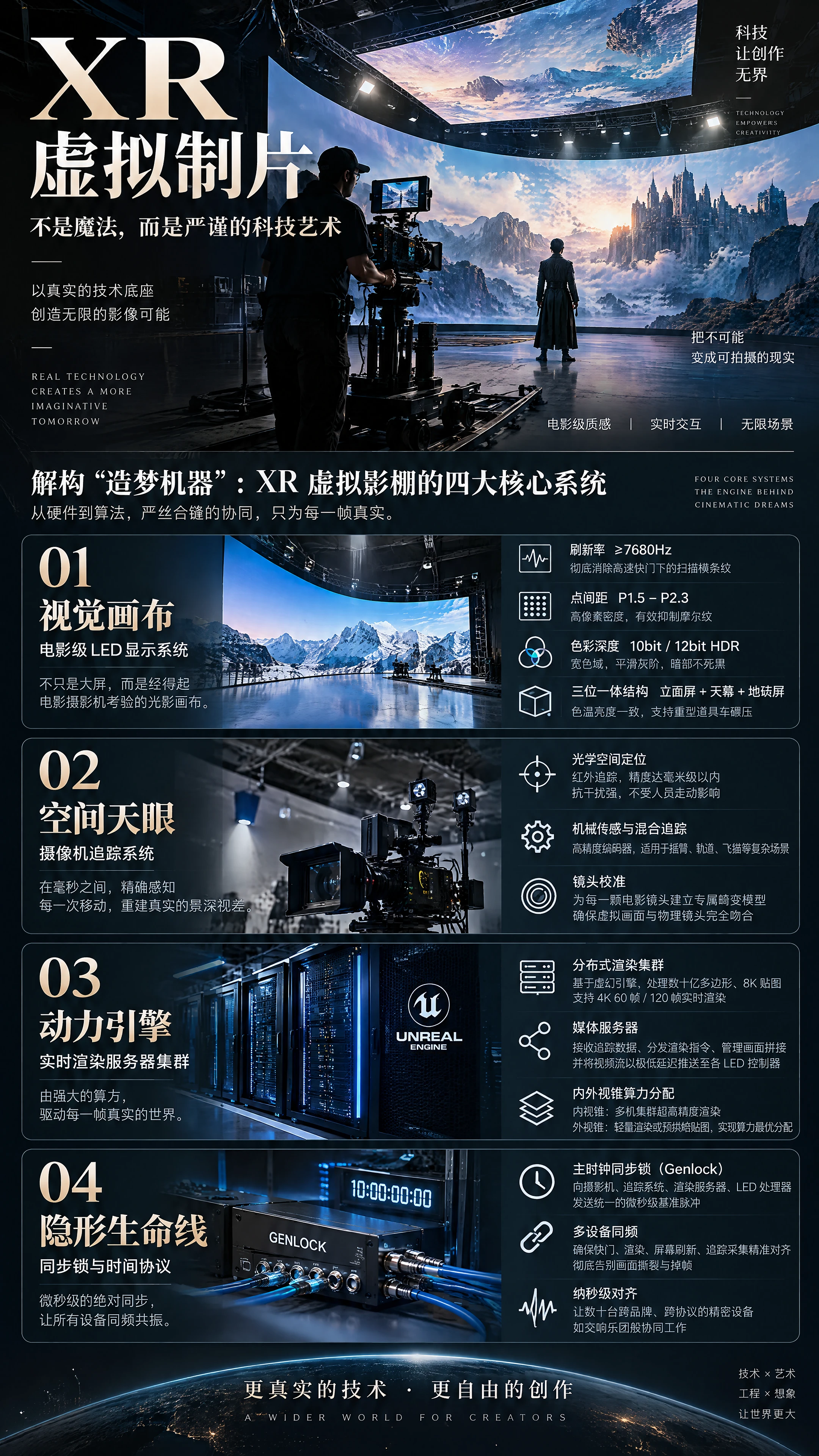
I. The Visual Canvas: Why Can't Commercial Large Screens Be Used for Film Shooting at All?
Many people's initial question is: the outdoor LED large screens in public squares look impressive too, so why can't they be used for virtual production?
The answer lies in the extreme pickiness of cinema camera sensors. The human eye has powerful persistence of vision and automatic adaptation mechanisms, but photosensitive elements record cold optical truth. A qualified cinema-grade LED system must cross four technical red lines:
- Refresh Rate and Scan Lines Kill Commercial screens typically have a refresh rate between 1920Hz and 3840Hz, which seems smooth, but under a high-speed cinema camera shutter, the image will immediately expose terrifying black scanning horizontal stripes. The driver chips of cinema-grade LED screens must achieve a refresh rate of 7680Hz or even higher to ensure that even when the camera enables high-speed continuous shooting or a shallow shutter angle, the image remains pure and flawless.
- Pixel Pitch and the Moiré Defense Line LED screens are matrices formed by tightly arranged tiny light-emitting diodes. The smaller the pixel pitch, the higher the pixel density. At present, professional studio facade screens generally use P1.5 to P2.3 fine-pitch panels paired with matte light-absorbing masks. This is not only to make the image more delicate, but also to minimize the probability of moiré patterns caused by interference between the pixel grid and the sensor grid when the camera's normal focus point shifts.
- Color Depth and Dark-Area Grayscale Performance Traditional displays are mostly 8-bit, which easily causes banding in color gradients. Film shooting requires the entire pipeline to support 10-bit or even 12-bit HDR and to have a wide color coverage range. More critically, low-grayscale performance: when simulating dark-light scenes such as late night or confined spaces, the screen must still maintain smooth grayscale transitions at extremely low brightness, without crushed blacks or flickering noise.
- Structural Layout: The Trinity of Facade Wall, Ceiling, and Floor Tiles A complete LED studio usually includes a curved facade main screen, an overhead ceiling, and floor tile screens. The ceiling is mainly responsible for simulating sky light and providing a large-area downward diffuse illumination for the actors; the floor tile screens need to have extremely high pressure resistance, slip resistance, and wear resistance, withstand the rolling of prop vehicles weighing several tons, and at the same time ensure that there is no color temperature or brightness discrepancy between the floor tiles and the facade screen.
II. The Space Eye: How Does a Camera Tracking System Achieve “Millisecond-Level Perception”?
The reason virtual scenes can produce realistic depth parallax when the camera moves depends corely on the system's perception accuracy of the camera's physical position. This requires a camera spatial tracking system.
The tracking system is equivalent to the nerve endings of the entire studio. Its core task is: within a few tenths of a millisecond, precisely calculate the camera's six degrees of freedom coordinates in space (forward/backward, left/right, up/down displacement, as well as pitch, yaw, and roll angles), and synchronously read the lens's current zoom ratio, focus distance, and optical distortion.
Currently, mainstream professional tracking solutions are mainly divided into two categories:
The first category is optical spatial positioning systems. Hundreds or even thousands of tiny reflective markers or infrared coded targets are carefully arranged on the studio ceiling, and infrared tracking cameras facing upward are installed above the camera, performing triangulation by continuously reading the geometric relationships of the reflective markers. This solution has strong anti-interference capability; cast and crew walking around will not block the top optical path, and accuracy can reach within millimeter level.
The second category is mechanical sensing and hybrid tracking. High-precision mechanical encoders installed at the rotation axes of heavy-duty jibs, tracks, or gimbals directly read mechanical rotation angles and displacement data. In large motion shots, flying-cat cableways, or complex occlusion environments, mechanical solutions can provide rock-solid physical determinism.
Collecting spatial data is only the first step. The more rigorous test is “lens calibration.” Every physical cinema lens has unique optical edge distortion and vignetting. The technical team must perform precise mathematical modeling of the lens before shooting and generate a corresponding distortion configuration table to ensure that the image generated by the virtual engine matches the distortion characteristics of the physical lens exactly; otherwise, the edges of the image will tear and float when the lens pans or tilts.
III. The Power Engine: Real-Time Rendering Server Clusters and Media Distribution Networks
If the LED screen is compared to the retina and the tracking system to the inner ear's balance nerve, then the rendering cluster is the brain center of the entire system.
Cinema-grade virtual scenes are usually built on Unreal Engine, containing high-precision models with billions of polygons, massive 8K textures, and physics-based real-time ray tracing. To render such a huge amount of computation in real time at 4K resolution and 60 frames or even 120 frames, a single workstation simply cannot bear it; distributed rendering server clusters are essential.
- The Role of the Media Server At the forefront of the rendering cluster, industry-standard media servers are usually stationed. It acts like a tireless traffic police commander, responsible for receiving camera tracking data, distributing rendering instructions to each rendering node, managing seamless splicing and slicing of huge images, and pushing the rendered video streams to each LED controller with extremely low latency.
- Distributed Compute Allocation for Inner and Outer Frustums To squeeze computing power to the extreme, the system usually adopts a layered rendering strategy: For the inner frustum area within the camera's field of view, multiple top-tier graphics workstation clusters collaborate to perform ultra-high-precision dynamic parallax rendering; For the large-area outer frustum screens outside the camera's field of view, since they are only used to provide environmental lighting and actor visual reference, lower-resolution or pre-baked lightweight texture rendering can be used. This compute offloading mechanism ensures the highest image quality output under limited hardware cost.
IV. The Invisible Lifeline: Microsecond-Level Genlock and Network Time Protocol
In the entire virtual production system, there is an invisible component that is the most inconspicuous yet will completely paralyze everything once something goes wrong: the synchronization bus.
Imagine: the camera shutter is opening and closing at a frequency of 24 times per second, the LED screen is refreshing and emitting light at several thousand hertz, the tracking cameras are capturing infrared reflections at high speed, and Unreal Engine is continuously generating new frames. If the rhythms of these devices are not perfectly aligned, even if they differ by only a few microseconds, what happens? At the instant the camera shutter opens, the LED screen happens to be refreshing and changing frames, and the image will capture a clear bright-dark black patch or image tearing.
To make dozens of precision hardware devices across brands and protocols resonate in absolute synchronization like a symphony orchestra, a black burst generator or master clock genlock must be introduced.
The synchronization generator sends a unified microsecond-level reference pulse square wave to the camera, tracking system, rendering servers, and LED processors. All devices must jump strictly in lockstep with this pulse signal: the instant the shutter opens is exactly the best timing when a new frame has just finished rendering and the LED screen is stably displaying. This nanosecond-level rigorous alignment is the only underlying guarantee for completely bidding farewell to image tearing and dropped frames.
Conclusion: The Ultimate Beauty of Integrated Engineering
When we withdraw our gaze from the gorgeous final cut and re-examine this system woven together from high-refresh photonic chips, optical infrared tracking matrices, 10-gigabit fiber switching networks, and distributed real-time graphics compute, you will find:
Virtual production is by no means merely an artist's canvas; it represents one of the highest achievements of contemporary humanity in digital imaging, real-time computing, and physical optics integration engineering.
It is precisely these cold, precise, seamlessly fitted hardware and algorithm foundations that silently absorb the constraints of wind, rain, gravity, and time in the real world, and ultimately allow directors and creators to obtain the privilege of truly freely dreaming between that play of light and shadow.

 简体中文
 English