
First, let's look at two sets of classic movie scenes that once stunned countless audiences.
Act One: On a desolate and bleak alien wasteland, a bounty hunter clad in Mandalorian iron armor walks alone against the setting sun. The dying light reflects off the metal helmet in a faint, cold shimmer. The desert gale whips up sand and dust, and the twin suns sink slowly at the far edge of the horizon.
Act Two: In the perpetual rain-soaked darkness of Gotham City, the new Batman stands beside a gargoyle atop a skyscraper. Below him lies a neon-lit, bottomless abyss of crime. Rainwater streams down his black cape, and puddles mirror the sins of the entire city.
The vast majority of viewers hold their breath before the screen, struck by this visceral audiovisual texture, even marveling at how many towering mountains and harsh extremes the crew must have trekked through to capture such awe-inspiring natural artistry.
But if someone told you today: there is no gale here, no wasteland, no high altitude—even that rain was created within a space of just a few dozen square meters; the armor-clad actor, from first day to wrap, never once stepped in real mud, and the entire crew shot the whole film in a temperature-controlled 24-degree black room sipping iced coffee.
Would you feel this is deception, or a miracle?
Welcome to the most hidden yet greatest migration of reality in the history of the film and television industry: humanity's film industry is bidding farewell to the “live-action myth” of risking flesh and blood.
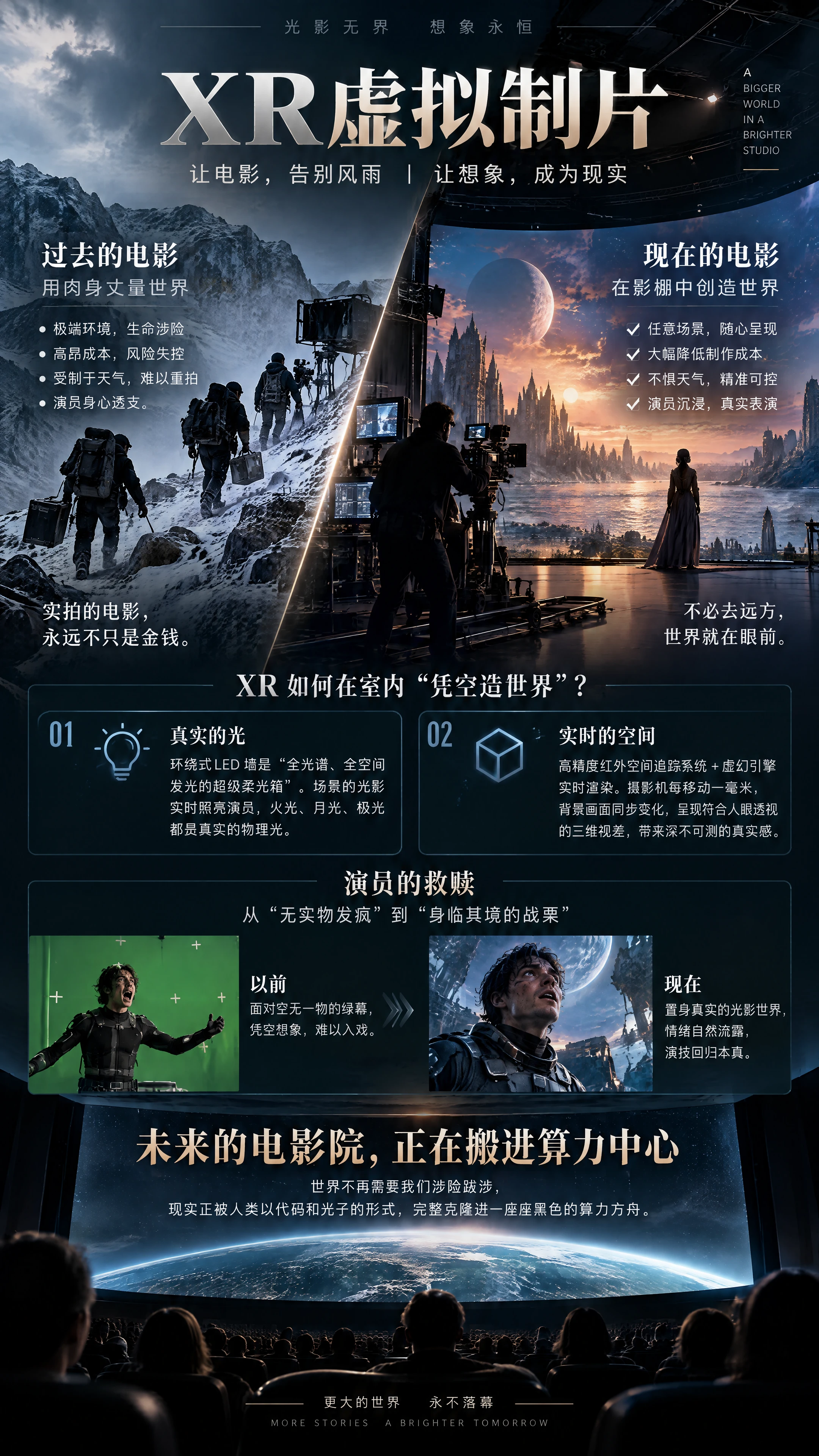
I. The End of Suffering Aesthetics: Why Are Great Directors Starting to “Betray” Real Locations?
In the long river of film and television art, “live-action shooting” was once a supreme badge of moral honor.
To capture the ultimate suffocating sense of survival in the wilderness, Leonardo DiCaprio soaked in a freezing river at minus thirty degrees and ate raw bison liver, ultimately winning the Oscar for Best Actor; to wait for a perfect sliver of sunset glow, Christopher Nolan could sit with his entire crew in the Canadian wilderness for an entire week, just to catch those fleeting minutes before the sun dips below the horizon.
This “suffering-style live-action shooting” was once revered as a totem of artistic purity. But strip away the romantic filter, and what's written on the bottom-line ledger of commercial film and television is nothing but bloody costs:
A crew of two hundred traveling overseas or to the poles spends hundreds of thousands per day just on flights, hotels, and meals the moment they open their eyes; a scene originally planned for three days hits consecutive rainstorms, and the entire team can only sit idle in the hotel while millions per day in equipment rental and crew call fees go straight down the drain; actors exhaust themselves in bitter cold and scorching heat, and their emotional performance is often drained away by harsh physical torment.
What's more terrifying is that even after paying such a devastating price, the final result still depends on the whims of the heavens.
If there were a technology that could freeze the sunset forever at 5:45 PM, make the aurora bloom overhead at any moment, make howling storms and torrential rain roar precisely on the director's command, and at the same time wipe out the transnational relocation costs of tens of thousands of tons of equipment—which clear-headed producer would still be willing to gamble the fate of an entire production in the biting wind and frost?
XR virtual production is that super bullet ending the aesthetics of suffering.
II. Top-Tier Visual Deception: How Do They “Build Worlds Out of Thin Air” Indoors?
Many people think that putting actors in a room to shoot is just like the old TV station's terribly fake “large screen backdrop” or “rough green screen”—how could that possibly fool the discerning eyes fed on Hollywood blockbusters?
This perception underestimates the visual deception jointly manufactured by contemporary photonic physics and real-time graphics engines.
The reason virtual production can fool the human brain and the sensors of top-tier cinema cameras has never been about “what image is placed on the screen,” but rather two dimensional-reduction weapons at the physical level:
Weapon One: Light Was Swapped for the Real Thing.
The biggest flaw of traditional green screen is that light is split. You hit the actor's face with warm light in the studio, but in post-production force them into a cold, gloomy snowfield background. That “floating” and “mask-like” quality between the character and the environment triggers the uncanny valley effect the moment the human eye sees it, making you feel deeply uncomfortable.
But in an XR virtual studio, the massive high-refresh LED wall surrounding the actor is essentially a set of “full-spectrum, full-spatial emissive super softboxes.” When the screen displays a doomsday ruin engulfed in raging fire, the leaping flames emitted by tens of thousands of micro-LEDs genuinely illuminate the actor's profile, leave real reflections of fire in the actor's eyes, and even precisely mirror the complete reflection of a collapsing building behind them on the curved surface of a metal dagger in the actor's hand. This interplay of light and shadow based on physical optical propagation is not computed in post-production—it is real light physically captured on set by the camera lens.
Weapon Two: The “Real-Time Parallax Space” That Deceives the Eyes.
Why is it that when you look at an ordinary large screen, you know at a glance it's flat, but when you watch footage shot in a virtual studio, you feel it's unfathomably deep? The secret lies in those pairs of “Eyes of God” on the ceiling—high-precision infrared spatial tracking systems.
For every millimeter the camera moves in the real physical world, the virtual camera in Unreal Engine synchronously shifts at sub-frame speed. When the cinematographer hoists the camera forward or pans left, the image on the background screen is not static: nearby broken ruins recede at extreme speed, distant skyscrapers undergo only tiny perspective shifts, and the extremely far moon remains almost perfectly still.
This “spatial parallax,” fully obeying the laws of human binocular motion perspective, completely shatters the perception of flatness. In the camera's viewfinder, the cold screen disappears, replaced by a three-dimensional physical universe of infinite depth.
III. The Actor's Redemption: From “Acting to Nothing” to “Trembling with Immersion”
During the twenty years that green screen ruled Hollywood, the ones who suffered most were actually the actors.
Imagine this absurd shooting scene: You're wearing a heavy futuristic mech suit, standing in a glaring, even dizzying expanse of sickly green. No reference points on any side, just a few white plastic crosses taped to the wall. The director shouts at you through a megaphone: “Attention! Thirty meters to your front-left, a ten-meter-long giant dragon is breathing lethal flames at you, its eyes full of fury! React! Scream! Draw your sword!”
Most actors facing this kind of shooting feel an inner awkwardness far exceeding the character's fear. They must, like a split personality, force themselves to hypnotize themselves in the midst of utter emptiness. This is also why many acclaimed dramatic actors in the past often delivered stiff, wooden “disaster-level performances” when taking on VFX blockbusters.
But in an XR studio, the rules of the game are completely rewritten.
When the lights suddenly dim, an annular giant screen eight meters tall and dozens of meters in diameter instantly illuminates. Storms howl in your ears, a vast planetary ring slowly rotates overhead, and starship wreckage smolders at the far horizon. Actors don't even need to summon complex techniques for acting against nothing—when they step into this结界 of interwoven light and shadow, their pupils naturally dilate from the sudden darkness, their skin pales under the shroud of cool blue light, and the shock, awe, and panic in their eyes are all genuine physiological instincts.
Technology ultimately did not erase acting skill; instead, with the most extreme immersion, it returned the soul to the actor.
IV. The Ultimate Prophecy: The Cinema of the Future Is Moving into the Computing Power Center
If we examine this transformation from a longer temporal dimension, you'll find that XR virtual production is not merely an upgrade of studio hardware—it is an ultimate leap in humanity's mode of artistic creation.
For the past two hundred years, the logic of photography and the film industry was “going out”—humans carried heavy lenses, trekked through mountains and rivers to record the world's existing landscapes, to capture nature's accidental gifts.
But today, from Unreal Engine 5“s nanite-level geometry to AI large-model one-click scene generation, to nanosecond-synchronized LED visual engineering, the logic of film and television creation has become ”bringing in"—the world no longer requires us to trek through danger; reality is being completely cloned by humans in the form of code and photons into one black computing ark after another.
For the audience, does it really still matter whether every frame of breathtaking scenery you see was scorched under the Sahara sun by a camera, or rendered in real time by tens of thousands of photonic chips in a studio hundreds of kilometers away?
When virtual light and shadow are more moving than reality, when a parameter-controlled sunset is more eternal than a real dusk, the ultimate meaning of cinema's dream-making is already achieved.
That small black room ultimately contains all of humanity's vast imagination.

 简体中文
 English