
In film and television production and commercial advertising, car scenes have always been a headache-inducing cost black hole. Traditional real-road location shoots require complex traffic control permits, low-bed trailers struggle to keep cameras stable on bumpy roads, not to mention unpredictable weather and fleeting golden-hour light. With the maturation of LED virtual production technology, in-studio car scenes have descended from being a privilege of Hollywood blockbusters to an everyday tool for small and mid-sized commercial teams. However, many teams simply place a real car in front of an LED screen and the final footage still falls apart—broken reflections on car paint, the car moves but the light doesn't, and no perspective stretching in the background during turns. This article will systematically break down the core physical logic of virtual car scenes, from background plate footage specifications, screen layout, frustum perspective correction to dynamic light streak simulation, guiding you through the entire workflow step by step.
I. Why Car Scenes Are the Most Deterministic Application Scenario for Virtual Production
If one were to pick a subject that can bring the advantages of virtual production to their fullest expression, it would absolutely be car scenes. This natural fit stems from the unique physical properties of automobiles:
First, vehicles have a high degree of enclosure and isolation. The car frame and windows form a natural physical viewfinder frame—the camera spends most of its time inside the car shooting outside, or shooting from outside through the side window into the interior. This perspective, cropped by the window frame, naturally hides a large number of scene edge seams, greatly reducing the pressure of edge keying and compositing.
Second, highly reflective curved surfaces have stringent demands for ambient light. Car paint, windshields, and chrome trim are extremely sensitive specular reflectors. Shooting a car in a green screen studio means the glass reflects a large area of green light, and the cost of removing reflections in post often exceeds the cost of the shoot itself; whereas in an LED virtual studio, the streets, buildings, and sky displayed on the screen are directly reflected on the paint and windows—this physically accurate environmental reflection is unmatched by any post-production compositing.
Third, extremely high economic efficiency and creative fault tolerance. No road closures, no traffic police escorts, no interference from rain or snow—the director can have actors rehearse the same challenging dialogue scene thirty times in a temperature-controlled studio; more importantly, time is completely frozen here—you can keep the view outside the car window at a perpetual sunset “magic hour” for a full eight hours of shooting.
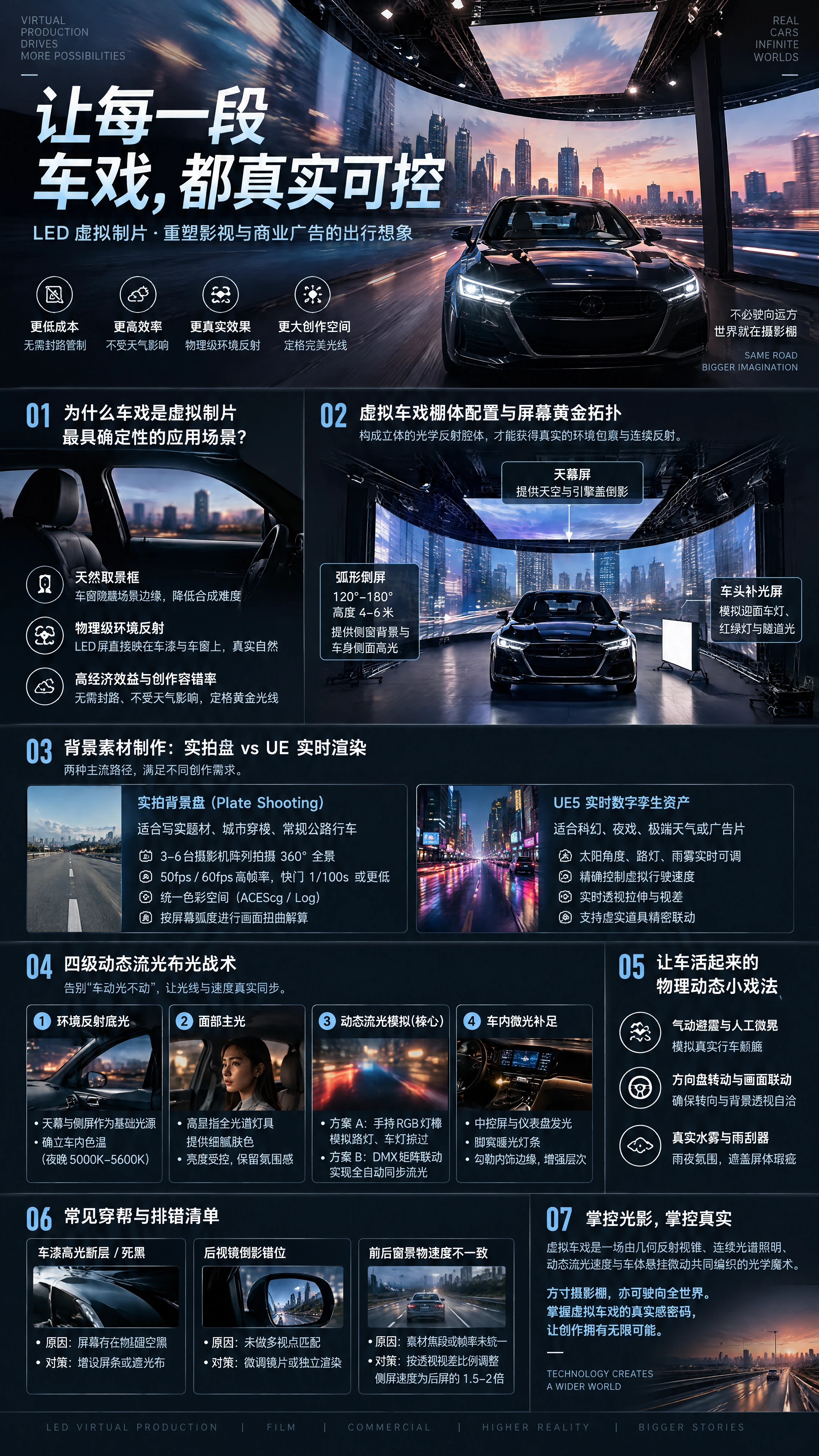
II. Virtual Car Scene Studio Configuration and Optimal Screen Topology
Many beginners think that simply placing a large screen behind the car is enough to shoot car scenes, only to end up with something that looks like a crude 1990s rear-projection setup. To achieve realistic environmental envelopment and reflection continuity, the physical layout of LED screens must form a three-dimensional optical reflection cavity.
- Side Curved Main Wrap-Around Screen (providing side window backgrounds and continuous body-side highlights) The main background screen typically uses a curved LED screen with a wrap angle of 120 to 180 degrees, with a recommended height of 4 to 6 meters. • Function: Not only serves as the shooting background for rear and side windows, but more importantly creates a smooth highlight line running from front to rear along the body sides (doors, side mirrors, body character lines). • Pitfall avoidance: The screen must maintain a safe distance of at least 1.5 to 2 meters from the vehicle body, both to leave room for camera track movement and to prevent the camera from capturing screen pixel grain beyond the shallow depth of field.
- Tilted Overhead Canopy Screen (core for roof sunroof and hood reflections) A slightly forward-tilted rectangular LED canopy screen is typically suspended directly above the vehicle. • Function: Provides sky diffuse reflection and dynamic passing highlights for the entire hood, front windshield, and panoramic sunroof. • Critical detail: Without this canopy, the hood and front windshield will directly reflect the studio ceiling's black acoustic foam, rigging, and exposed lighting fixtures, and the entire vehicle immediately loses environmental immersion.
- Front Fill Mobile Screen (frontal light for front fascia and windshield) A movable small LED screen or high-brightness soft light panel is positioned directly in front of the vehicle. • Function: Simulates the halo of oncoming headlights, traffic light indications ahead, and the frontal light impact of tunnel entrances.
III. Background Asset Production: Live-Action Plate vs. UE Real-Time Rendering Trade-offs
There are two mainstream production paths for the background rushing past the car windows, each with its own applicable scenarios:
- Multi-Camera Array Live-Action Plate Shooting Suitable for realistic genres, conventional highway driving, urban traversal, and other real geographic scenes. • Shooting plan: Use a camera array of 3 to 6 cameras, recording 360-degree road panorama footage (front, left, right, rear) synchronously in full-frame, ultra-wide angle. • Key technical specifications: Must maintain 50fps or 60fps high frame rate recording, with shutter speed strictly controlled at 1/100 second or lower to preserve natural motion blur; footage must undergo color space correction (uniformly converted to ACEScg or Log) upon returning to the studio, and image warping must be solved based on the physical curvature of the three screens in the studio to ensure that the movement speed of scenery on the side screens and rear screen matches absolutely.
- Unreal Engine 5 Real-Time Digital Twin Assets Suitable for sci-fi night scenes, cyberpunk style, extreme weather conditions, or commercials requiring precise interaction with virtual and physical props. • Core advantages: Sun angle, streetlight density, rainfall intensity, and fog density are all adjustable in real time; virtual vehicle speed can be precisely controlled through blueprints, and when the camera moves significantly, the inner frustum presents correct perspective stretching and parallax in real time.
IV. Completely Bidding Farewell to "Car Moves But Light Doesn't": Four-Tier Dynamic Light Streak Lighting Tactics
The ultimate watershed for shooting realistic car scenes lies in: when the car is moving forward, does the surrounding light sweep across the car body and actors' faces at a matching physical speed?
Tier 1: Ambient Reflection Base Light from Canopy and Side Screens Adjust the brightness of the background playing on the LED screens so that the screens themselves serve as the base ambient diffuse light source. This step establishes the approximate color temperature foundation for the interior characters (e.g., nighttime city cool light at approximately 5000K to 5600K, tree-lined roads at approximately 4500K diffuse green), and gives the windows a deep, translucent reflective quality.
Tier 2: High-CRI Full-Spectrum Fixtures for Facial Key Light The color rendering index of the screens cannot perfectly reproduce actors' skin tones, so high-CRI cinema lights filtered through softboxes must be positioned outside the car door or in front of the windshield as the facial key light. The key light is responsible for providing delicate, rosy skin detail, and its brightness must be controlled—never set too bright, which would destroy the dim atmosphere inside the car.
Tier 3: DMX Matrix and Handheld Light Tube Streak Simulation (Core Tactic) When a car drives through a city, the most conspicuous light sources are intermittently passing streetlights, the yellow low beams of oncoming cars, and the colorful neon of billboards. • Option A (low-budget tactic): Have two grips each hold an RGB full-color handheld light tube (or a focus flashlight with diffusion paper) on either side of the car front. Following the rhythm of the background video playback, quickly sweep a 45-degree angled arc of light “from front to back” across the windshield and side windows. A vivid streak of light flashes across the actors“ cheeks, nose bridges, and eyes instantly, immediately creating a strong illusion of speed. • Option B (professional-grade industrial solution): Hang a ring of strip LED pixel tubes around the roof of the car. Connect to the render host via DMX protocol, mapping the pixel brightness and color of the edge画面 in the background video directly to the overhead fixture array, achieving fully automated seamless linkage where ”a red car drives by on screen, and the physical overhead lights simultaneously flash a red streak sweeping through the interior."
Tier 4: Interior Dashboard and Ambient Light Micro-Fill Don't neglect the car's self-illuminating components. Set the center console screen and LCD instrument cluster to appropriate brightness; place miniature warm-colored light strips in the footwells to illuminate legs, and embed low-power thin flexible light strips along the edges of the center console to outline interior trim edges. This adds richly layered industrial mechanical detail to the otherwise pitch-black, rigid cabin interior.
V. Physical Dynamic Micro-Tricks That Bring the Car to Life
Beyond the movement of light, the subtle physical feedback of the vehicle body itself is another dimension by which audiences subconsciously judge authenticity:
- Air Suspension and Manual Micro-Sway Even on the smoothest asphalt, a vehicle produces micron-level body pitch during acceleration, braking, and passing over speed bumps. • Simple practical technique: Two crew members stand at the front and rear of the car in dead angles (camera blind spots), using their palms to apply extremely subtle, irregular downward pressure on the body in rhythm with normal breathing and driving bumps. • Key point: The amplitude must never be too large—excessive swaying looks like deliberate acting. Just a few millimeters of suspension compression is enough to make the light spots reflected on the body undergo a fascinating subtle distortion.
- Steering Wheel Rotation and Physical Causality with Road Footage The biggest flaw in many amateur short films is: the actor turns the steering wheel all the way left, but the background outside the window still rushes straight ahead, or moves in the opposite direction. A first assistant director or on-set control operator must be present, establishing cues with the actor through the intercom system: “Three, two, one, slight right turn into the curve!” As the actor gently turns the steering wheel, the control desk synchronously eases the background footage into a leftward rotation with perspective stretching, ensuring strict visual-physical logic consistency.
- Real Water Mist and Wiper Blade Clearing When shooting rainy night car scenes, spray hydrophobic agent and water droplets on the windshield, and turn on physical wiper blades to sweep back and forth. The light spots refracted through water droplets combined with the fan-shaped clear areas wiped by the blades can completely mask any subtle moiré patterns and insufficient resolution on the background screens, maxing out the cinematic atmosphere.
VI. Common Practical Pitfalls and Troubleshooting Checklist for Virtual Car Scenes
- Broken highlights or large dead black areas on car paint • Root cause analysis: There is a large physical gap between the side screens and the canopy screen, with no supplementary fill screens or improperly handled black masking cloth, causing the curved car paint surface to reflect the black zone where there is no screen. • Solution: Use reflective flags or add movable LED strip screens at the junction between the canopy and side screens to fill the reflection blind spots at minimal cost, maintaining continuous smooth brushed highlights on the body.
- Severe misalignment of reflections in the rearview mirror during camera panning • Root cause analysis: The rearview mirror is essentially a secondary optical reflection surface—it reflects the image of the rear screen at a specific angle. If the main camera moves but the virtual perspective reflected in the mirror is not multi-viewpoint matched, it causes a visual break. • Solution: In medium close-ups and close-ups where the rearview mirror content is not a focus, apply an extremely fine matte film to the mirror glass or slightly adjust the mirror angle to avoid the primary reflection source; if a clear rear-chase shot must be shown, allocate a separate independently rendered auxiliary frustum for the rearview mirror.
- Inconsistent apparent speed of scenery receding between front and rear windows • Root cause analysis: The focal length or playback frame rate of the side screen footage and rear screen footage have not been uniformly calibrated. Typically, side window scenery is closer to the lens with greater relative linear velocity, while rear window scenery is farther away with smaller relative angular velocity. If footage of the same speed is blindly applied to different screens, it immediately creates visual dizziness and a sense of falseness. • Solution: Strictly following the physical perspective parallax ratio, adjust the movement speed of the side screen footage to 1.5 to 2 times the movement speed of the rear window distant scenery.
VII. Conclusion
Virtual car scenes are by no means a simple physical assembly of a real car and screens, but rather an optical magic woven together by geometric reflection frustums, continuous spectrum lighting, dynamic light streak speed, and subtle vehicle suspension movement.
As the film industry continues to industrialize and deepen, small teams no longer need to envy Hollywood's hundreds-of-millions-dollar privilege of road closures for live shoots. A finely calibrated mirrorless camera, a small-scale LED curved screen, a few handheld light tubes combined with scientifically rigorous light streak rhythm—and you can speed through Tokyo's neon rainy nights and traverse California's desert sunsets within a studio of just a few dozen square meters. Master the laws of relative motion of light and shadow, and you master the password to realism in modern virtual car scenes.

 简体中文
 English