
In the entire food chain of film and television production, post-production visual effects companies have long been in an extremely awkward, even heartbreaking position.
When a project is initiated, the VFX budget is often ranked behind star salaries, practical set construction, and overseas travel; once shooting is underway, if the front-line crew goes over budget, the first thing producers slash is usually the post-production VFX contract; at wrap and handover, that famous line “It's fine, fix it in post” has not only become a fig leaf for rough on-set lighting, but also a life sentence of all-nighters for the VFX team.
What's even more fatal is the fragility of the business model. Traditional VFX companies are essentially “piece-rate subcontractors”: taking orders based on shot count, bearing long-term labor financing, and facing clients“ endless ”give me another version"—often falling into a vicious cycle of losing money on every job.
However, in the past two years, as XR virtual production has blossomed across top-tier theatrical releases, premium series, and commercial advertising, the once-lifeless VFX industry has suddenly seen an unprecedented channel for upward breakthrough.
Those VFX teams that have keenly embraced virtual production are quietly completing their identity transformation: they are no longer downstream receivers huddled in dark rooms waiting for footage, but have for the first time sat beside the director at the script draft stage, re-leading the visual direction of the entire work in the role of “full-case visual lead” or even “co-producer.”
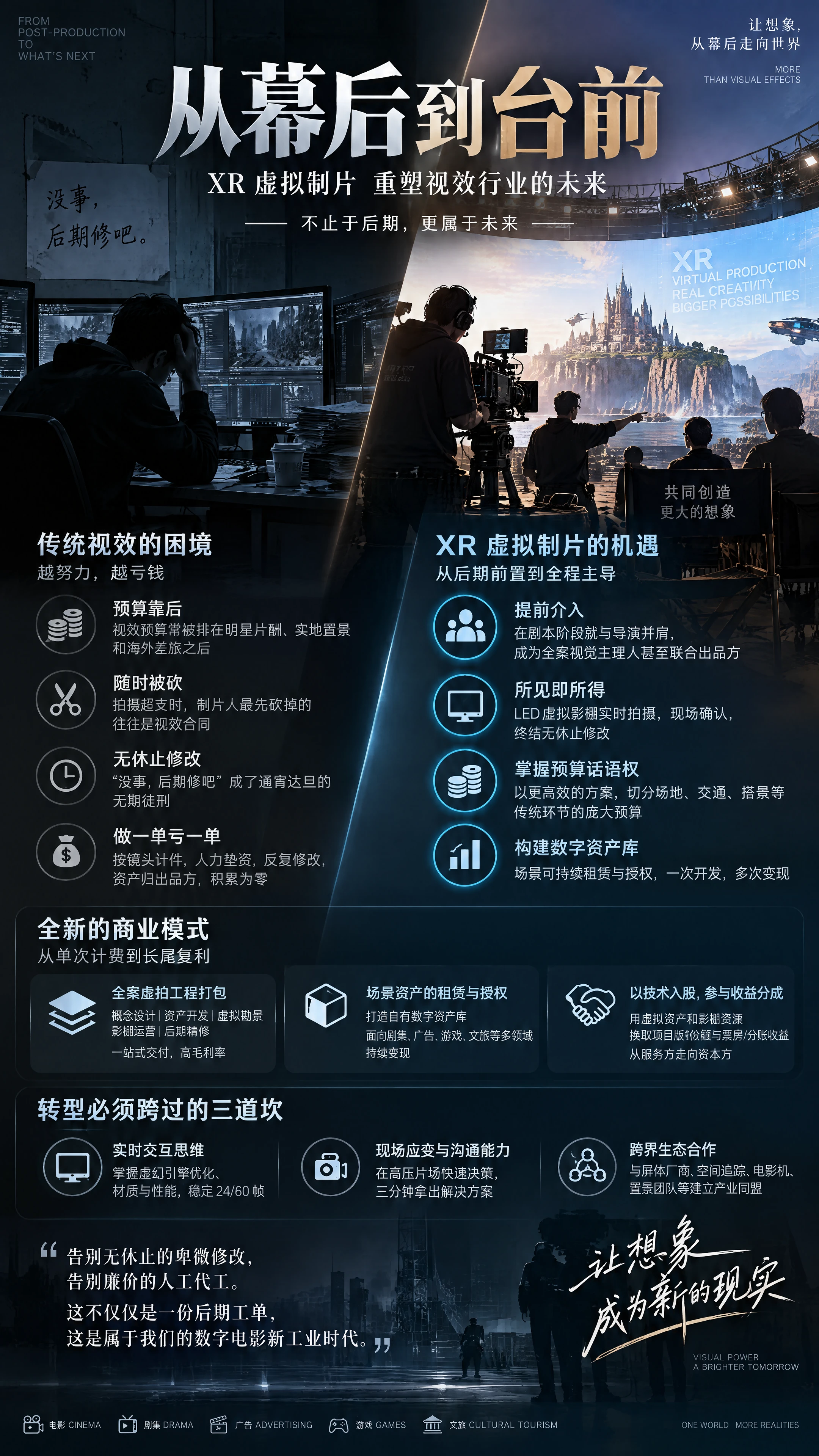
I. The Deadlock of the Traditional VFX Model: Why Do You Lose More Money the Harder You Work?
Many VFX company owners are often puzzled: why is it that the team's technical skills are getting stronger and their software proficiency is improving, yet the company's profit margin declines year after year?
The answer is not that your models don't have enough polygons, but rather the structural flaws of the traditional film and television pipeline:
First, the point of intervention is extremely late. In the traditional workflow, the VFX team only gets offline footage after the entire film has wrapped. By then the rice is already cooked: on-set lighting is a mess, green screen spill has severely contaminated hair strands, and reflective surfaces are full of crew members caught in frame. The VFX team spends seventy percent of man-hours “wiping bottoms” and “patching holes,” leaving very little time for actual artistic creation.
Second, extremely long communication and feedback delays. The director shoots with great satisfaction on set, only to exclaim months later upon seeing the VFX rough cut, “This is not the atmosphere I wanted.” By then, adjusting the camera movement trajectory or scene layout costs a complete teardown and rebuild of the entire 3D scene. This trust crisis based on imagining without physical reference ultimately translates entirely into free overtime costs for the VFX company.
Third, complete detachment of asset ownership. The snow-capped mountains, castles, or spaceships painstakingly sculpted over months—after delivering hundreds of rendered shots, the copyright goes directly to the producer. Apart from receiving payment, the VFX company accumulates nothing at the asset level, and when the next project starts, everything must be drawn from scratch.
II. Dimensional Strike into the Set: How Does XR Let VFX Teams “Usurp Power”?
The core logic of XR virtual production is post-production前置 (front-loading post). This disruptive change naturally pushes the VFX team from the very end of the industry chain directly to the center of the stage.
- From “Footage Fixer” to “On-Set Dream Weaver”
In an XR virtual studio, Unreal Engine scenes are no longer CG slowly rendered after wrap, but physical reality captured by the camera on set. This means the VFX Supervisor's status on set has undergone a qualitative leap. He is no longer a technician passively waiting for instructions, but one of the “three chariots” riding abreast with the director and cinematographer: he is responsible for controlling the ambient light falloff emitted by the on-set LED screens, supervising nanosecond-level synchronization of camera spatial tracking, and instantly adjusting the virtual sun's angle and fog density in front of the monitor. The VFX team has walked straight from the sunless dark room server farm into the core decision-making hub of the set.
- Killing “Endless Revisions” with Certainty”
Virtual production follows the principle of “what you see is what you get.” When actors stand in front of the LED wall, what the camera captures is the Final Pixel. The director watches the cinema monitor on set—if it works, it works; if not, fine-tune on the spot. Once the director calls “pass” on set, the VFX portion of that take is effectively delivered in both legal and workflow terms. The “repeated overturning and starting over” and "infinite style revisions" that plagued VFX companies for months are physically terminated the moment the shutter is pressed. Certainty not only saves artists' hair but also protects the company's profit bottom line.
- Regaining Control Over Production Budget Allocation
When a VFX company masters the full virtual production pipeline, they gain the confidence for dimensional negotiation when facing producers: “If this scene were shot on location according to your original plan, flights, hotels, and road closure permits would cost three million; if you give it to me for virtual production, two million all-inclusive, I'll shoot it in the studio in two days, and the image quality will go up another notch.” VFX companies are no longer fighting for that meager post-production editing fee, but directly carving out the massive pie that originally belonged to traditional physical segments like locations, transportation, and set construction.
III. Business Model Restructuring: From One-Off Billing to a “Digital Asset Bank”
VFX teams that have shaken off the subcontractor mindset are exploring healthier, more long-tail compound modern business models:
Model One: Full-Case VFX and Virtual Production Engineering Package. No longer selling models or compositing separately, but providing one-stop full-case services from “concept design, Unreal asset development, virtual scouting and previsualization, on-set studio operations, to lightweight post-production finishing.” What clients buy is not thousands of parts, but an ultimate result guaranteed to be delivered on time and to quality. The gross margin of this full-case delivery model is far beyond what traditional outsourcing can compare.
Model Two: “Leasing and Licensing” of Scene Assets. In the virtual production system, high-precision 3D scenes are eternal digital real estate. A Tang Dynasty palace meticulously built for a period drama, or an alien base developed for a sci-fi series, after shooting ends not only belongs to the project—the VFX team can incorporate it into the company's own digital asset library through reasonable copyright agreements. Subsequently, these assets can be licensed down-market to mid-tier short dramas, brand commercials, game teams, or even cultural tourism exhibition projects. One development cost, multiple monetization cycles—VFX companies finally have passive income of their own.
Model Three: Contributing Technology Assets as Equity, Participating in Project Revenue Sharing. For certain high-potential quality independent films or premium short dramas, VFX companies armed with full virtual production capabilities can even become co-producers in the form of “technology equity.” Using their own virtual assets and studio resources to offset part of the production costs in exchange for copyright share and box office/revenue-sharing returns. Under the protection of technical barriers, VFX teams have for the first time the possibility of rising to become capital partners.
IV. Self-Innovation of the Breakthrough Makers: Three Hurdles VFX Companies Must Cross in Transformation
Of course, moving from traditional post-production to virtual production is by no means as simple as buying a few high-performance computers and downloading a few game engines. To complete this thrilling leap, the team must undergo deep bodily reconstruction:
First, the mindset must leap from “frame thinking” to “real-time interactive thinking.” Traditional film and television post-production is accustomed to “offline rendering,” where a single detailed shot can take dozens of render farm machines a whole day. But in Unreal Engine's real-time world, the frame rate must be stable at 24 fps, 60 fps or above. The team must thoroughly master polygon count optimization, material shader efficiency, and the underlying overhead of Nanite and Lumen. Without optimization know-how, even the best model will stutter into a slideshow once it enters the studio.
Second, build on-set adaptability and set communication EQ. VFX artists in the server room are used to quietly pondering in front of a screen for days; but on a noisy, high-pressure set where money burns by the second, the VFX supervisor must possess extremely strong on-the-spot decisiveness. Facing sudden signal packet loss, camera occlusion, or the director's last-minute changes of mind, you must come up with a feasible engineering solution within three minutes.
Third, abandon going it alone and build a cross-industry ecosystem alliance. Virtual production is a stage for integrators. LED screen hardware manufacturers, spatial tracking teams, cinema camera dealers, traditional set and prop teams—VFX companies must learn to cooperate deeply with these hardware and engineering teams that originally had no overlap, and build their own industry alliance circle.
Conclusion: Reclaiming the Dignity and Value That Belongs to VFX Artists
In the century-long development of Hollywood and the global film and television industry, every violent technological upheaval has been a reshuffling of wealth and power.
When digital replaced film, Kodak's empire came crashing down and digital cinematographers rose powerfully; when non-linear editing systems replaced scissors and paste, modern editors gained unprecedented audiovisual magic.
Today, what XR virtual production is igniting is not just a revolution in the form of the studio, but a tidal wave of the era that regathers creativity, discourse power, and commercial profit toward digital artists and VFX teams.
Say goodbye to endless humble revisions, say goodbye to cheap manual labor subcontracting.
When VFX artists step out of the shadows of the server room and stand before the radiant giant screen, guiding the seamless interweaving of reality and virtuality, we can finally say with pride: This is not just a post-production work order—this is our new industrial era of digital cinema.

 简体中文
 English