
In the long river of world film history, technological revolutions have always been accompanied by the reconstruction or even alienation of creative instinct.
At the end of the last century, when digital green screen technology thoroughly conquered Hollywood and the global film industry, everyone believed that cinematic art had ushered in ultimate freedom. From that day on, any bizarre spectacle, earth-shattering storm, or grotesque alien world could be easily contained within a few lifeless fluorescent green cloths.
But few noticed the exorbitant price that film directors paid behind that revelry.
During the more than two-decade era of “green screen tyranny,” cinema's most captivating “on-set organicity” was ruthlessly dismembered: Directors stood before empty green screens, stripped of immediate perception of physical space, able only to surrender visual control to VFX compositing months later; actors gazed blankly into the verdant void on all sides, their originally fluid and continuous emotional experience fragmented into isolated convulsions without physical objects; camera movement was reverse-locked by tracks and post-production tracking—any improvisational pan, tilt, or dolly would draw complaints from the VFX team about “breaking the perspective anchor points for post.”
Cinema—an art of happenstance originally born from “the encounter of light and shadow with space”—gradually degenerated into a cold digital jigsaw engineering project.
Until XR virtual production (In-Camera VFX) broke through the soil. That massive LED dome surrounding actors and cameras not only shattered the harsh green curtains but, like a stirring Renaissance, pulled film directors from the long offline fog back onto the golden throne of the live dramatic stage.
I. Reclaiming the Sense of Space: Returning “Mise-en-Scène” to the Set
For true film directors, space has never been a container for story—space itself is the protagonist of narrative.
The renowned film theorist André Bazin emphasized the crucial importance of long takes and depth of field for the continuity of reality. But in traditional green screen shooting, directors simply could not achieve truly complex blocking and staging. Because the background did not exist at all—you could not judge on set whether an actor walking from two meters to five meters in depth of field would have shadows behind him that oppress the foreground protagonist; you could not create suspense through real physical occlusion.
In an LED virtual studio, the certainty of space returns in a breathtaking way:
First, the absolute anchoring of sightlines and horizon. When an actor stands at the center of the studio and the tens-of-meters circular screen displays the roaring angry sea at the edge of a cliff, the director can clearly see through the monitor whether the protagonist's gaze precisely cuts at the golden ratio point where the sea horizon meets the precipice. When the villain slowly enters frame from the rear side, how the shadows of the background rocks gradually encroach upon the faint light of the foreground. This real-time negotiation of geometric relationships within the frame allows directors to once again rely on optical intuition to construct oppression and lyricism.
Second, the revitalization of the long take. In the green screen era, to avoid complex reflection replacement and multi-layer compositing risks, directors were often forced to fragment shots, relying on montage to conceal the unreality of the image. But in an XR studio, thanks to the seamless meshing of the camera tracking system with the virtual engine's real-time parallax, cameras can be mounted on Steadicams or telescoping jibs to achieve a two-minute continuous take: from an actor's anguished facial close-up, smoothly pulling back to a vast desolate snowfield panorama, then panning and pushing in to bloodstained footprints on the roadside snow. The seamless perspective deformation between real and virtual fully awakens the genuine sense of time and spatial tension inherent in the long take.
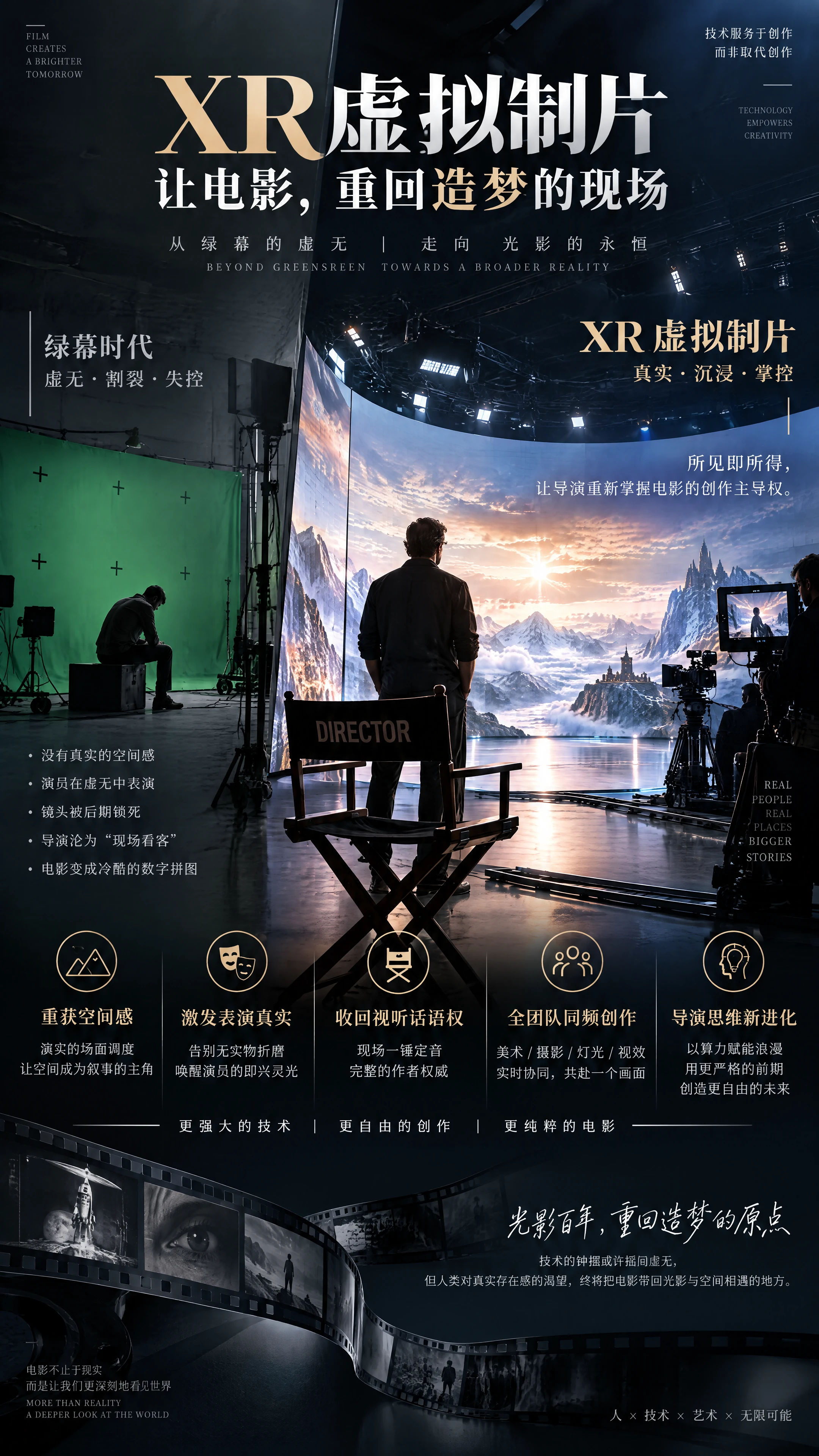
II. The Chemical Recomposition of Performance: Ending the Torture of Acting Without Objects, Activating Improvisational Spark
The birth of great performances is often not meticulous technical replication, but the actor's physiological resonance within a specific circumstance.
Before a traditional green screen, actors—regardless of fame—inevitably fall into a kind of “psychological cognitive dissociation”: they must force themselves, before retinas scorched by fluorescent green light, to believe that ahead lies a bottomless abyss and behind them a beloved's death. This process of forcibly mobilizing rational brain function to bridge sensory voids often exhausts the actor's emotional perceptivity, causing performances to remain at the level of conceptualized screaming or rigid staring.
XR virtual production's rescue of actors' performances operates at an almost physiological level:
- The instinctive takeover of pupils and nervous system. When the studio's main console suddenly illuminates the faint light before a deep winter dawn on set, the cool-toned skylight genuinely lights up the actor's forehead and bridge of nose. Extremely realistic glacier crevices and the on-set surround wind effects whistling past the ears allow the actor's organism to directly take over the performance. What reflects in his eyes is the genuinely flickering flame of the setting sun; his pupils instinctively contract as the screen's ambient light dims; his breathing naturally quickens as the apocalyptic ruins close in from all sides. These micro-expressions and micro-movements that cannot be choreographed through performance are the true screen miracles that strike the audience's soul.
- Improvisational moments belonging to director and actor. The celebrated highlights of performance in film history often come from on-set improvisational collisions sparked in the moment. Before a green screen, there is no soil for improvisation to grow, because any action beyond the pre-planned storyboard means devastating disaster in post. But in an XR studio, the environment is panoramic and alive. The director watches from behind the monitor as the actor walks to the edge of the ice cliff, then suddenly whispers through the intercom: “Don't stop, turn and look at the lightning on the horizon, slowly kneel down.” The actor responds in motion, the camera tilts and tracks accordingly, the engine operator gently pushes a slider to deepen the clouds. A god-tier shot not in the original script plan flows naturally out of two minutes of on-set breathing.
III. Reclaiming Audiovisual Authority: Directors Bid Farewell to Being “Clock-Punching Bystanders”
In the mature Hollywood system of traditional VFX pipelines, an absurdly ironic phenomenon once emerged: Many renowned directors holding hundred-million-dollar blockbusters, when shooting VFX-heavy scenes, were actually more like “on-set clock-punching outsourced workers.” Because everything in the green screen studio was controlled by the VFX supervisor and the second unit, the director only needed to direct actors to deliver lines; as for what the final image would look like, whether colors would be intense or somber, whether lighting would be sharp or hazy—all of that had to wait until after wrap, followed by lengthy tug-of-war and compromise with post-production giants like Industrial Light & Magic or Weta Digital.
The most radical cultural significance of XR virtual production lies in how it returns complete “authorial authority” to the director:
First, eliminating post-production hostage-taking—final decisions made on set. Inside the virtual studio, what you see on the monitor is the final pixel (In-Camera VFX). Whether the focal length is right, whether shadows are pressed deep enough, whether the foreground dead trees and background ridges create a dramatic echo—the director can decide with a single glance at the on-set monitor. If it doesn't feel right, brighten the background or rotate the mountain within three minutes on set; if it feels right, call it on set and that shot is permanently welded to the hard drive—no subsequent stage can tamper with the director's original aesthetic intent.
Second, the “synchronized resonance” of all departments on set. In the past, the film's creative team was fragmented: the production designer finished before shooting began, the cinematographer worked on set, the colorist worked half a year later. But on an XR virtual production set, creators from all dimensions are regathered into the same physical time-space: the director is blocking actors, the art department is fine-tuning physical fallen leaves on the ground, the lighting artist is adjusting the sun height in Unreal Engine, the cinematographer is calibrating lens aperture. Everyone faces the same real-time generated image; everyone is responsible for the same immediately presented artistic result. This passionate collective creation is a soul experience that no industrialized offline division of labor can replace.
IV. The New Evolution of Directorial Thinking: Embracing “the Romance Empowered by Computing Power”
Of course, regaining power also means heavier artistic responsibility. Virtual production is not a refuge prepared for mediocre directors; on the contrary, it is a lens that ruthlessly magnifies mediocrity and profundity alike.
When external technical obstacles are thoroughly flattened by real-time rendering supercomputers, when the ultimate ends of heaven and earth descend with a mere tap at the console, directors can no longer offload the blandness of story, the ostentation of performance, or the anemia of audiovisual expression onto “bad weather on location” or “insufficient post-production budget.”
A new generation of film directors must establish an entirely new creative mindset:
- Bid farewell to lazy arbitrariness; regain rigorous pre-production finalization. Directors accustomed to “shooting a few random takes on set and letting the editor save it in post” will be ruthlessly punished by virtual production. Because the efficiency of virtual production is built one hundred percent on weeks of absolute precision in storyboarding, virtual scouting, and art details before shooting begins. It demands that directors have already established a precise full picture of audiovisual rhythm in their minds before the first day of shooting.
- From “recording the world” to “constructing the laws.” Directors of the past searched for light and shadow in the crevices of the real world; directors of today establish the laws of the world within the physical rules of Unreal Engine. You need to understand how the sun's illuminance curve affects the degree of emotional oppression; you need to understand how the transition of depth-of-field blur guides the audience's unconscious gaze. The digitalization of technology paradoxically demands that directors hold a deeper reverence for classical optics and the essence of drama.
Conclusion: A Century of Light and Shadow, Returning to the Origin of Dream-Making
Looking back over the more than 130 years since the birth of cinematic art—from Méliès creating illusions with double exposure in a small theater, to Tarkovsky gazing at time through long takes in real wilderness; from film to digital, from physical sets to green screen keying.
Every time the pendulum of technology swings toward extreme nothingness, it is ultimately pulled back with force by humanity's longing for “a sense of real existence.”
XR virtual production is not a betrayal of traditional film aesthetics, but a grand homecoming after traversing a long and winding detour.
When green screens are finally dismantled, packed up, and sent to glass display cases in museums, becoming a helpless and compromised footnote in the evolutionary history of the film industry; when directors once again stand before the vast glowing screen, gazing affectionately at the genuinely shifting dawn and dusk before them, at the light rekindled in actors' eyes; we can finally be certain: That dream-making palace of cinema—woven from light and shadow, space, time, and human nature—has not crumbled in the wave of computing power, but has greeted its new epoch in a freer, purer, and more essential posture.

 简体中文
 English