
In the landscape of the film and television industry, traditional film and television bases were once regarded as “a business of land and space.”
Relying on a few backlot locations, several rows of standard sound stages and warehouses, base operators could easily achieve stable returns through rent. This “sublandlord”-style operating model supported the initial prosperity of China's film and television industry over the past three decades.
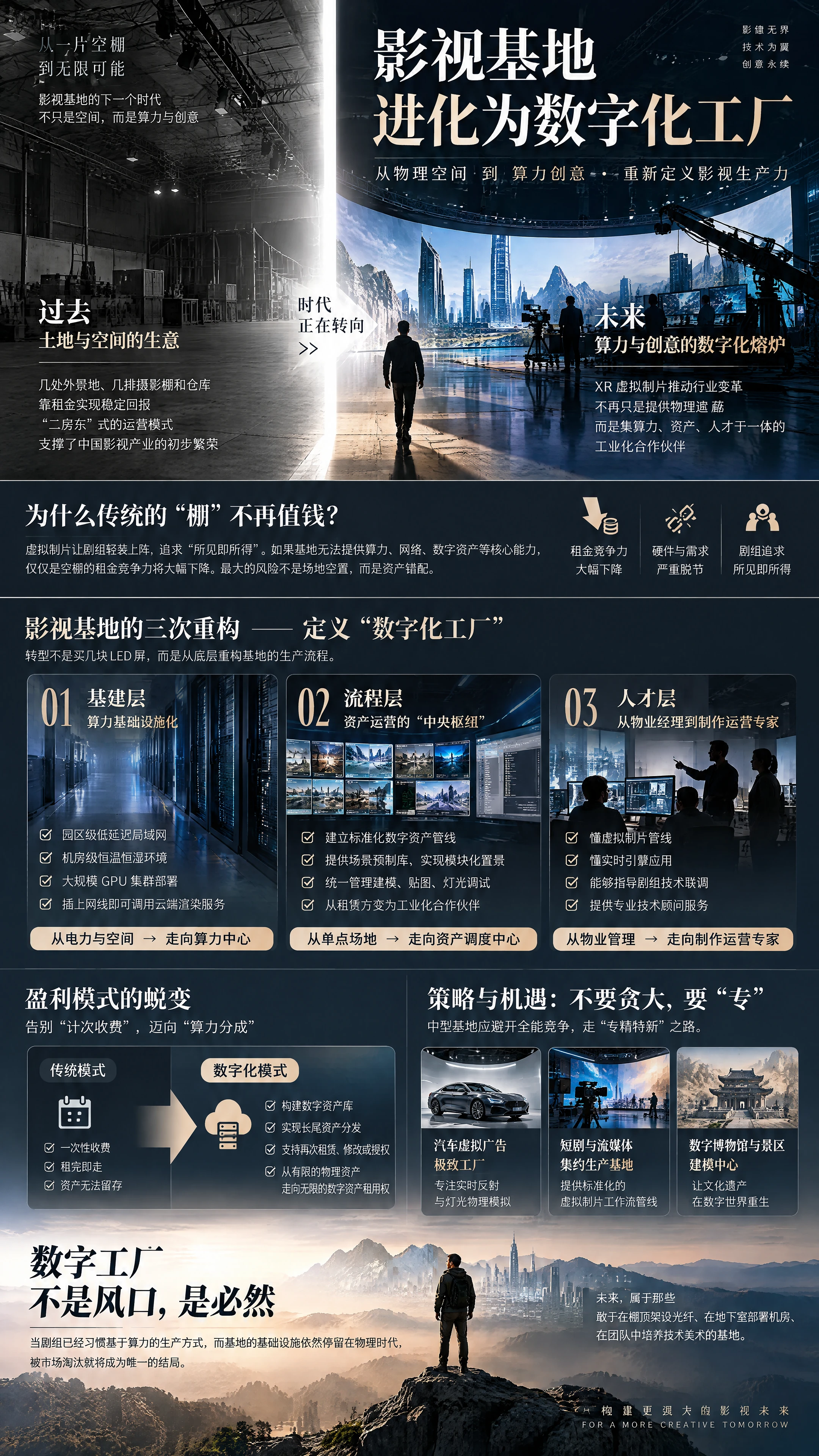
However, as the industrialization of film and television accelerates, especially with the widespread adoption of XR virtual production technology, this logic is collapsing. When filmmaking no longer relies solely on physical locations but shifts toward screens and computing power, those traditional film and television bases that merely provide “physical shelter” are losing their most core appeal to production crews.
The future of film and television bases lies in an evolution into “digital factories” that must be completed.
I. The Crisis of Spatial Excess: Why Are “Stages” No Longer Valuable?
Today's production crews increasingly favor “traveling light.”
In the past, when a crew entered a base, they needed to bring a huge set construction team, a massive lighting crew, and piles of physical equipment. What was most valuable about a base was its spatial area and geographic convenience.
But now, the introduction of virtual production has changed all of this. Directors pursue “what you see is what you get” and real-time preview effects within rendering engines. If a base still only provides empty stage space without being able to offer stable network bandwidth, cluster rendering environments, high-precision camera tracking technology, and deep digital asset libraries, then the rental competitiveness of that stage will decline exponentially.
For base operators, the greatest risk is not vacant space, but “asset mismatch”—our hardware has become disconnected from the needs of production crews.
II. Defining the “Digital Factory”: Three Reconstructions of Film and Television Bases
Transformation is not about buying a few LED screens, but about reconstructing the base's production processes from the ground up. Film and television bases need to complete three layers of reconstruction:
- Infrastructure Layer: Computing Power as Infrastructure The film and television bases of the future should be regarded as “computing power centers.” This is not just about upgrading power capacity, but more importantly about park-level low-latency local area networks, machine-room-level constant temperature and humidity environments, and GPU cluster deployment capable of supporting large-scale real-time asset loading. If a production crew can come here, plug in a network cable, and access the park's cloud-based high-efficiency rendering services, the service premium will be far higher than the profit from merely renting out empty stages.
- Process Layer: The “Central Hub” of Asset Operations A traditional base is just a point. The base of the future should be an “asset scheduling center” within the industrial chain. Bases should establish a standardized “digital asset pipeline” to help production crews uniformly manage everything from modeling and texturing to lighting adjustment for scenes. Bases can provide prefabricated libraries of digital scenes, enabling production crews to achieve “modular set construction.” This asset operation model transforms the base from a “lessor” into an “industrialization partner” for production crews.
- Talent Layer: From Property Managers to Production Operations Experts The base's operations team can no longer be merely property management personnel who “manage utilities and clear trash.” What we need are “production operations experts” who understand virtual production pipelines, know how to apply real-time engines, and can guide production crews in technical integration and debugging. When the base can provide technical consulting services to production crews, the boundary of cooperation between the two parties shifts from “paid leasing” to “co-production.”
III. The Transformation of Profit Models: Farewell to “Per-Use Charging,” Toward “Computing Power Revenue Sharing”
When a film and television base transforms into a digital factory, its profit model will also undergo profound changes.
The traditional profit model is one-off: rent and leave. But under the digital operations model, bases have the ability to “retain” assets.
Through virtual scenes customized for production crews, bases can build their own “digital heritage libraries.” These assets can later be rented, modified, or licensed to subsequent production crews. This means bases are beginning to shift from “one-time charging” to “long-tail asset distribution,” transforming limited physical assets through digital means into unlimited digital asset rental rights.
IV. Strategies and Opportunities: Don't Be Greedy for Scale—Be “Specialized”
Not all film and television bases need to become “Hengdian.” For the vast majority of medium-sized bases, the path of transformation should avoid all-around competition and turn toward being “specialized, refined, distinctive, and innovative”:
—Some bases can become ultimate factories for “automotive virtual advertising,” focusing on real-time reflections and physical lighting simulation; —Some bases can become intensive production bases for “short dramas and streaming media,” providing standardized virtual production workflow pipelines; —Some bases can become modeling centers for “digital museums and scenic areas.”
Conclusion: The Digital Factory Is Not a Trend—It Is an Inevitability
Digital transformation is not about chasing fashion, but about responding to the diminishing marginal returns caused by the depreciation of physical assets.
For film and television bases, the window period for transformation is not long. When production crews have already become accustomed to computing-power-based production methods while the base's infrastructure remains in the physical era, then being eliminated by the market will become the only outcome.
The future belongs to those bases that dare to install optical fiber on stage roofs, deploy machine rooms in basements, and cultivate technical artists within their teams. The film and television bases of the future will no longer be gathering places for actors, but “digital melting pots” of computing power and creativity.

 简体中文
 English