
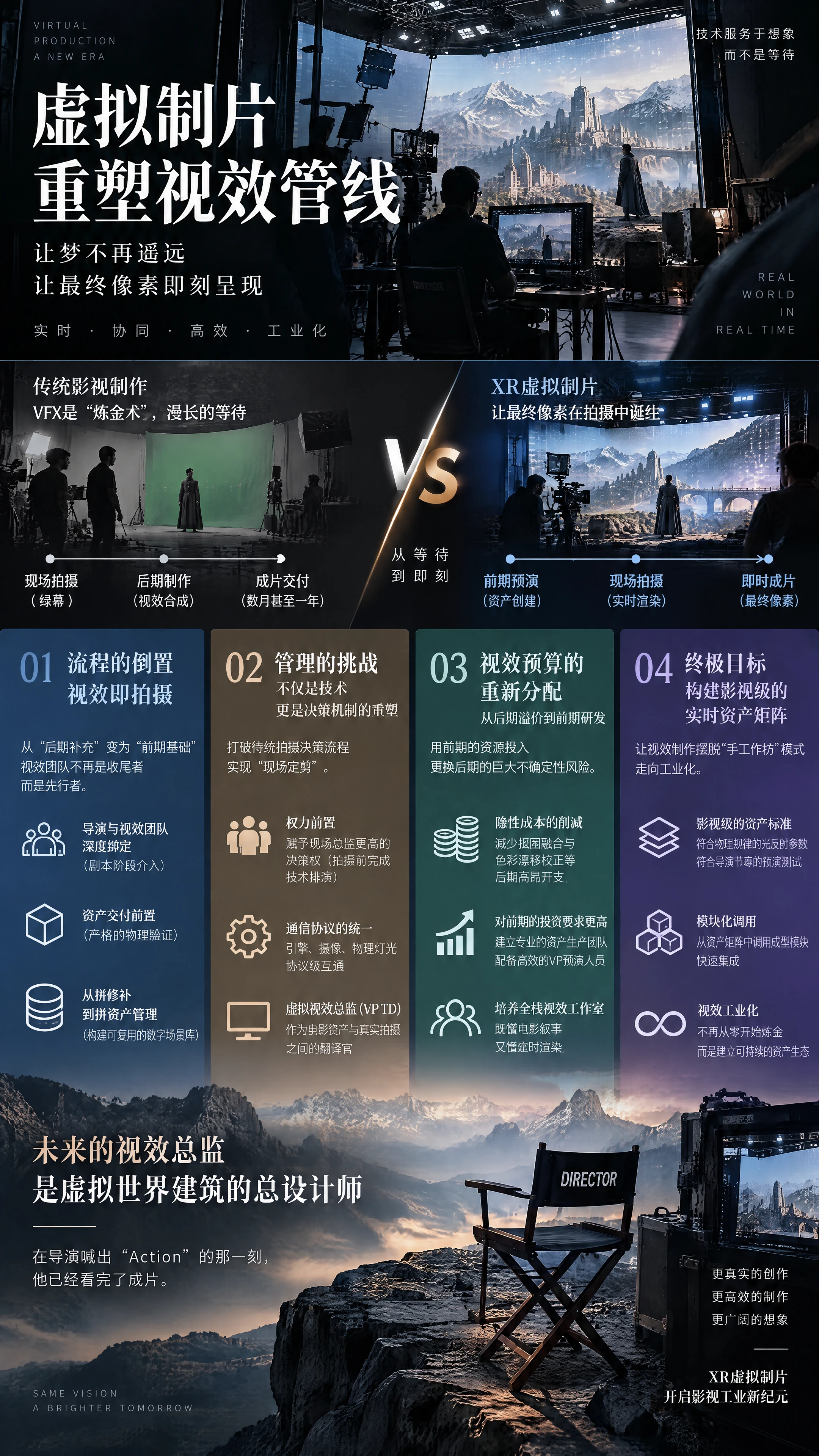
In traditional film and television production, visual effects (VFX) are often regarded as a kind of “alchemy.”
On set, the director stares at a green screen imagining the final image, the cinematographer struggles to match future lighting, and the VFX team waits painfully in post for footage. By the time the final picture takes shape, months or even a year have often passed. This is the typical logic of “delayed production”: we shoot footage on set and create the image in post.
XR virtual production, however, is brutally and efficiently putting an end to this long wait.
It forcibly pulls the VFX output timeline from “after the shoot” back into “during the shoot.” When the “Final Pixel” becomes the direct delivery standard on set, the VFX management pipeline must be thoroughly restructured.
I. Inversion of the Workflow: VFX Is Shooting
The biggest change brought by virtual production is that VFX work shifts from “post-production supplementation” to “pre-production foundation.”
In the traditional pipeline, the VFX team is the project's “finisher,” responsible for patching up the shortcomings of on-set footage; in the virtual production pipeline, the VFX team is the project's “pioneer,” responsible for building the world before shooting begins.
This inversion of the workflow requires us to completely change how we manage the VFX team:
- Asset Delivery Upfront: Deep Binding Between Director and VFX Team In traditional VFX, the director might not discuss the image in depth with the VFX supervisor until the rough cut is complete. But in virtual production, if the 3D scene is not properly calibrated before shooting, the LED screen is just a rigid backdrop. This means the VFX team must enter the project at the script planning stage and participate deeply in the creation of digital assets, ensuring that the color and spatial perspective of every tree and every light have been rigorously physically validated in the engine.
- From “Patching” to “Asset Management” Virtual production does not require the VFX team to desperately do “rotoscoping, green screen removal, and lighting integration,” because these tasks have already been completed on set through engine rendering. The core task of the VFX team shifts from “footage patching” to “asset operations.” They need to build a reusable, scalable digital scene library that conforms to engine standards, not only meeting the requirements of this shot but also ensuring the extensibility and consistency of the scene in future shots.
II. Management Challenges: Not Just Technology, but a Reshaping of Decision-Making Mechanisms
The core difficulty of restructuring the VFX pipeline for virtual production lies not in the technical threshold, but in the rigidity of management processes.
To achieve “final cut on set,” we need to break the traditional shooting decision-making process:
- Power Upfront: Rigidifying On-Set Decisions Traditional shooting allows for secondary creation of the image in post, and even major plot changes through VFX in the editing room. But on a virtual production set, once assets are imported into the engine, it means the lighting, composition, and VFX assets of this scene are already “locked.” This requires the project to complete a highly precise “Technical Pre-viz” before shooting. If a scene logic problem is discovered on set, the cost of rework is far higher than post-production modification. Therefore, the virtual production pipeline must grant higher decision-making authority to the on-set supervisor, and even require the project to produce a “refined previs” before shooting.
- Unified Communication Protocols: The Dialogue Between Engine, Camera, and Physical Light The virtual production set is an intersection of multi-dimensional information. Data from the real-time rendering engine (UE5) must achieve protocol-level interoperability with the camera's physical parameters (aperture, focal length, shutter) and the on-set physical lighting system. Traditional VFX teams often do not understand camera sensor parameters, and lighting artists do not understand material reflection algorithms in the engine. Future VFX teams must be equipped with a “Virtual Production TD” (VP TD) to serve as the translator between engine assets and real shooting.
III. Reallocation of VFX Budget: From Post-Production Premium to Pre-Production R&D
Many people question whether virtual production is expensive. From a unit price perspective, the rental of a virtual production stage is indeed higher than that of a traditional stage; but from the perspective of the VFX pipeline, we are using “upfront resource investment” to exchange for “the enormous uncertainty risk of post-production.”
- Reduction of Hidden Costs Let's do the math: because complex virtual-physical matching is no longer needed in post, the expensive “rotoscoping and integration” and “color drift correction” expenses of VFX companies in post-production can theoretically be reduced.
- Higher Investment Requirements for Pre-Production Migrating this portion of the budget to pre-production means we need to build a more professional asset production team and equip more efficient VP previs personnel. This is not just the flow of money, but the flow of talent capabilities. We need to transform from teams that only do post-production packaging into “full-stack VFX studios” that understand both cinematic storytelling and real-time rendering.
IV. The Ultimate Goal: Building a “Cinematic-Grade Real-Time Asset Matrix”
Virtual production is not just for making films; it is also for freeing VFX production at film and television bases from the “handicraft workshop” model.
Our goal is to build a “cinematic-grade real-time asset matrix”: every digital model carries light reflection parameters that conform to physical laws, and every animation segment has been previs-tested to match the director's rhythm. When a project launches, we no longer start alchemy from zero, but call upon finished modules from the asset matrix for integration.
That is the endpoint of VFX industrialization.
The future VFX supervisor is no longer a post-production overseer, but the chief architect of the virtual world. They stand on set, directing the rendering of digital assets and the flow of light through real-time monitors, and at the moment the director calls “Action,” they have already seen the final film.
This is the meaning of virtual production reshaping the VFX pipeline: making dreams no longer distant, and letting the final pixel appear instantly.

 简体中文
 English