
If you've been in high-end virtual production (VP) or real-time compositing long enough, you're bound to encounter a “deadlock” that drives countless compositors and TDs crazy.
When the director looks at the monitor and frowns, saying, “Why are the edges of the actor's hair so rough? And why is there trailing on the background when he moves?”
At that moment, you take a deep breath, facing an unsolvabletechnical paradox: In Unreal Engine (UE5), to ensure that high-precision virtual scenes (especially Nanite geometry and fine textures) don't flicker or show aliasing, youmustenable Temporal Anti-Aliasing (TAA or TSR). The principle of TAA is to use motion vectors to “blend” the current frame with historical data (History Buffers) from the past few frames.
However, when your scene includes a real, live-moving actor (integrated via green screen keying or AR), disaster strikes:
- “Ghosting”: TAA, while blending the engine's background frames, has no idea there's a real person moving in the foreground. When the actor waves quickly, the TAA history frames of the engine background continue to blindly blend, causing a semi-transparent delayed afterimage (commonly known as “ghosting”) around the actor's arm.
- “Massacre” of Sub-Pixel Details: The most valuable aspects of advanced keying are those semi-transparent individual strands of hair, glass edges, and contact shadows. These details occupy only a fraction of a pixel (sub-pixel). When they enter the engine pipeline “softened by TAA blending,” these fragile Alpha information are instantly destroyed by TAA's blending algorithm, turning hair into a blurry mess and glass into a dirty smudge.
In the native UE5 pipeline, you either turn off TAA and endure full-screen aliasing flickering, or keep TAA on and suffer from ghosting and loss of keying details. It's a deadlock.
Faced with this underlying rendering conflict that plagues the industry,Aximmetrythe solution provided demonstrates its profound expertise as a top-tier real-time compositing hub:Isolating the Alpha operation pipeline and establishing an independent channel “immune to TAA contamination” at the compositing endpoint.
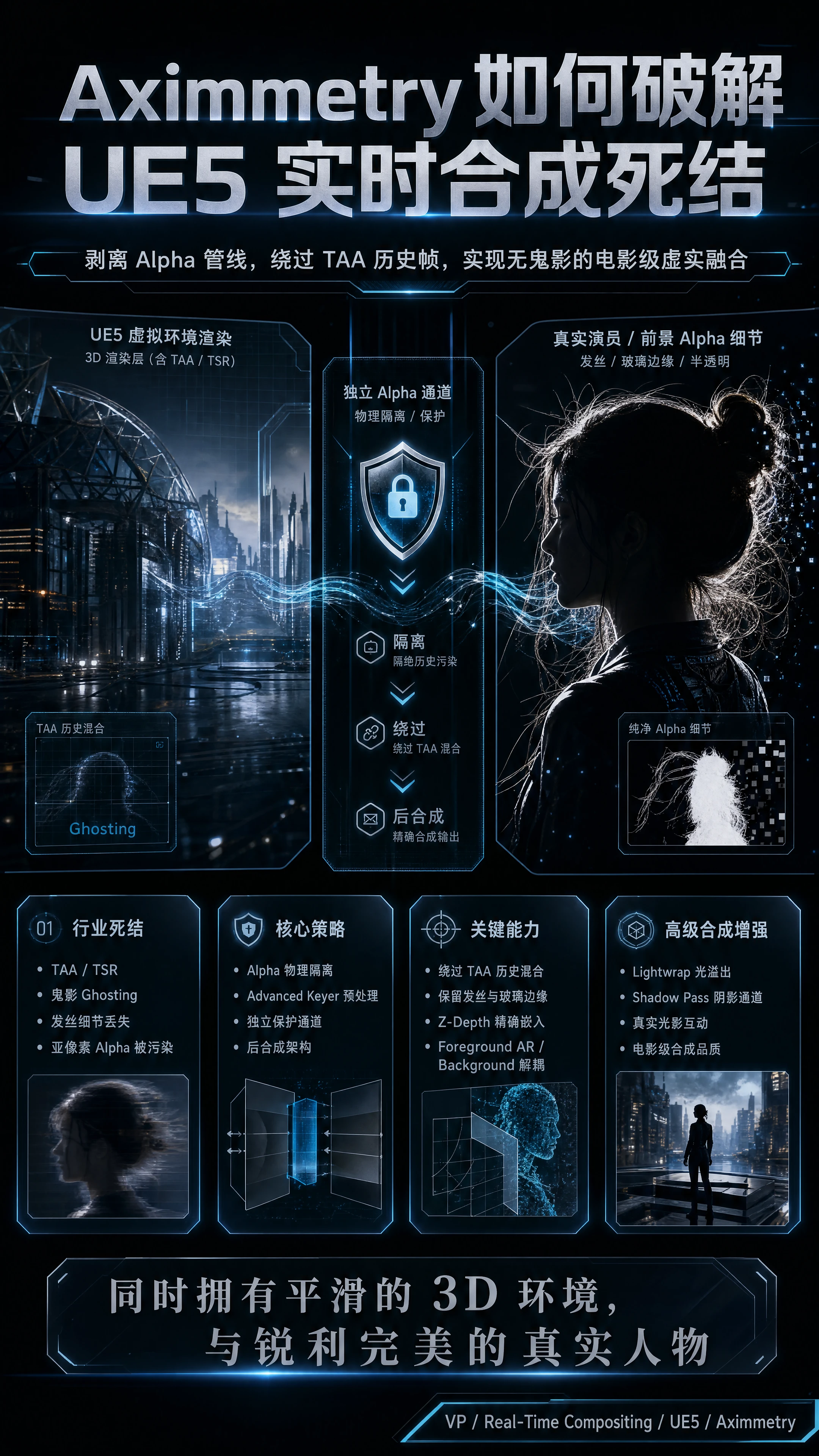
Core Solution One: “Physical Isolation” and Preprocessing of the Alpha Channel
The core idea behind Aximmetry's solution to this paradox is: “Don't throw clean real elements into the engine's anti-aliasing pot to cook.”
It achieves physical-level pipeline isolation between keying operations and engine rendering.
- When the camera's green screen signal enters Aximmetry, its built-inAdvanced Keyercompletes the highest-precision Alpha channel extraction on the GPU before entering the engine.
- This Keyer's algorithm is completely independent and real-time, without the burden of historical frame blending, allowing it to extract those sub-pixel hair strands and semi-transparent channels with extreme sharpness and precision.
- Crucially, when Aximmetry sends the video stream into UE5 as a Foreground or calls it in materials, it applies special “marking and protection” to this Alpha data, preventing it from being erroneously blurred by the engine's global anti-aliasing algorithm.
Core Solution Two: Bypassing TAA History Frames with “Post-Composite Architecture”
To completely solve the “ghosting” issue, Aximmetry leverages its uniqueDE (Dual-Engine) architecture, implementing an exceptionally cleverPost-Composite Workflow。
In traditional approaches, many people like to place the keyed-out character as a Plane directly into the UE5 scene for rendering. This absolutely triggers the TAA ghosting paradox.
Aximmetry completely abandons this practice.
- It lets UE5onlyrender the clean background (Background) without the foreground character and the occluding objects in front of the character (Foreground AR). UE5 can confidently crank TAA/TSR to the maximum, fully enjoying a smooth, aliasing-free virtual environment.
- Meanwhile, Aximmetry, through its own Flow Graph, extracts the perfectly rendered background and foreground occluders from the engine (with perfect Z-Depth information).
- Finally, inAximmetry's own extremely clean, TAA-free 2D compositing module, the previously keyed-out real character, full of sub-pixel details, is precisely “embedded” between the virtual and real images according to the depth information.
In this process, the real character's movement does not participate in UE5's TAA calculation at all,“and the physical conditions for ”ghosting" are completely eliminated.
Core Solution Three: Independent Transfer of Dynamic Shadows (Lightwrap & Shadow Pass)
While isolation solves ghosting, without special treatment, the character loses light interaction with the environment, appearing like a “sticker.”
Aximmetry's Flow Graph nodes provide extremely advanced split compositing capabilities:
- Lightwrap: Aximmetry can extract the highlight colors from the UE5-rendered background and precisely “wrap” them around the edges of the real character at the compositing end, especially in the gaps of hair strands, reconstructing the physical texture of light diffusion.
- Independent Shadow Pass: Aximmetry allows the real character to cast only a pure shadow channel (Cast Shadow Only) in UE5, without the character itself participating in the engine's direct rendering. This calculated shadow channel is then sent back to Aximmetry's compositing module for overlay.
This preserves the engine's realistic ray-traced shadows while protecting the absolute purity of the real character's pixels.
Conclusion: A “Dimensional Reduction” of Compositing Logic”
In the field of real-time compositing, many pain points often arise from “over-reliance on the omnipotence of 3D engines.”
Unreal Engine is unmatched in handling 3D ray tracing and geometry, but when it comes to precise 2D pixel compositing (such as Alpha blending and anti-ghosting), its native underlying algorithms are not always the optimal solution.
Aximmetry deeply understands the fundamental contradictions between these rendering characteristics. It doesn't compete with the engine for 3D rendering power but, with a high-level perspective, achieves a perfectpipeline decoupling。
between “3D environment rendering” and “2D precision compositing.” In the chaotic quagmire of TAA, it carves out a pure, flawless high-speed channel for those extremely fragile sub-pixel hair strands and contact shadows. This is not just a technical breakthrough but Aximmetry's ultimate proof of its uncompromising commitment to "cinematic compositing quality." It finally allows frontline technical teams to simultaneously enjoy a smooth 3D environment and sharp, perfect real characters, truly crossing the "uncanny valley" of real-time compositing.

 简体中文
简体中文  English