
In the technical command center of an S-level television broadcast (such as the Super Bowl or Election Night), the ultimate measure of a real-time graphics system is not how many polygons it can render, but its“Uptime Survival Rate”。
As a broadcast truck Engineer-in-Charge (EIC), when you look at the monitor and see an incredibly realistic AR dragon generated by Unreal Engine (UE5), your palms start to sweat. Because you know full well that UE5 is essentially a monolithic architecture software designed for gaming. It is extremely large, consumes massive amounts of VRAM, and is highly sensitive to memory fluctuations. Once a material experiences a memory leak, or an API call passes an abnormal string that causes a thread deadlock, the rendering engine will instantly crash, throwing a cold “Fatal Error” window in your face. In a live broadcast watched by hundreds of millions, this means a black screen disaster lasting tens of seconds, enough to end a technical team's career.
If you try to manually set up two UE5 instances for primary-backup switching in the native pipeline, you'll find it futile: the animation states, particle random seeds, and physics simulations of two independently running engines are completely impossible to align. When you switch from the “dead” primary to the backup, the audience will see the dragon that was in the air instantly teleport to the ground.
Faced with this systemic survival anxiety,AximmetryAximmetry offers not an optimization of image quality, but an extremely ruthless side of an industrial-grade master controller:A deeply embedded “Active-Active State Sync and Hot-Swap Redundancy Pipeline” at the underlying architecture level.
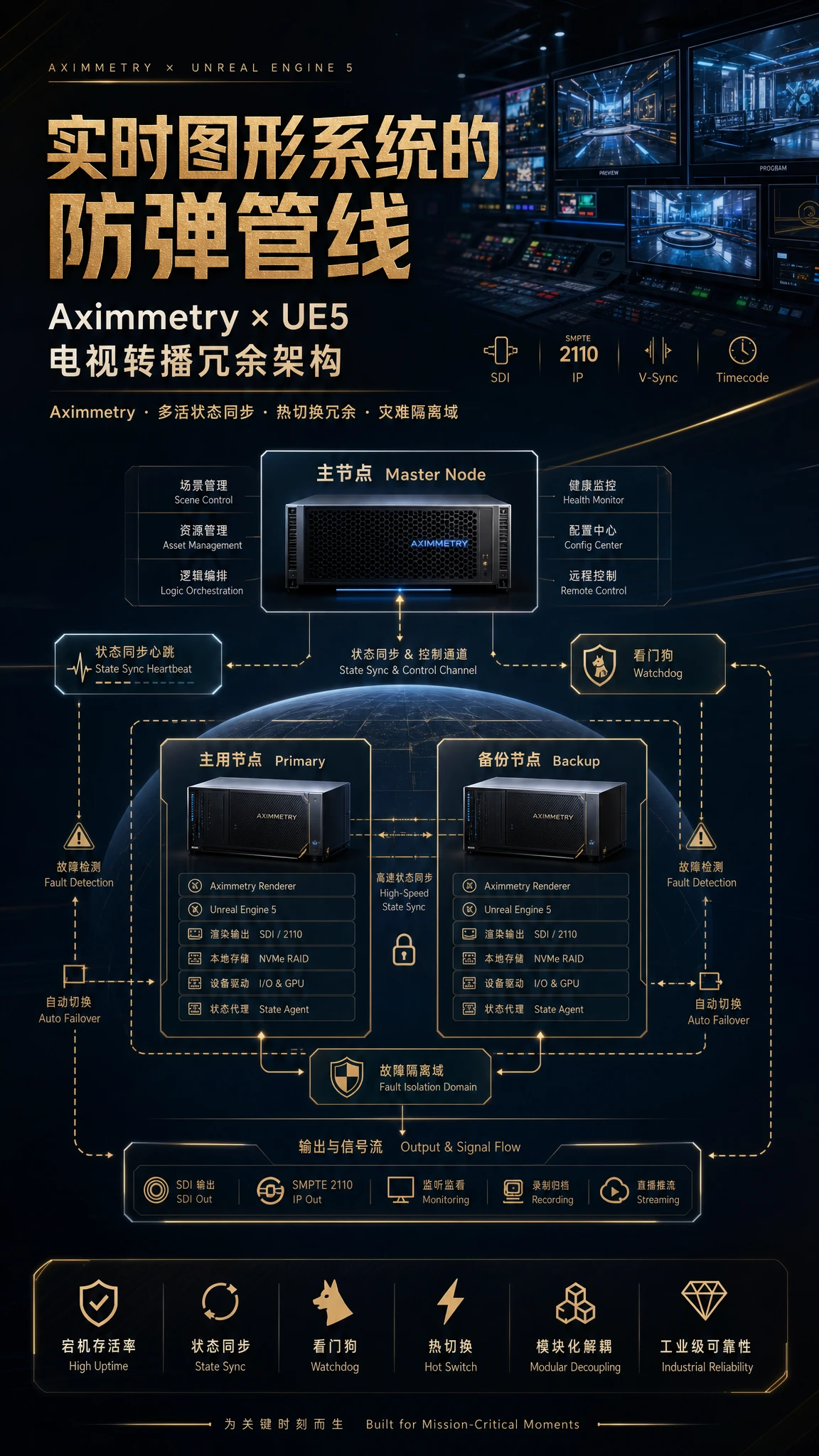
First Layer of Armor: The Hegemonic Control of the State-Sync Engine
To achieve “seamless switching,” the primary and backup machines must maintain absolute consistency as time progresses.
Aximmetry abandons the loose architecture where two UE5 instances “fight their own battles.” Through its own Flow Graph, it establishes an extremely dominant“State-Sync Engine”。
- Absolute Clock and Data Distribution: All external inputs (camera tracking data, key trigger signals, network API data) never directly enter the rendering nodes. They first enter Aximmetry's “Master Node.” The Master node stamps each piece of data with a strict frame timecode, then distributes it uniformly and synchronously to both the Primary rendering host and the Backup rendering host, like distributing ammunition.
- Forced Physics Reset and State Alignment: During operation, if there is a physically simulated falling box in the AR scene, the trajectories calculated by the primary and backup machines may have tiny errors. Aximmetry's node logic can capture the Transform state of the primary host at an extremely high frequency and forcibly overwrite it onto the backup engine. This means that although the backup is rendering silently in the background, every animation frame and every lighting calculation is firmly pinned by Aximmetry to the exact same state line as the primary.
Second Layer of Armor: Nanosecond-Level “Watchdog” and Frame-Level Seamless Arbitration
If the Primary crashes, who detects it? Who performs the switch? How is it done?
In traditional broadcast chains, an external video switcher is often relied upon, but the switcher cannot predict an internal engine deadlock. By the time it detects a frozen frame and switches, the audience has already noticed.
Aximmetry embeds an extremely sensitive“Software Watchdog Timer”:
- into its underlying I/O pipeline. Internal Heartbeat Detection:
- Aximmetry doesn't just monitor the presence of a video signal; it deeply monitors the heartbeat of UE5's Render Thread. If the primary host's frame time suddenly spikes above a threshold, or if it stops submitting frames to VRAM due to a crash, the watchdog triggers an alarm within one millisecond. Master Control Takes Over Switching:
In extremely high-end deployment architectures, Aximmetry can route the video output streams (SDI or 2110) of both the Primary and Backup directly into its own Master node (or a matrix it controls). The moment the watchdog detects the primary's death, Aximmetry, before the next V-Sync arrives, ruthlessly and smoothly redirects the output route to the backup, which has been rendering in perfect synchronization. For the audience watching the screen, the moment the primary explodes, there is no black screen, not even a single frame of stutter or animation jump.
Third Layer of Armor: Modular Decoupling and Fault Isolation Domain
The most terrifying disaster is often a chain collapse triggered by "toxic data." For example, a score API containing malicious code, if fed to both primary and backup machines simultaneously, could cause both to crash at the same time.To guard against this worst-case scenario, Aximmetry achieves extremely thorough。
- Modular Decoupling in its pipeline design.
- Separation of Business Logic and Rendering Logic:
- Aximmetry allows you to run the "Data Parsing/API Fetch" business, which is most prone to crashes, on a separate, lightweight Control Node.
Only data that has been parsed, cleaned, and strictly formatted into safe floating-point numbers is sent to the two expensive graphics rendering workstations.
Even if the API data interface suddenly crashes or receives garbled data, only that Control Node dies. The rendering primary host is completely unaffected; it continues to run smoothly with the last frame's image until the data node restarts and recovers.“
This “Fault Isolation Domain” design places the rendering engine, a highly precise yet fragile sports car, in an absolutely dust-free, safe vacuum.
Conclusion: Rejecting Luck with a "Bulletproof Pipeline"At the pinnacle of the real-time audiovisual industry, "Murphy's Law" (anything that can go wrong will go wrong) is the Sword of Damocles hanging over every technical director.
Faced with complex engine code, fragile hardware, and unpredictable live broadcast emergencies, native graphics pipelines can only pray for good luck. Aximmetry, however, deeply understands the underlying logic of the television broadcast industry:
Reliability always comes before image quality. Image quality determines your score, but reliability determines whether you can even play the game.

 简体中文
简体中文  English