
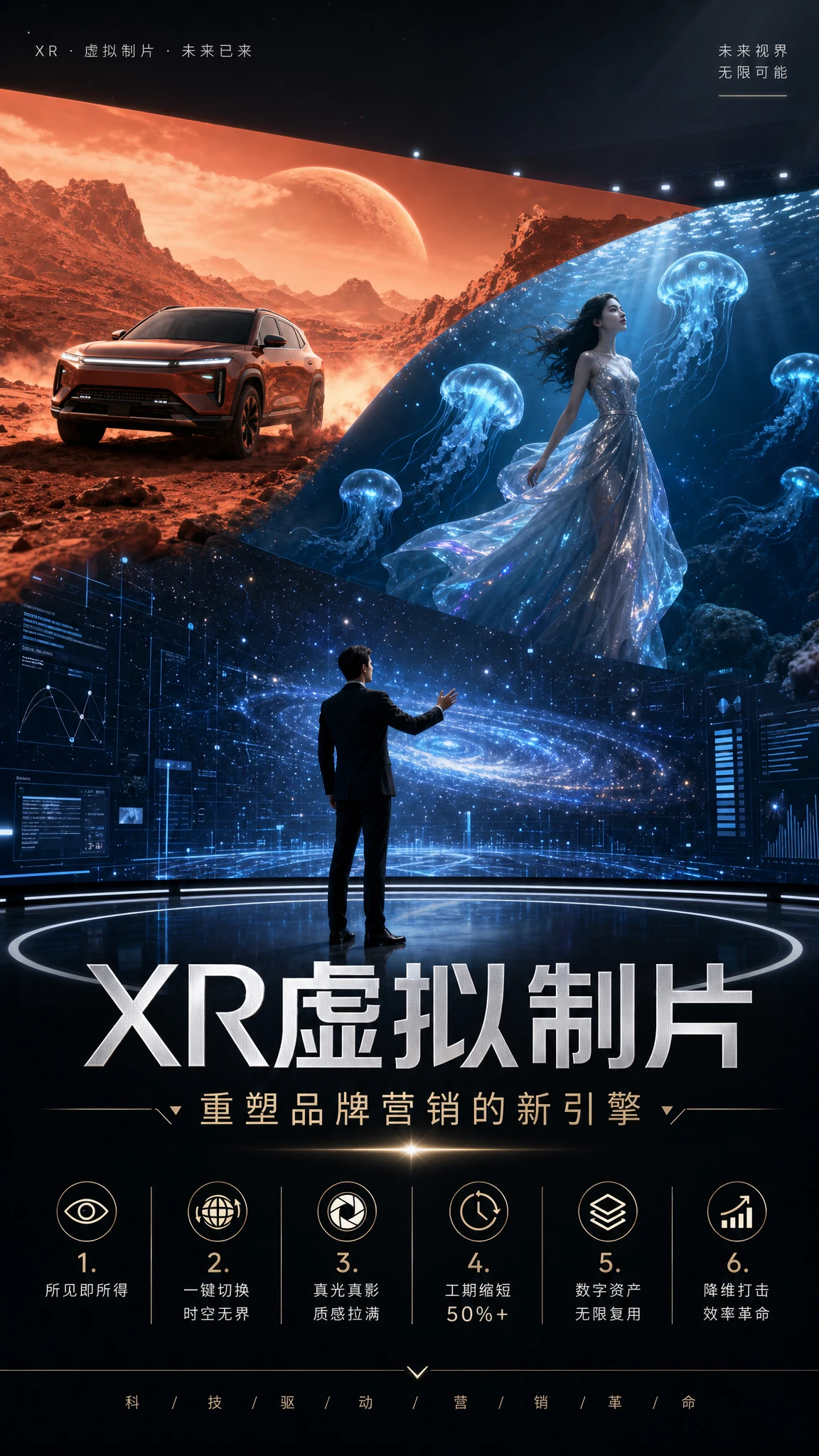
Imagine this scene: In the early morning, a latest smart SUV races across the red desert of Mars, its body reflecting the afterglow of an alien sunset; in the afternoon, a model in haute couture strolls 1,000 meters deep in the blue ocean, with glowing jellyfish passing through her hair; in the evening, the brand spokesperson stands in a massive dynamic data galaxy, and with a gesture, a groundbreaking tech product is “born” out of thin air from the virtual nebula...
In the past, producing a commercial with such striking visual impact meant coordinating cross-border shoots, waiting for expensive schedules and weather, enduring months of post-production VFX rendering, and a budget of tens of millions.
Yet today,All of this can be fully captured in a single studio in just one day.
This isn't magic—it's the black tech reshaping global brand marketing.the daily reality ofFor brand advertisers in the “era of attention scarcity,” XR virtual production is sparking a creative efficiency revolution with its “dimensionality reduction” advantages.
I. The “Three Mountains” of Traditional Commercial Shoots Draining Brand Budgets
In traditional commercial production, brands and production teams often face three hard-to-reconcile pain points:
- “Extreme Uncertainty of ”Relying on the Weather": To capture the perfect “golden hour” reflection on a car's body, a crew might have to wait outdoors for three days just for that fleeting sunset glow.
- High Location Transfer and Travel Costs: To realize a grand “travel the world” concept, you'd need to fly a crew of hundreds to Iceland, the Sahara, or Tokyo—airfare, accommodation, and equipment transport costs drain away like water, with nothing spent on the actual visual quality.
- “The ”Green Screen Blind Box" Communication Disaster: Shooting in front of a green screen forces directors, clients, and actors to rely solely on “faith” and imagination. Months later, when the post-production VFX is composited, the brand discovers “this isn't the feel I wanted,” but by then the budget is exhausted and revisions are prohibitively expensive.
As traditional models hit a bottleneck, XR virtual production steps up with a brand-new approach.
II. XR Virtual Production: How to Deliver a “Dimensionality Reduction” Strike on Traditional Commercials?
Simply put, XR virtual production usesultra-high-definition LED wallsto replace traditional green screens, projectingthe Unreal Enginereal-time rendered 3D virtual scenes onto the screens, and throughcamera tracking system., the background changes with the camera's movement to create perfect perspective shifts (parallax).
This technology brings a nearly revolutionary experience to brand commercials:
Absolute Freedom in Space and Time: One-Click Scene Switching, Boundless Time and Space
In an XR studio, the director has a “god-like hand.” One moment it's a cyberpunk future city, the next it can switch to a serene Alpine snowscape. Without weather constraints or location transfer losses, commercials can switch between multiple completely different scene styles in the shortest time, vastly expanding creative boundaries.
“Real Light, Real Shadow” Texture Perfection: A Paradise for Luxury and Tech Aesthetics
The hardest issue with green screen keying is the “mismatched” lighting. When green light reflects on an actor's skin or a metal product's surface, the texture suffers significantly. But LED screens themselves are massive light sources. In an XR studio,the light from the virtual environment on the LED screen naturally and realistically projects onto the product and actors. Whether it's the highly reflective paint of a car or the dazzling refraction of jewelry and diamonds, the footage delivers unparalleled physical realism. This high-end texture is extremely difficult to simulate with post-production CG compositing.
“What You See Is What You Get”: Turning Decision-Making into a Non-Gamble
“Post-production upfront” is the core logic of XR production. On set, what the brand, director, and cinematographer see on the monitor is infinitely close to the final output. “Not satisfied? Adjust it on the spot!” If a tree in the virtual background is in the wrong position, a technician can move it with a mouse in seconds; if the sunset lighting isn't warm enough, adjust the color temperature on-site with one click. Brands no longer have to “open a blind box” staring at a green screen, and decision-making efficiency increases exponentially.
III. The New Battlefield for Brand Marketing: High-Impact Applications of XR in Commercial Scenarios
Currently, forward-thinking leading brands are deeply integrating XR technology into various marketing scenarios:
- Tech and Automotive Brands: Crafting Epic Visual Narratives In car and phone commercials, XR is a powerful tool for showcasing “futurism.” New cars no longer just drive mundanely on roads; they travel through virtual light tunnels and digital matrices, even interacting directly with AR (Augmented Reality) elements, visually concretizing abstract concepts like “intelligent computing power” or “safety systems.”
- Fashion and Luxury Brands: Building Immersive Avant-Garde Aesthetics Haute couture brands are no longer limited to physical runways. Using XR, models can walk on floating clouds or melting glaciers. The surreal aesthetics brought by XR perfectly align with the “otherworldly” and artistic tone luxury brands pursue.
- Product Launches: Redefining “Online Releases” From Apple to Xiaomi, more and more giants are choosing to record their launches in XR studios. The presenter is no longer trapped in front of a monotonous PPT but is placed in a dynamic, interactive digital universe. When introducing the chip architecture, the chip enlarges and deconstructs in mid-air; when discussing waterproof performance, heavy rain falls around the presenter without getting them wet—this immersion keeps online viewers glued to the screen.
IV. Calculating the Business Case: The “Digital Assets” Behind High ROI”
Many brand owners, upon hearing terms like “XR” or “Unreal Engine,” first think:This must be very expensive, right?
This is a typical misconception. If we look atoverall Return on Investment (ROI),XR virtual production is often actually “cost-saving”:
- Zero Travel Expenses: Eliminates costs for transportation, accommodation, and location permits for a hundred-person team.
- Production Time Reduced by Over 50%: Shooting equals post-production. Traditional VFX that takes two months can be captured and delivered in just three days in an XR studio.
- Infinite Reuse of Digital Assets: This is XR's most compelling business story. The “future concept flagship store” or “forest scene” built in Unreal Engine for this commercial shootbecomes a digital asset owned by the brand. After the shoot, these scenes can not only be used for next quarter's commercials but also directly imported into the brand's showroom, online 3D store, or even as an interactive map in a metaverse game. Developed once, reused forever, with marginal costs approaching zero as usage increases.
Conclusion
In today's highly fragmented media landscape, consumer attention is more precious than gold. Mediocre creativity and cookie-cutter visuals will only be swiped past mercilessly by users.
XR virtual production is not just an upgrade in filming technology; it's a liberation of brand imagination. It breaks the shackles of the physical world, allowing brands to realize their wildest creative ideas at the lowest trial-and-error cost.
The future of brand competition is a battle for mindshare, and even more so, a competition in the fusion of technology and aesthetics. While your competitors are still waiting for the weather to shoot at the next location, the pioneering brands that have chosen XR have already completed a grand exploration from the universe to the deep sea in a single day's light.

 简体中文
简体中文  English