
Over the past half century, broadcast engineers have held an almost religious fervor for SDI cables. The benefits of SDI are clear: point-to-point, zero packet loss, absolute synchronization. Plug in a cable, and as long as there's a signal, it will never fail.
However, with the explosion of 4K/8K, HDR, and multi-camera AR broadcasting, the physical bottleneck of SDI has been completely shattered. As a result, high-end studios have begun transitioning toSMPTE ST 2110 (All-IP Uncompressed Video Transport Protocol)Theoretically, this is a revolution: video, audio, and auxiliary data (tracking signals) all flow freely like water within a 10G or even 100G network, allowing you to access footage from any node in the network at any time.
But in practice, when broadcast network architects attempt to connect a real-time graphics workstation running Unreal Engine (UE5) to an ST 2110 switch, a terrifying“network storm”descends.
Native Unreal Engine is simply not designed to handle high-concurrency uncompressed network video streams. In the world of ST 2110, video does not arrive as complete “frames”; instead, it is chopped into millions of network packets.
- The CPU Disaster of Packet Reassembly: If the engine is tasked with capturing these packets and reassembling them into video frames, the CPU's bus bandwidth will be instantly drained, causing severe rendering frame drops.
- Network Jitter and Clock Drift: Ethernet inherently suffers from latency jitter. When video packets containing green screen footage and spatial tracking packets each “drift” by a few milliseconds due to network congestion before reaching the engine, the lack of a robust locking mechanism results in extremely nauseating “spatial tearing” and temporal misalignment in the AR composite.
Faced with this treacherous highway of the all-IP era,AximmetryAximmetry showcases its hardcore strength as a top-tier broadcast control system:It establishes an independent “IP Packet Offload Zone” at the engine's front end, along with an “Absolute Clock Iron Fist” based on the PTP protocol.
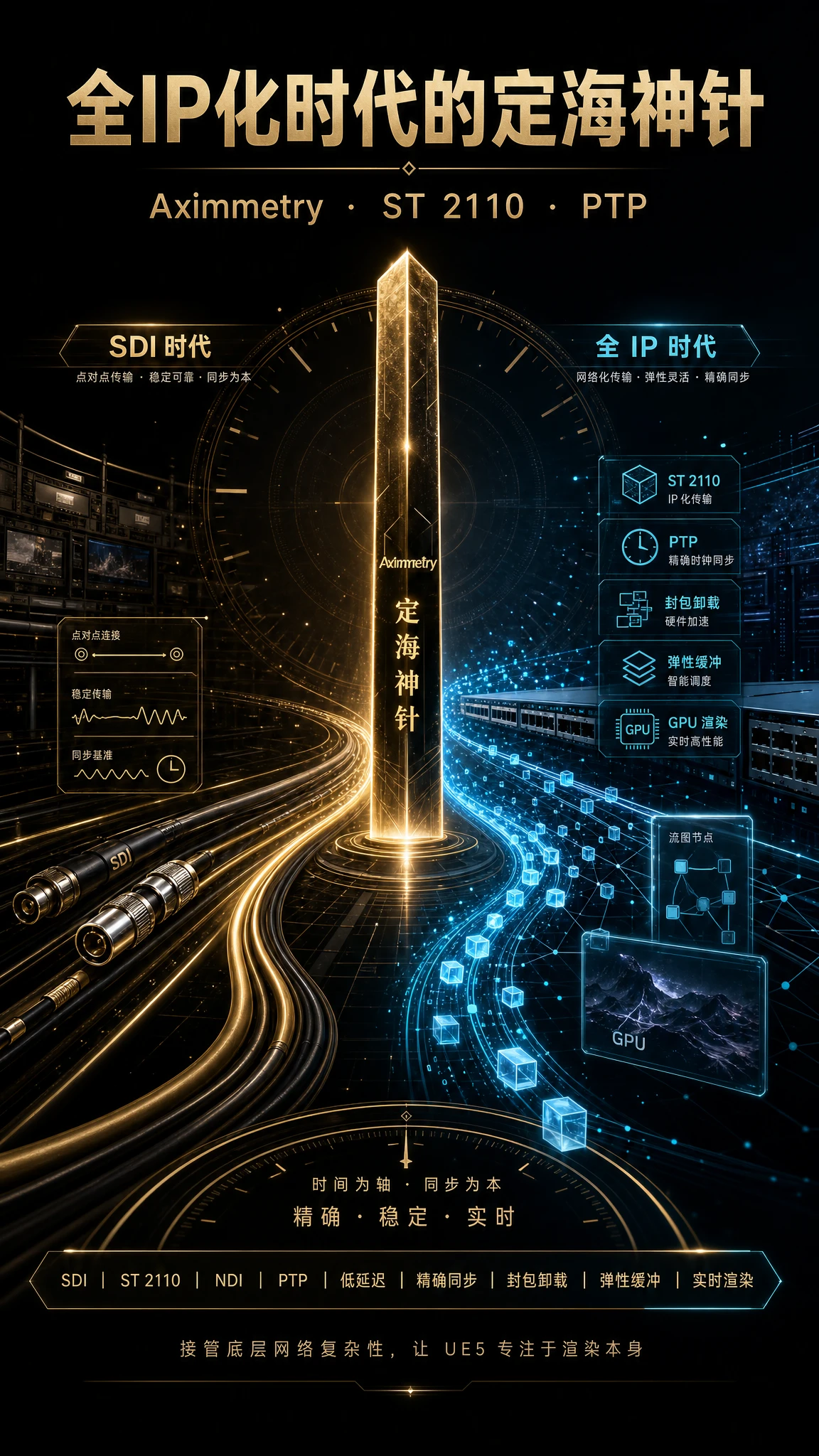
Core Solution One: Low-Level Takeover of 2110“s ”Ultra-Fast Depacketization and Bypass Cache"
Aximmetry is acutely aware that the fragile UE5 must never be allowed to touch those chaotic network packets.
At the system's low level, Aximmetry deeply integrates the underlying drivers (e.g., Rivermax API) of dedicated IP video/audio network cards (such as Mellanox ConnectX or AJA IP cards). It transforms into a ruthlessEdge Packet Engine:
- Hardware-Accelerated Decoding: When a single 4K ST 2110-20 video stream at up to 12Gbps surges toward the workstation, Aximmetry, at the lowest level of the network card and operating system, uses DMA (Direct Memory Access) technology to depacketize and reassemble network packets directly in GPU memory.
- Zero Engine Burden: The entire reassembly process completely bypasses the CPU's main thread. By the time UE5 needs this frame for material compositing or blueprint calculations, it is already presented with a clean, neatly arranged GPU texture. The engine bears no network I/O load, and all computing power is preserved intact for ray tracing and complex physics simulations.
Core Solution Two: PTP (Precision Time Protocol) “Spatiotemporal Iron Fist” Command
In an ST 2110 network, the traditional Blackburst sync line disappears, replaced byPTP (Precision Time Protocol - IEEE 1588)transmitted over the network cable. PTP provides sub-microsecond network clock synchronization, but only if the receiving end adheres to it with extreme rigor.
Aximmetry deeply embeds itself into the PTP clock domain, establishing an absolute “spatiotemporal iron fist.”
- The “Alignment Hourglass” for Asynchronous Data Streams: Video streams (ST 2110-20), audio streams (ST 2110-30), and tracking system metadata (ST 2110-40) travel independently within the network. Their arrival times at the network card are inevitably staggered. Aximmetry does not rush to feed data to the engine. It reads the extremely precise RTP timestamp from each packet and places it into its own elastic buffer. Only when the video pixels and tracking coordinates with perfectly matching timestamps are all assembled does Aximmetry, at the precise microsecond of the PTP clock tick, push this complete “composite state” to UE5 for rendering.
- Resisting Network Jitter: If network jitter occurs and a data packet arrives half a millisecond late, a native pipeline might directly drop frames or cause screen tearing. Aximmetry, through its powerful frame buffer mechanism and smoothing algorithms, forcibly smooths out these network jitters, ensuring that the frame interval output to the rendering pipeline remains rock-solid.
Core Solution Three: NDI and 2110 “Hybrid Routing Remapping”
Not all projects have the budget for extremely expensive 2110 switches. Many studios adopt a hybrid architecture using both ST 2110 and NDI (Network Device Interface) (high-end cameras use 2110, while roving cameras and remote connections use NDI).
If native UE5 were used to simultaneously handle network streams with different protocols and compression rates, the project file would become extremely bloated and prone to crashes.
Aximmetry's incredibly elegantThe Flow Graph architecturebecomes the “ultimate universal conversion plug” for the all-IP era. Regardless of whether the input is 2110, NDI, or even a public network stream pulled back via WebRTC, within Aximmetry's flow graph, they are all uniformly abstracted into a very clean “Video IN” node. Modifying network routes, redirecting IP addresses, or even seamlessly switching from the main 2110 stream to a backup NDI stream mid-broadcast can all be done with a single click in Aximmetry's control panel, without modifying any internal logic of Unreal Engine. It completely isolates the complexity of the underlying network protocol from the engine's view.
Conclusion: The “Stabilizing Pillar” of the All-IP Era”
Broadcast television and live production are irreversibly racing toward full IP adoption. This is not just a change in physical cables but a complete restructuring of the underlying data transmission logic.
In this grand transformation, a 3D rendering engine is like an extremely delicate supercar. Once it drives onto a chaotic highway made of countless network packets, it is highly prone to breaking down due to road bumps (network jitter) and traffic chaos (data asynchrony).
Aximmetry precisely seizes the technological bottleneck of this era's transition. It does not interfere with how the “supercar” operates; instead, it lays an ultra-smooth, absolutely synchronized underlying track for it. By taking over the low-level ST 2110 depacketization, enforcing PTP network synchronization with an iron fist, and gracefully isolating the complexity of all network protocols, Aximmetry builds an absolutely tranquil breakwater for the real-time rendering pipeline at the center of this raging network storm.
It is precisely because of this “stabilizing pillar” that broadcast architects dare to unleash the peak performance of real-time graphics engines without restraint amidst the waves of full IP adoption.

 简体中文
简体中文  English