
In Hollywood's film and television industry, a bittersweet and helpless true story has been circulating.
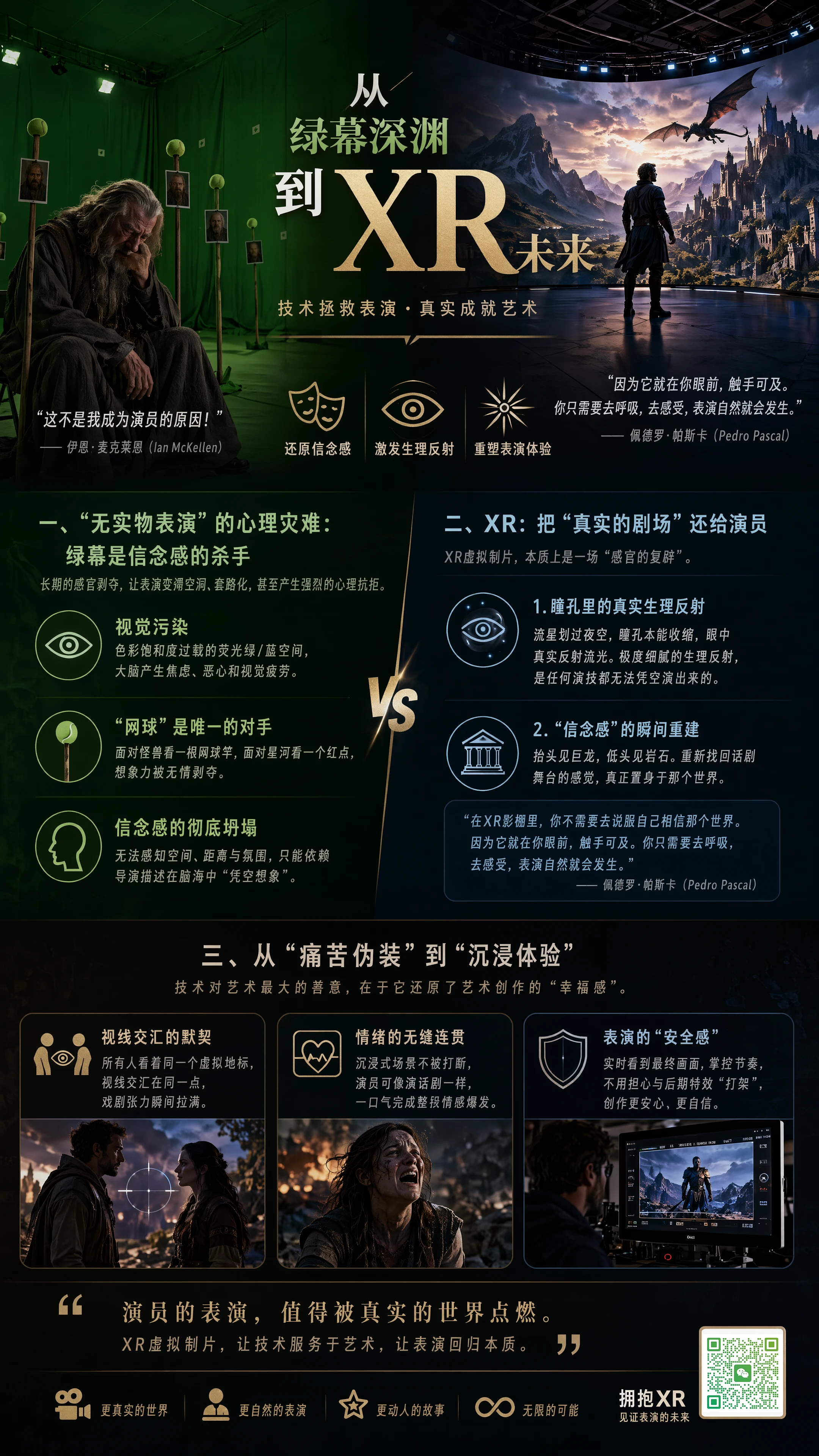
During the filming of The Hobbit, the national treasure actor Ian McKellen, who played Gandalf, once sat alone in a huge, empty green screen tent.
There were no other actors around him, only wooden sticks with photos of dwarves attached and rows of flashing green lights. He had to speak to himself with affection, anger, and pain, all directed at these sticks.
After hours of continuous filming, the theater master, who had performed Shakespearean plays his entire life, finally broke down. He even forgot the microphone still clipped to him and wept in despair into the empty air:“This is not why I became an actor!”
For a long time,green screen keyinghas been like a slow-acting poison—while bringing convenience to visual effects, it is also pushing actors to the edge of “schizophrenia.”
Untilthe daily reality ofThe emergence of XR has finally rescued actors from this green abyss.
I. The Psychological Disaster of “Acting Without Props”: The Green Screen Is the Killer of Belief
Theater master Konstantin Stanislavski once said:“The essence of acting is communication and reflection.”
Actors are not robots; every expression and every breath they take requires stimulation from their surroundings.
On a green screen set, this is ruthlessly stripped away:
- Visual Pollution from Oversaturated Colors: Prolonged exposure to high-saturation fluorescent green or blue spaces can cause physiological anxiety, nausea, and visual fatigue in the human brain.
- “Tennis Balls” as the Only Opponent: Facing a monster, the actor looks at a green pole with a tennis ball on top; facing a galaxy, the actor stares at a red dot on the wall.
- The Complete Collapse of Belief: Actors cannot establish a sense of space, distance, or atmosphere. They don't know if they are standing in a magnificent palace or a desolate ruin, relying solely on the director's descriptions to “imagine it out of thin air.”
This long-term “sensory deprivation” makes actors' performances hollow and formulaic, even triggering strong psychological resistance.
II. XR: Giving the “Real Theater” Back to Actors
XR virtual production is essentially a“restoration of the senses.”。
When the massive LED ring screen closes in and the virtual world lights up instantly, actors are delighted to discover:Acting has become easy again.
Genuine Physiological Reflexes in the Pupils
The human eye contracts its pupils when seeing bright light and dilates them in darkness. In front of a green screen, the light is constant and artificial; but inside an XR studio:
- When a meteor streaks across the screen's night sky, the actor's pupils producean instinctive, genuine physical contraction,and their eyes reflect that real streak of light.
- This extremely subtle “physiological reflex” cannot be faked by any acting skill.
The Instant Rebuilding of “Belief”
In an XR studio, actors can look up and see a soaring dragon, or look down and see shattered rocks beneath their feet. They rediscover the feeling of being on a theater stage—They are no longer “pretending” to be on an adventure; they are truly immersed in that world.
Pedro Pascal, the actor who played in The Mandalorian, once said excitedly: “In an XR studio, you don't need to convince yourself to believe in that world. Because it's right in front of you, within reach. You just need to breathe, to feel, and the performance happens naturally.”
III. From “Painful Pretense” to “Immersive Experience”
The greatest kindness technology can offer art is restoring the “sense of happiness” in artistic creation.
- The Chemistry of Eye Contact: In the past, when filming scenes with other actors, they often had to look at different heights in the air to match the later keying positions. In an XR studio, everyone can look at the same virtual landmark, their gazes meeting at the same point, instantly maximizing the dramatic tension.
- Seamless Emotional Flow: Green screen filming is often fragmented by post-production adjustments, frequently interrupting the emotions actors have painstakingly built up. XR provides an immersive scene, allowing actors to complete an entire emotional outburst in one go, like performing in a play.
- A “Sense of Security” in Performance: Actors no longer have to worry about their performance conflicting with the later visual effects. They can see the final image directly on the monitor, giving them absolute control over their performance rhythm.
Conclusion
Technology should not be cold algorithms, nor should it become a shackle on artistic creation.
In the green screen era, human actors' psychological suffering was traded for the prosperity of digital effects. XR virtual production, with the warmth of technology, rediscovers the dignity and soul of the art of performance.
When the green screen is mercilessly buried, we can finally say to the actors:
“Goodbye, tennis balls on wooden sticks; welcome back, the actor's belief.”

 简体中文
简体中文  English