
In the past, one measure of whether an actor was an “international superstar” was theirpassportbeing the most direct evidence.
Flipping through their passports, they were filled with dense stamps and visas from various countries: filming an art film along the Seine in Paris last week, flying to the Sahara Desert for an action scene this week, and heading to Iceland's glaciers for a sci-fi film next month.
Accompanying the halo of being an “international superstar” was the never-resolved jet lag, the perpetually packed suitcase, and the crew's cross-border travel expenses often running into millions of dollars.
Yet today, the passports of Hollywood and top domestic stars are quietly gathering dust in drawers.
It's not that they've fallen from fame, but XR (Extended Reality) virtual production has made “going abroad” an unnecessary endeavor.
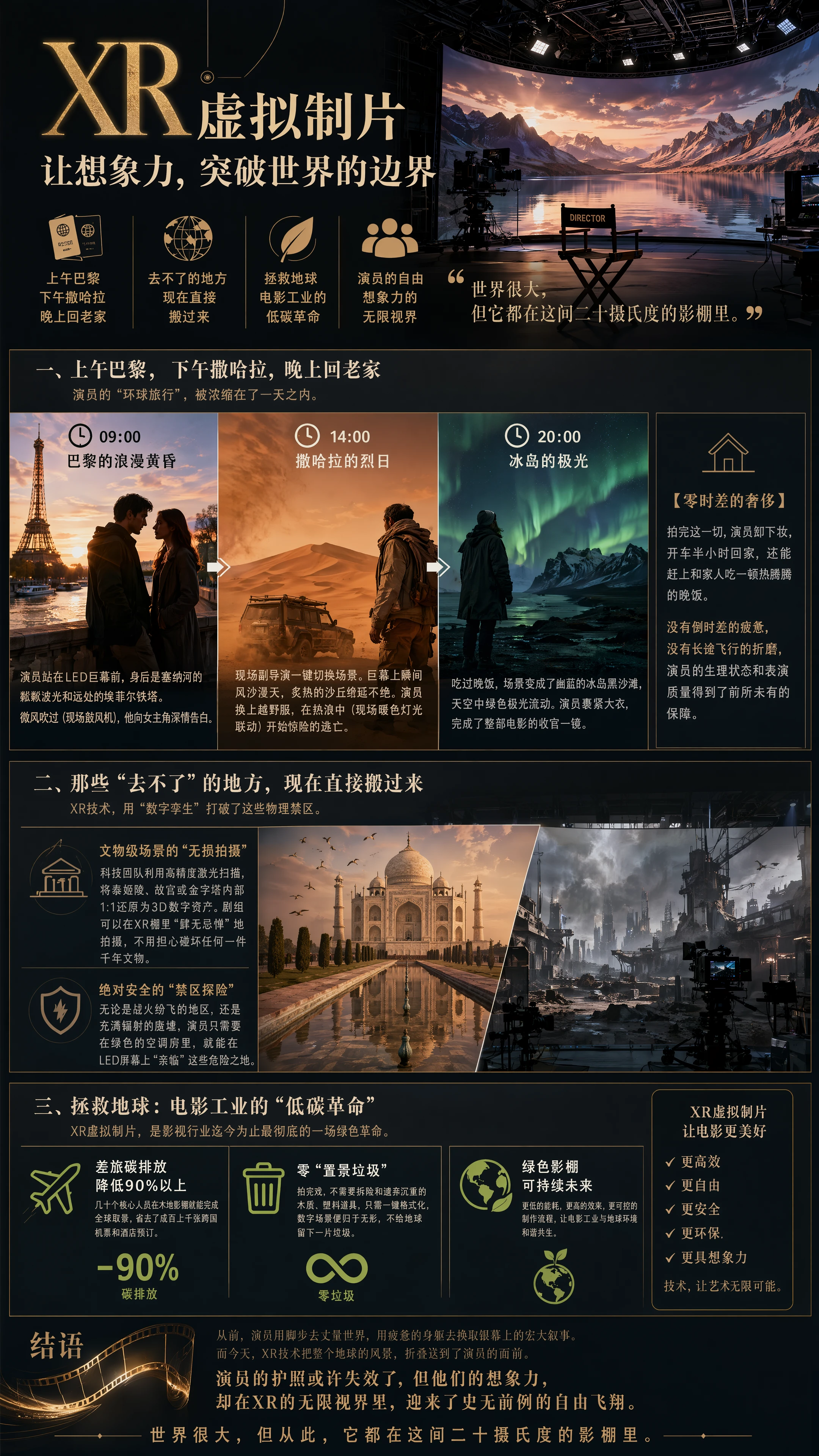
I. Morning in Paris, Afternoon in the Sahara, Evening Back Home
In the era of XR virtual production, an actor's “global tour” is condensed into a single day, without even needing to step outside the studio.
- 09:00 AM | Romantic Dusk in Paris The actor stands before an LED wall, with the shimmering Seine and the distant Eiffel Tower behind them. A breeze blows (via on-set wind machine), and he delivers a heartfelt confession to the leading lady.
- 02:00 PM | Scorching Sun in the Sahara The assistant director switches the scene with one click. The wall instantly shows a sandstorm, with endless scorching dunes. The actor changes into off-road gear and begins a thrilling escape amidst the heat (with on-set warm lighting synced).
- 08:00 PM | Aurora in Iceland After dinner, the scene shifts to the icy black sand beach of Iceland, with green auroras flowing in the sky. The actor wraps up in a coat and completes the final shot of the entire film.
【The Luxury of Zero Jet Lag】: After filming all this, the actor removes their makeup, drives home in half an hour, and still catches a warm dinner with family. Without the fatigue of jet lag or the ordeal of long-haul flights, the actor's physical state and performance quality are guaranteed like never before.
II. Those “Inaccessible” Places, Now Brought Right Here
In the real world, there are many stunning filming locations that crews can't access even with money.
Geopolitical conflicts, strict restrictions on preserving historical artifacts, or extremely harsh natural environments are insurmountable barriers for traditional location scouting. For example, you can't bring a 200-person crew into the Chernobyl exclusion zone, nor can you shoot an intense gunfight inside the Louvre.
XR technology breaks these physical barriers with “digital twins”:
- “Damage-Free Filming” of Heritage-Level Scenes: Tech teams use high-precision laser scanning to recreate the Taj Mahal, the Forbidden City, or the interior of the pyramids as 1:1 3D digital assets. The crew can film “unrestrainedly” in the XR studio without worrying about damaging any thousand-year-old artifacts.
- Absolutely Safe “Forbidden Zone Exploration”: Whether it's a war-torn region or a radiation-filled ruin, actors only need to be in an air-conditioned green room to “visit” these dangerous places on the LED screen.
III. Saving the Planet: The “Low-Carbon Revolution” of the Film Industry”
Traditional “jet-setting” crews are not only costly but also a huge burden on the environment.
A medium-sized international crew generates staggering carbon emissions from travel, air-freighted equipment, on-site generators, and disposable set waste. In today's environmentally conscious era, many major studios are under heavy pressure to “reduce carbon.”
XR virtual production isthe most thorough green revolution in the film industry to date:
- Reducing travel carbon emissions by over 90%: Dozens of core personnel can complete global location shooting in a local studio, saving hundreds or thousands of international flights and hotel bookings.
- Zero “Set Waste”: After filming, there's no need to dismantle and discard heavy wooden or plastic props. Just one click to format, and the digital scenes vanish without leaving a single piece of trash on Earth.
Conclusion
In the past, actors measured the world with their footsteps, trading their weary bodies for grand narratives on screen.
But today, XR technology folds the entire planet's landscapes and delivers them right before the actors.
An actor's passport may have become obsolete, but their imagination, within XR's infinite vision, has achieved unprecedented freedom to soar.
The world is vast, but from now on, it all resides within this 20°C studio.

 简体中文
简体中文  English