
In the past film and television industry, there was a mysterious profession known as the “most enviable” one—Location Scout。
Their job was to travel the world at the company's expense. To fulfill a line in the director's script like “a desolate alien canyon” or “a lonely rainy night street,” they would carry their cameras, trekking across Iceland's black sand beaches, the heart of the Sahara, or the hidden alleys of Tokyo. They were the “eyes” of the production team, measuring the Earth with their steps, searching for the intersection of reality and imagination.
However, in recent years, this romantic profession has faced an unprecedentedwave of unemployment。
What took away their jobs wasn't more experienced peers, but the XR (Extended Reality) virtual production studios quietly standing in urban industrial parks.XR (Extended Reality) Virtual Production Studio。
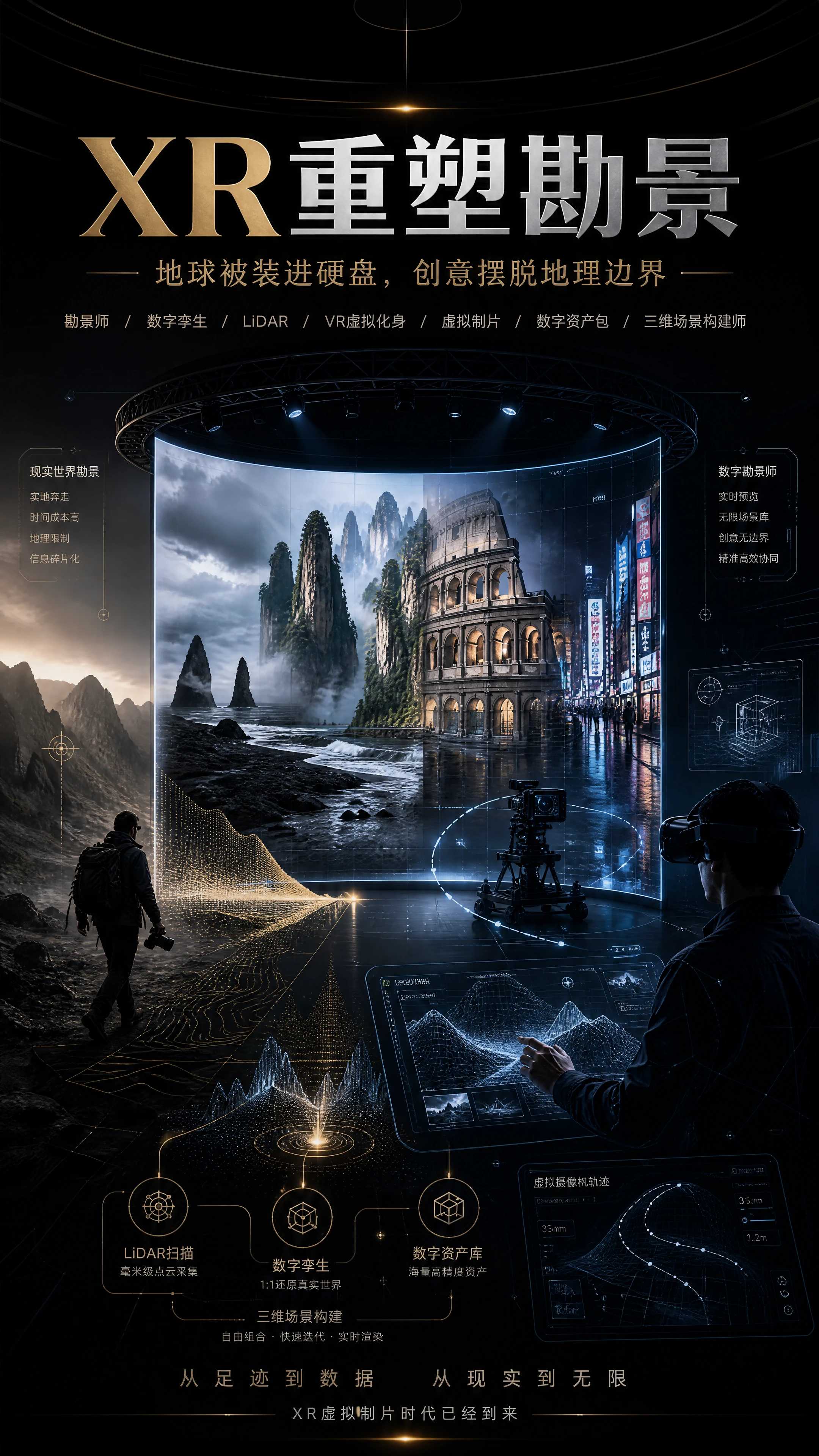
I. “Putting the Earth into a Hard Drive”
The demise of the location scout began the moment the physical world was “digitized.”
In the past, to film Iceland's basalt black sand beaches, the crew had no choice but to endure the hassle of flying there. But now,“Digital Twin” technology and high-precision scanning have brought the world's stunning wonders into computers at a 1:1 scale.
Using LiDAR and drone oblique photography, tech companies can replicate real-world landmarks and natural wonders with millimeter-level precision.
- The unique quartz sandstone canyons of Zhangjiajie;
- The weathered ruins of the Roman Colosseum;
- Iceland's glaciers shimmering under the aurora...
These once-distant wonders, requiring long journeys to reach, have now become“3D digital asset packages” that can fit into a portable hard drive.”In an XR studio, a simple double-click of the mouse brings these scenes to life with high precision on a massive LED ring screen.
Since Iceland is right there on the studio wall, why would the crew buy plane tickets?
II. From “Traveling the World” to “Wearing VR Glasses”
Technological change has completely overturned the rules of “finding beautiful scenery.”
Traditional location scouting was an inefficient puzzle game. Scouts would take hundreds of photos and then repeatedly discuss with the director back at the studio: “Is this angle too cramped?” “At what time in the afternoon will the sun be blocked by that mountain?”
In the XR era,“Digital location scouting” makes all of this as cool as a sci-fi movie:
- VR Virtual Avatar Scouting: Directors, cinematographers, and art directors don't need to leave their offices. By simply putting on VR headsets, their “virtual avatars” can instantly teleport into digital scenes built in Unreal Engine.
- Real-time “Spatial Measurement”: Cinematographers can place virtual cameras directly in the virtual scene, test different lens focal lengths, and even simulate in real-time how light and shadow will behave if shooting at 3 PM.
- “Modifying the World” on the Spot: If the director thinks “this tree is too obstructive,” the artist simply clicks a mouse in the background, and the tree disappears. This absolute control is something no real-world location can offer.
Location scouting has transformed from “an outdoor adventure relying on luck and physical effort” into “a precise, efficient digital simulation.”
III. Career Reinvention: They Haven't Disappeared, They've Become “Digital Hunters”
While technology ruthlessly eliminates old jobs, it also fosters entirely new career ecosystems. Those unemployed traditional location scouts haven't truly left the industry; instead, they've ushered in a“upgrade” in their careers.”。
They've transitioned from “travelers seeking real-world beauty” into“Digital Asset Hunters”或“3D Scene Builders”:
- They no longer study flight schedules and weather; instead, they focus on how to use the most advanced cameras to capture material textures and how to reconstruct realistic 3D spaces using optical flow methods.
- Their battlefield has shifted from the real wilderness to the asset stores of Unreal Engine and the creation desks of digital scenes.
- Using their years of accumulated exceptional aesthetic sense, they guide technicians on how to make virtual falling leaves more natural and how to make the color temperature of a digital sunset more cinematic.
Conclusion
“Behind the ”mass unemployment of location scouts" lies thedisappearance of geographical boundaries in the film and television industry.。
Human creativity was once severely limited by transportation convenience, weather conditions, and budget constraints. XR technology has freed humanity from these geographical limitations.
When the entire Earth, and even the entire universe, is digitized and packed into a hard drive, creators gain eternal freedom of movement.
Farewell to the era of traveling the world with a suitcase chasing the light; hello to the digital age where the universe is at your fingertips.

 简体中文
简体中文  English