
When the protagonist of *The Mandalorian* traverses an alien desert, or when Wang Miao in *The Three-Body Problem* stands amidst the spine-chilling flicker of the cosmos—behind these breathtaking scenes, it is not a film crew trekking through the wilderness or constructing massive physical sets, but a revolutionary technology called XR virtual production that is reshaping the foundational logic of the film and television industry.
Traditional green screen technology acts like an invisible wall, forcibly separating actors from the final scene. Actors can only face an empty green backdrop, while directors and cinematographers cannot perceive the final composited image in real time, leaving post-production burdened with heavy keying and compositing tasks. This “wall” not only consumes enormous time and financial costs but also deeply hinders creative freedom and the possibility of instant judgment. XR virtual production emerges from this dilemma, with its core value lying in using real-time rendering and immersive environments to completely break down the barriers between on-set filming and post-production visual effects.
The core technical architecture of XR virtual production resembles a precisely coordinated digital ballet:
-
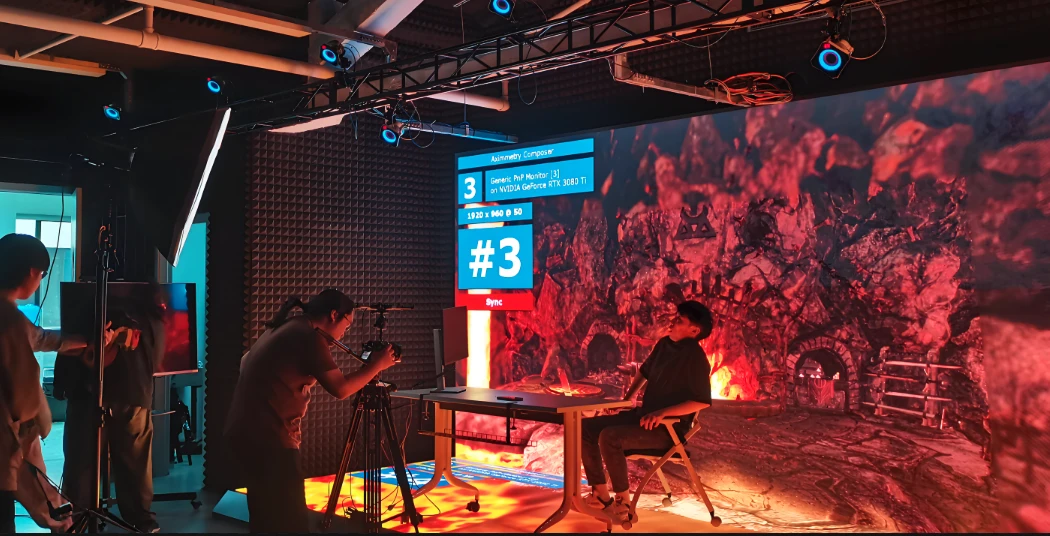
A massive curved LED screen forms the main stage, displaying high-precision virtual scenes created by real-time rendering tools such as Unreal Engine;
-
The camera is equipped with a precision tracking system, capturing its position and lens parameters in real time;
-
The engine adjusts and outputs screen content accordingly, ensuring the virtual scene accurately matches perspective as the camera angle changes;
-
Actors perform surrounded by LED screens, with lighting blending with the virtual scene, casting realistic reflections and shadows onto the actors—thus giving the virtual world the tangible quality of the physical world.
This technical architecture brings about a profound “scene revolution”:
-
Immersive Performance and Real-Time Decision-Making: Actors no longer face a void but are placed in lifelike environments, inspiring more authentic and compelling performances. Directors and cinematographers can instantly see images close to the final output, allowing precise adjustments to composition, lighting, and performance on set, greatly enhancing creative efficiency.
-
Efficiency and Cost Optimization: XR technology significantly reduces reliance on physical set construction and large-scale location shoots, while notably cutting the time and labor costs of post-production compositing. Many tedious post-production tasks in traditional green screen shooting are resolved upfront.
-
Liberation of Creative Expression: Directors' imaginations are no longer constrained by the physical world or budget limitations. Whether it's a fantasy wonderland, futuristic city, or historical relic, scenes can be quickly built and flexibly modified, greatly expanding narrative boundaries.
From Disney's "The Mandalorian" pioneering large-scale successful application of XR, to the domestic "Three-Body Problem" crew using it to create grand and intricate sci-fi scenes; from blockbuster films to commercial shoots, variety show production, and even stage performances, XR virtual production technology is penetrating various content production fields at an unprecedented pace. Its application scenarios are continuously expanding, demonstrating strong adaptability and transformative power.
However, this revolution is not without challenges:
-
High initial equipment investment and the demanding requirements for technical teams create barriers;
-
The physical size of LED screens imposes limitations on camera movement, with ultra-wide angles or special angles still requiring traditional green screen assistance;
-
The industry urgently needs unified technical workflow standards and more interdisciplinary talent with cross-domain skills.
Looking ahead, the development of XR virtual production will be deeply intertwined with several major trends:
AIwill more deeply participate in the intelligent generation and real-time optimization of virtual scenes; the high speed and low latency of *5G/6G* will facilitate real-time transmission of larger scenes and remote collaborative shooting; technological iterations aim to break through the physical limitations of LED screens, providing broader virtual spaces.
XR virtual production is far more than a simple technological replacement tool. It profoundly reshapes the filmmaking workflow, breaking down the rigid barriers between traditional stages, allowing creative thinking to roam freely in a new dimension where virtual and real blend. As the virtual and real seamlessly merge before the lens, and the boundaries of imagination are infinitely expanded, the film industry is undergoing a profound transformation driven by technology. XR virtual production is rewriting the future chapter of visual storytelling with the pen of technology.

 简体中文
简体中文  English