
In the film and advertising production industry, when it comes toXR Virtual Production (Extended Reality), the first reaction of many producers and brands is often: “This technology is too high-end; only Disney could afford it for filming *The Mandalorian*. Our project budget is limited—we can’t match that.” “The daily rental for an LED stage is so expensive—it’s practically synonymous with ‘burning money.””
This is actually the biggestmisconception。
in the industry right now. If you only look at the “daily stage rental,” XR is indeed more expensive than traditional studios; but if youbroaden your perspective to the entire project lifecycle and calculate the total comprehensive cost, you’ll find:XR虚拟制片 is not only not expensive, but it’s actually a powerful tool for “saving big money” for crews and brands, boosting efficiency while reducing costs.
Today, let’s cut through the tech fog and, using the most down-to-earth “producer mindset,” seriously calculate this ROI (Return on Investment).
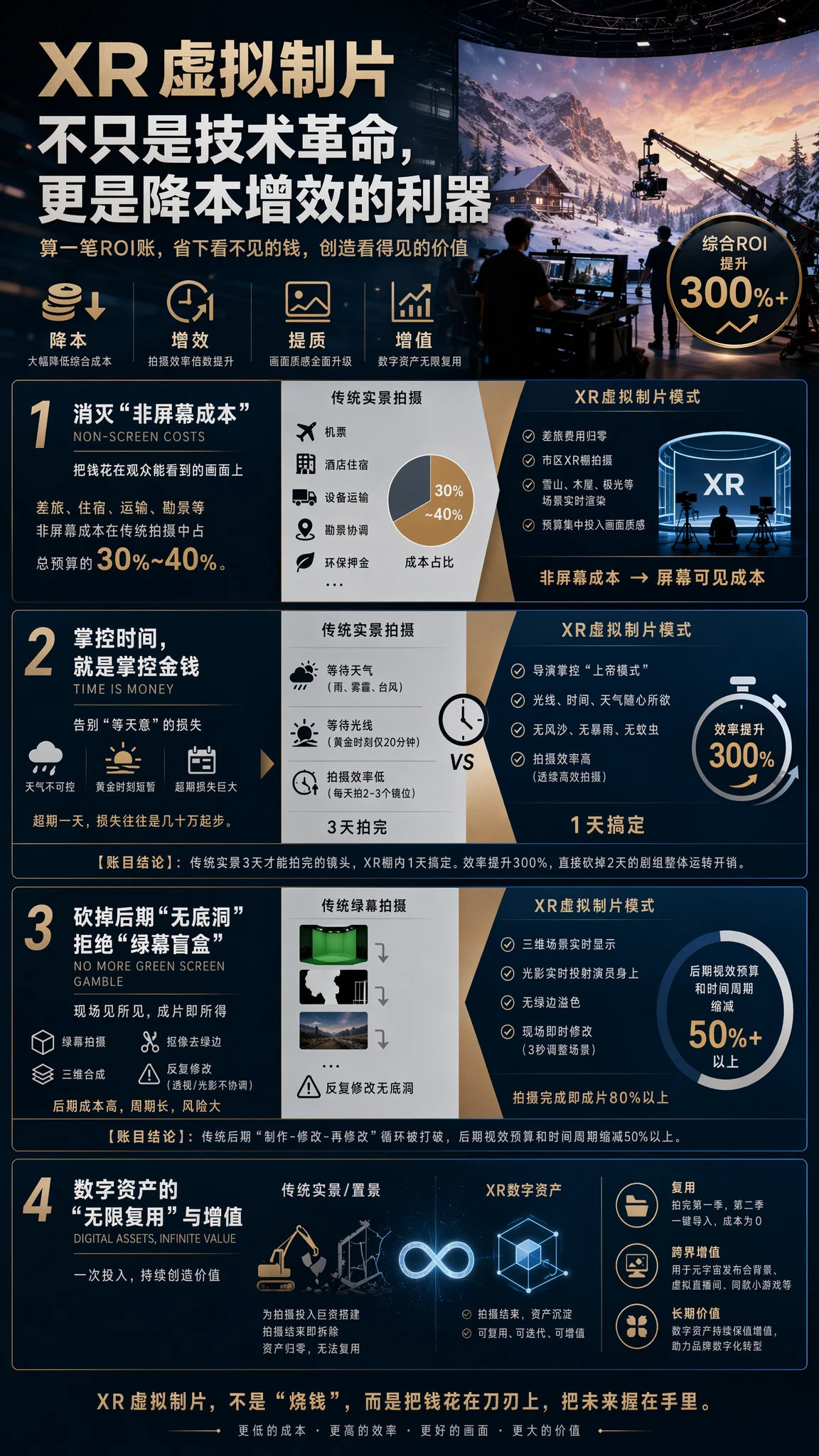
First Account: Eliminating “Non-Screen Costs”
In traditional film crews, there’s a huge amount of money spent unfairly—it’sspent outside the blade yet unavoidable, known in the industry as “non-screen costs” (costs the audience doesn’t see on screen but the crew must pay).
- Traditional Location Shooting: To shoot a “snowy mountain cabin” scene, a crew of 100 needs to buy 100 plane tickets, book dozens of hotel rooms, rent large trucks for equipment transport, and pay for location scouting, local coordination fees, environmental deposits…These travel and logistics costs often account for 30% to 40% of the total budget.
- XR虚拟制片 Mode: Travel costs go directly to zero. The entire crew just takes the subway or drives to the XR studio in the city. The snowy mountain, cabin, and aurora are all rendered on the big screen by Unreal Engine. The hundreds of thousands or millions originally budgeted for airlines and hotels are saved outright.
【Account Conclusion】: XR converts “non-screen costs” into “screen-visible costs,” with every penny spent on the visual quality the audience can see.
Second Account: Controlling Time Means Controlling Money
On set, “time” is the biggest monster. Going over schedule by one day means paying an extra day for equipment rental, actor availability, and crew labor. In traditional shooting, there are too many uncontrollable “time thieves.”
- “The Cost of ”Waiting on Nature”: The “Golden Hour” (the 20 minutes of softest light before sunset) that cinematographers love is fleeting. To capture a few Golden Hour shots, the crew might waste an entire day. If it rains, fogs, or typhoons, the whole crew shuts down “waiting for clear skies,” and the loss from going over schedule often starts at hundreds of thousands.
- XR’s “God Mode”: In the XR studio, the director has absolute control over time.You can make the “4:30 PM sunset” stand still on the screen for 10 hoursNo wind, no rain, no mosquito bites. Shooting efficiency skyrockets from the traditional 2-3 setups per day to continuous, high-efficiency shooting.
【Account Conclusion】: Shots that take 3 days on location can be done in 1 day in the XR studio. Efficiency increases by 300%, directly cutting 2 days of the crew’s overall operating costs.
Third Account: Cutting the Post-Production “Money Pit,” Rejecting the “Green Screen Blind Box”
Traditional “green screen keying” is a classic “take the medicine first, pay later” process. It’s fun on set, but a nightmare in post.
- Traditional Green Screen: Actors perform in front of a green screen, and the producer gets a pile of green footage. Entering the VFX (visual effects) stage, keying, removing green spill, compositing 3D scenes… every step is expensive labor. Worst of all, if after compositing, the director thinks the “perspective is off” or the “lighting doesn’t match,”the cost of redoing it is a bottomless pit。
- XR “Post-Production Front-Loading”: Because the LED screen displays the 3D scene in real time, and the lighting projects directly onto the actors,the final shot is already over 80% complete the moment filming ends。
- No “Green Spill”: The hardest-to-handle green spill on hair strands and green reflections on metal in traditional green screen simply don’t exist in XR.
- On-Site Instant Modifications: If the director thinks a building in the background is too tall and blocks the light, the technician hits a few keys on the keyboard and moves the building away in 3 seconds. If it’s not right, change it on the spot—never leave it for post-production tuition.
【Account Conclusion】: The long traditional post-production cycle of “create-modify-re-modify” is broken, reducing post-production VFX budget and timeline by over 50%.
Fourth Account: The “Infinite Reuse” and Value Appreciation of Digital Assets
This is the most forward-looking and exciting account for investors in XR虚拟制片—the accumulation of Digital Assets。
- Traditional Location/Set Building: To shoot a drama, spend 2 million building a Republic-era street on a film lot. On wrap day, the demolition crew comes in, and 2 million instantly turns into a pile of construction waste.
- XR Digital Assets: The 3D high-precision digital scene built in Unreal Engine for the shoot, after filming ends,doesn’t disappear—it becomes the brand’s “digital asset”。
- Reuse: After finishing Season 1, Season 2 can import the scene with one click and continue shooting, reducing the scene cost to zero.
- Cross-Industry Value Appreciation: This 3D scene can be slightly modified and used directly as the background for a brand’s metaverse launch event, developed into a similar mini-game, or turned into a virtual streamer’s studio.

 简体中文
简体中文  English