
If you take on a multi-million-dollar immersive cultural tourism large-space project (such as a 500-square-meter holographic interactive digital forest), as the system's chief architect, what you face is far more than just “rendering an extremely realistic glowing tree.”
What you are truly facing is a reality constructed by countless underlying languages“The ”Babel Tower of Heterogeneous Hardware":
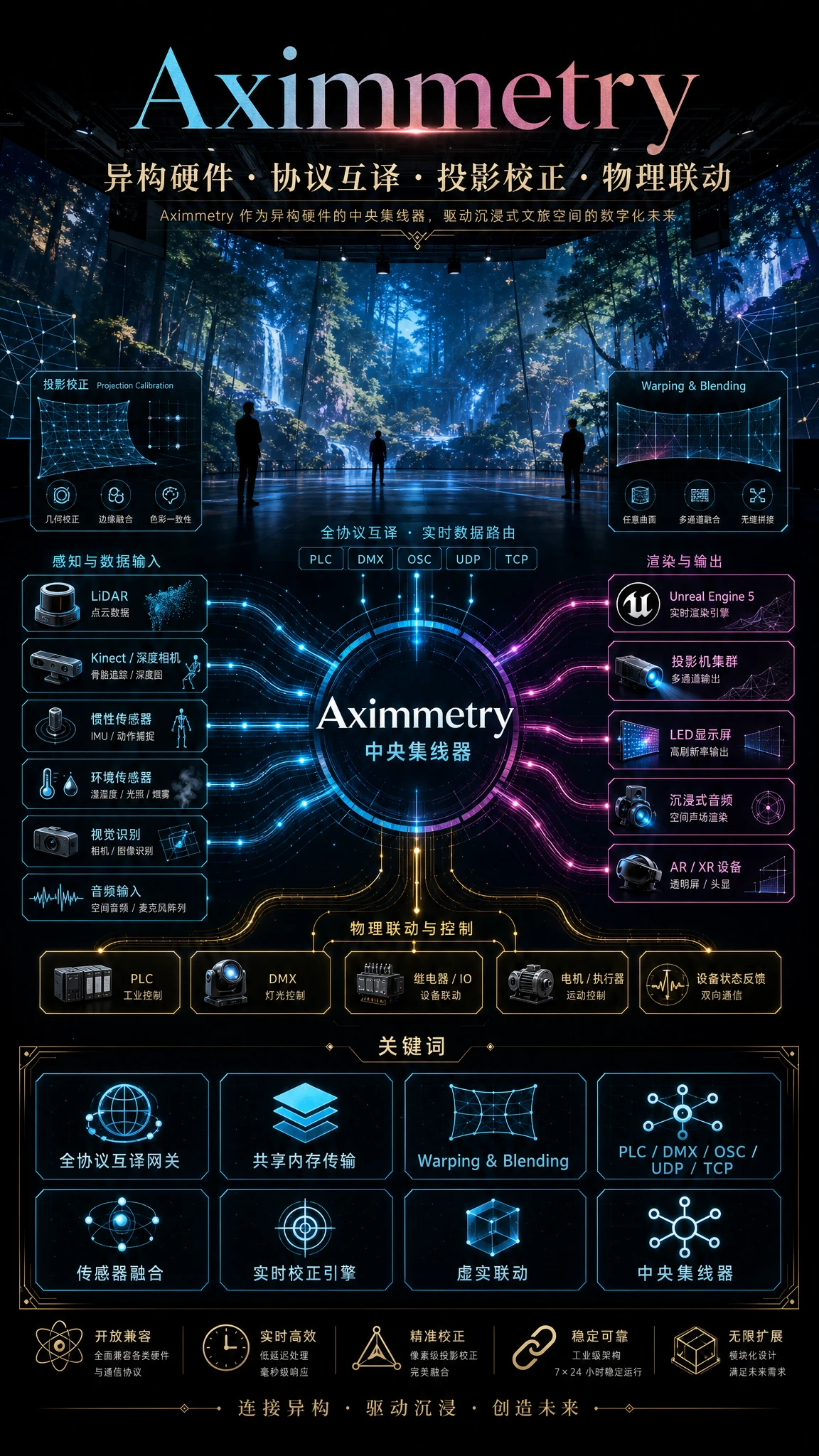
- The disaster of interactive input: On-site, 10 LiDAR units, 5 Kinect depth cameras, and hundreds of infrared pressure sensors sending data via the OSC protocol are deployed. They relentlessly bombard the main control system with all kinds of bizarre data formats.
- The fragmentation of physical output: Besides driving the video streams for 20 projectors, you also need to send signals to the DMX lighting console to control the beams, and transmit TCP/UDP commands to the on-site PLC (Programmable Logic Controller) to control the blooming of mechanical flowers and the start/stop of the mist machines.
- The nightmare of irregular screens: These 20 projectors are not projecting onto flat walls, but onto undulating artificial rockeries and curved domes. You require extremely complex geometric correction (Warping) and edge blending (Blending), and this blending must take effect in real-time on the images rendered by UE5, without a single millisecond of delay.
If you try to “brute-force” all these external hardware devices using Blueprints or C++ plugins within the native Unreal Engine (UE5), the system will instantly become extremely bloated. Frequent string parsing, network port listening, and complex projection distortion calculations will completely clog the engine's main thread, causing catastrophic stuttering in the interactive visuals. Not to mention the nightmare of recompilation during on-site debugging, where a single change affects the entire system.
Faced with this “I/O Heterogeneous Black Hole” capable of strangling any rendering engine,Aximmetry[Aximmetry] reveals its hardcore nature as a top-tier system hub:Completely decoupling hardware management, building a “Universal Protocol Translation Gateway” and a “Purely Independent High-Dimensional Calibration Engine” outside the engine.
Core Solution 1: The “Ultimate Protocol Translator” for All-Terrain Hardware”
Aximmetry ruthlessly establishes a clear architectural red line:Dirty data and low-level protocols are absolutely forbidden from touching the Unreal Engine.
It transforms itself into an all-encompassing “Super Routing Hub”:
- The dimensionality reduction strike on low-level protocols: Whether it's hexadecimal gibberish from UDP/TCP, tree-structured addresses from OSC, level signals from MIDI controllers, or dry contact switches from GPIO, Aximmetry intercepts and digests them instantly within its highly optimized low-level C++ network module.
- Bus Abstraction: Within Aximmetry's clearly visible Flow Graph, those complex LiDAR coordinate point clouds are instantly “unpacked, cleaned,” and transformed into extremely clean Float arrays or Transform matrices.
- The “Spoon-Feeding” Transmission to UE5: After this rigorous filtration, Aximmetry uses an ultra-fast shared memory channel to directly “feed” pure data variables, such as “the visitor's current X/Y coordinates,” to UE5. The engine doesn't need to know whether these coordinates were calculated by LiDAR or Kinect; it only needs to focus on converting these coordinates into interactive ripples on the water surface. This physical isolation completely preserves the engine's computational purity.
Core Solution 2: “Warping & Blending” for Irregular Surfaces, Outside the Engine”
In large-scale projection projects, multi-channel edge blending and curved surface correction are critical technical points. If you use UE5's native nDisplay for Warping, and discover on-site that the physical position of an artificial rockery is off by 5 centimeters, you might need to re-adjust the Mesh in the engine and then re-distribute the nodes, which is extremely inefficient.
Aximmetry completely decouples “screen display management” from the rendering pipeline, establishing a“Post-Render Calibration Engine”。
- Independent Geometric Mapping Matrix: What the Aximmetry master control receives is the perfectly rendered, distortion-free image from UE5. After this, Aximmetry utilizes its own extremely powerful image engine (completely independent of UE) to attach high-precision Warping and Blending modules before the final output node.
- Hot-Grid Tweaking: When on-site engineers drag Bezier Grid curves or import mapping files from professional calibration software like VIOSO/Scalable within Aximmetry's interface, they are directly performing pixel-level distortion on the final output signal. This process is completely transparent to UE5! The engine continues to render the orthogonal view without distraction, completely unaware of how the outside world is being distorted. This means that when you spend hours on-site fine-tuning the projection blend zones, it will never interfere with the massive UE5 project.
Core Solution 3: “Reverse Automation” of the Physical World”
Besides receiving interaction, Aximmetry can also extremely elegantly“Control the Real World in Reverse”。
Imagine the director's request: When the virtual dragon in UE5 breathes fire, the real-world heat mist machine on-site must activate in the same microsecond.
Within Aximmetry's logic nodes, you can easily extract the “Spawn Rate” of the particle effects system or the “Brightness Parameter” of a certain material in UE5. Then, you pull out a wire and connect it to a “TCP/UDP Send” node or a “DMX Out” node. Aximmetry instantly translates the microscopic numerical changes within the engine into hexadecimal instructions that the Programmable Logic Controller (PLC) can understand, sending them to the motors and valves on-site.
Every subtle fluctuation of emotion in the digital world can be instantly transformed into the roar of machinery and the tremor of light and shadow in the real world through Aximmetry's Flow Graph. In this architecture, Aximmetry becomes the ultimate neuron breaking the dimensional barrier between the virtual and the real.
Conclusion: The “Central Hub” of the Immersive Ecosystem”
On the battlefield of large-scale real-life interaction and immersive spaces, “realistic rendering” is merely a basic entry ticket. What truly determines project success and tests engineering expertise is how to seamlessly stitch together hundreds of independent physical sensors, mechanical peripherals, and the virtual 3D world onto an absolutely synchronized timeline.
The Unreal Engine is an unparalleled dragon-slaying sword, adept at conquering all visual rendering challenges; but when facing a complex ecosystem of heterogeneous hardware, what you need is not a dragon-slaying sword, but a “top-tier motherboard” capable of connecting all ports.
Aximmetry has a profound insight into the systemic pain points of this type of large-scale integration. With an almost arrogant assertiveness, it strips the Unreal Engine of its control over network I/O, hardware management, and screen calibration, completely protecting it.
Through a gateway for universal protocol translation, an extremely independent and efficient projection blending pipeline, and a WYSIWYG node bus, Aximmetry weaves a chaotic collection of electronic components and code into a highly sensitive, stable, and robust “All-Terrain Operating System.” Under its command, even the most chaotic heterogeneous hardware ecosystem can instantly transform into precise appendages absolutely obedient to the digital world. This is the indispensable cornerstone for the future of large-scale immersive interactive architecture.

 简体中文
简体中文  English