
In the realm of film-grade real-time compositing, testing whether a TD (Technical Director) or a system is truly top-tier doesn't require rendering a complex alien battlefield. You simply need to place a“glass filled with water”in front of a green screen and have it composited into a virtual background.
Native pipelines or hardware keyers above 90% will be exposed for what they are when faced with this glass.
You will see the following disastrous images:
- “Crushed Blacks” and “Holes”: To cleanly key out the green screen behind the glass, aggressive alpha clipping will punch a large hole directly through the glass, making it look like a black plastic frame.
- Toxic Green Spill: If the tolerance is loosened, the refractive parts of the glass will carry an extremely nauseating green screen reflection.
- “Dimensional Collapse” of Refraction: Most critically, a real glass refracts the texture of the green screen itself. Now you forcibly insert a virtual cyberpunk city behind it, but the refraction inside the glass remains unchanged, instantly maximizing the sense of incongruity.
Traditional post-production can use Nuke to spend weeks frame-by-frame rotoscoping and performing channel math ops to restore texture, but this is an impossible task under the real-time broadcast requirement of 59.94 frames per second.
Facing this “Wall of Sighs” for real-time optical compositing,AximmetryThe reason it is revered as a deity in the industry is precisely because of its独创Advanced Chroma KeyerIt completely breaks away from the traditional “color picker” logic, establishing an industrial-grade compositing pipeline at the foundational level based on“Subtractive Optics and Global Background Recalculation”.
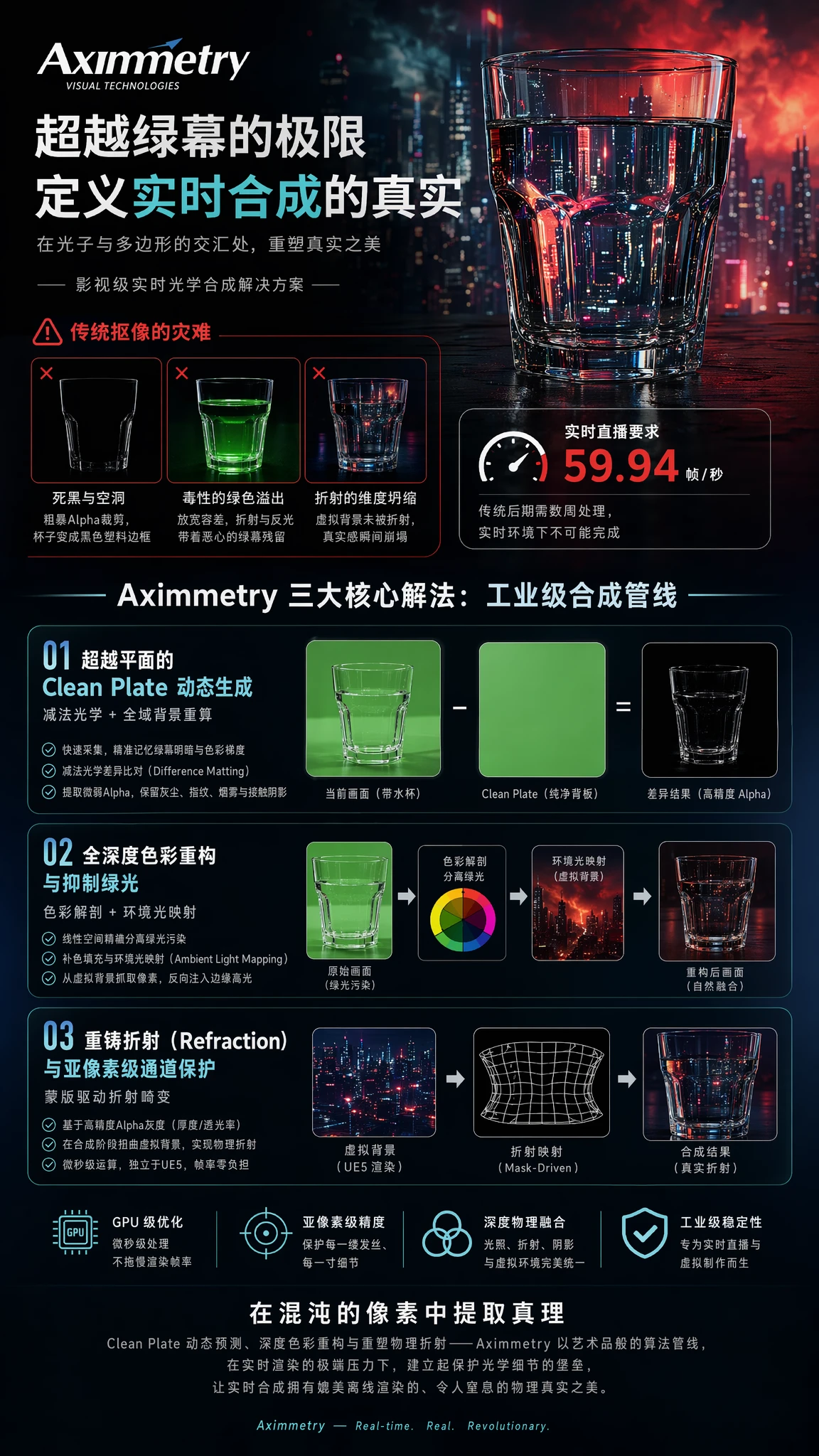
Core Solution One: Dynamic Generation Algorithm for the “Clean Plate” Beyond the Plane
The reason traditional keyers struggle with semi-transparency is that they make an extremely crude logical judgment: “If this pixel is green, make it transparent (Alpha=0).”
Aximmetry's algorithm fundamentally overturns this. Its first step is tocalculate in real-time at the GPU level the pristine green screen background (Clean Plate) of the set “when no actor is present.”
- Immunity to Non-Uniform Lighting: Real-world green screens always have wrinkles, uneven lighting, and vignetting. Aximmetry doesn't require the set to have perfectly uniform green light. Through a quick initial capture, its algorithm can extremely accurately memorize the brightness and color gradient of every inch of the green screen at different positions.
- Subtractive Optics Model: When a frame containing the glass comes in, Aximmetry doesn't “look for green pixels.” Instead, it performs a high-precisionDifference Mattingbetween the current frame and that perfect Clean Plate. It makes a mathematically ruthless judgment: “The position of this glass is 20% darker than the clean green screen, and its hue has shifted by 5 degrees.” Based on this, it can not only precisely extract an extremely subtle alpha channel but also preserve the brightness attenuation information caused by fine dust and fingerprints on the glass's surface. This algorithm allows even barely perceptible smoke and very shallow contact shadows to survive completely intact.
Core Solution Two: Deep Color Reconstruction and Green Spill Suppression
Despilling the green light is the step most likely to “dirty” the image in keying. Common practice in native pipelines is to reduce the saturation of the green channel, which can cause blonde actors' hair to turn gray or skin edges to take on a sickly purple-gray hue.
Aximmetry introduces aFull-Depth Color Reconstruction Mechanism:
- Color Space Dissection: In the underlying linear space, it precisely separates the parts of the frame contaminated by green light.
- Complementary Color Filling and Ambient Light Mapping: Aximmetry cleverly utilizes the “virtual background.” When it strips away the green light from the edges of the glass or hair strands, it doesn't leave behind a dead gray color. Instead, it directly grabs pixel colors from the current background rendered by the UE5 engine (e.g., if the virtual scene is a sea of red fire), and theninjectsthis layer of red highlights back into the refractive highlights of the hair and glass, based on the previously extracted precise alpha channel.
This step is nothing short of magic. The glass not only becomes transparent, but its edges also realistically reflect the red light of the fire from the engine. This instantly creates a deep physical light fusion between the previously lifeless foreground and the virtual environment.
Core Solution Three: Recasting Refraction and Sub-Pixel Channel Protection
The ultimate problem in making the glass look “fake” is how to make the water glass refract the virtual background.
In native blueprints, this usually requires extremely complex material post-processing and severely consumes performance. Aximmetry, within its unique 2D Flow Graph compositing module, has built-in“Mask-Driven Refraction Mapping”。
It uses the grayscale variations (indicating thickness and transmittance) of the extracted high-precision alpha channel to locally distort the virtual background image from UE5 directly during the compositing stage. The lights of the virtual city, at the moment they pass through this real filmed glass, undergo physically accurate optical distortion. All these complex mathematical operations are completely independent of UE5, completed by Aximmetry's highly optimized image engine at microsecond speeds, without slowing down the 3D environment's render frame rate.
Conclusion: Extracting Truth from Chaotic Pixels
In the world of real-time compositing, “realism” always lurks in the most fragile sub-pixel details – a wisp of flowing blonde hair, a faint reflection on the water's surface, a subtle friction of fabric.
Crude keying algorithms are like a rusty butcher knife, mercilessly chopping away these details along with the green screen, leaving behind harsh edges and a plastic-looking foreground. This has also led to a deep-seated prejudice against “real-time compositing” among many filmmakers.
Aximmetry, with its algorithm pipeline that is a work of art, completely shatters this prejudice. It no longer uses simple thresholds to slice pixels but acts like a top-tier color scientist, using the scalpel of mathematics to perform extremely precise micro-sculpting in the chaos of light and shadow.
Through dynamic prediction of the Clean Plate, deep color reconstruction, and the magic of reshaping physical refraction, Aximmetry forcibly builds a fortress protecting optical details under the extreme pressure of real-time rendering. It tells the entire industry: at the intersection of photons and polygons, real-time compositing can not only be extremely efficient but also possess a breathtaking physical realism comparable to offline rendering.

 简体中文
简体中文  English