
In a virtual production (VP) or XR live streaming tech group, if you want to make an experienced TD's blood pressure spike instantly, all you need to do is show them a composite screenshot with “an eerie magenta tint in the highlights and completely crushed blacks in the shadows.”
This is often not a lighting issue, but a problem erupting in the underlying pipeline.“Color Space Tearing”。
In real-time production, we face a “battlefield” of extremely chaotic color dimensions:
- Camera I/O: Outputs a video stream based on a Log curve (e.g., S-Log3, C-Log, ARRI LogC), with an extremely high dynamic range, but appearing gray and flat on the monitor.
- Engine Side (UE5 Render): Internally operates in Linear sRGB or ACEScg color space, with ray tracing calculations being strictly linear (Linear Workflow).
- Display & Output Side (Output): LED screens typically require Rec.709 or a customized color gamut, while HDR live broadcasts may need Rec.2020/PQ (ST 2084).
If, in a compositing node, you roughly overlay the Log video with the Linear rendered image (Multiply/Add) without strict mathematical conversion (Tone Mapping/LUT), your lighting logic will completely collapse—sunlight from Unreal Engine shining on a live-action character will produce highly counterintuitive errors in Albedo.
Facing the pain point that the native UE5 pipeline is extremely cumbersome and error-prone to handle,Aximmetrythe solution provided is:Strip the engine of color control and establish an “industrial-grade OCIO clearing center” at the compositing foundation.
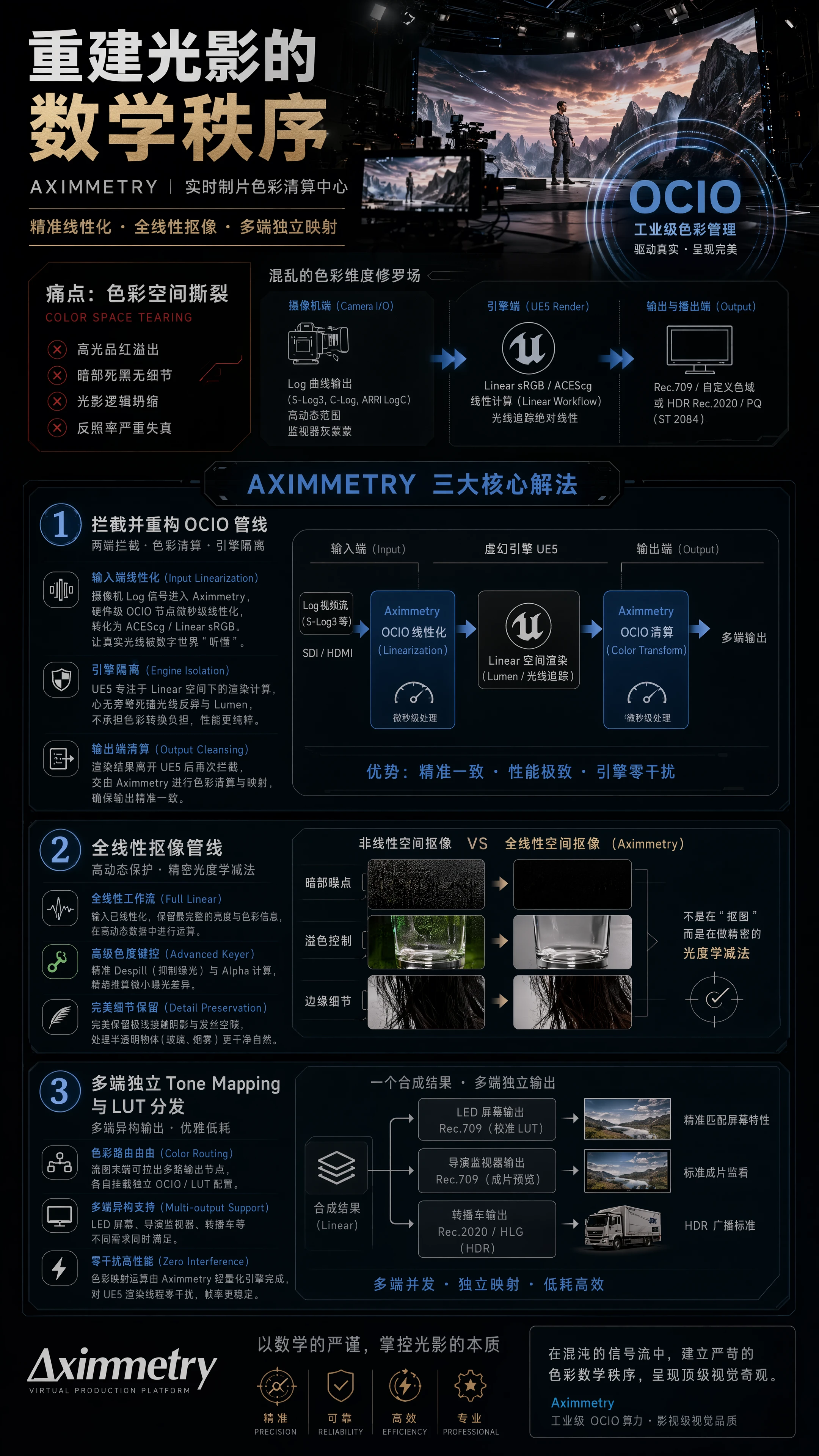
Core Solution 1: Intercept and Reconstruct the OCIO (OpenColorIO) Pipeline
Although native UE5 supports OCIO, the configuration is cumbersome, and when handling high-load real-time multi-channel I/O video streams, the performance overhead is significant, even causing frame rate drops.
Aximmetry's approach is:Perform interception and color clearing at both ends: before the video enters UE5 and after the rendered result leaves UE5.
- Input Side (Input Linearization): When the camera's S-Log3 signal enters Aximmetry via SDI, it is not directly sent to the compositor or engine. Aximmetry has built-in, extremely high-precision hardware-level OCIO nodes. At the GPU level, at microsecond speeds, it perfectly linearizes the Log signal(Linearize), converting it into ACEScg or Linear sRGB, consistent with UE5“s internal working space. This means that every reflection of light from a real actor is translated into linear data that digital light can ”understand” before entering the digital world.
- Engine Isolation: In this architecture (Aximmetry DE), Unreal Engine only needs to focus on what it does best: working on Lumen and light bounces in Linear space, without consuming any computing power to manage the color conversion mapping of video input and output.
Core Solution 2: Full Linear Keying Pipeline
If the color space mapping is not done correctly, the most severely affected is definitelyGreen Screen Keying。
In traditional non-linear spaces (e.g., directly using Rec.709 video streams), noise in the shadows is amplified by the Gamma curve, leading to extremely rough handling of spill on semi-transparent objects (e.g., glass cups, smoke).
Aximmetry'sAdvanced KeyerThe fundamental reason it is revered in the industry is that it is built on aFull Linear WorkflowBecause Aximmetry linearizes the video at the input, its Keyer operates on high dynamic data that retains the most complete luminance and color information. In this state, for Despill (suppressing green light) and Alpha channel calculations, Aximmetry can precisely calculate minute exposure differences that are even difficult for the naked eye to detect. This is why it can perfectly preserve very shallow contact shadows and hair strand gaps—it is not “keying,” but performing extremely precise “photometric subtraction.”
Core Solution 3: Multi-End Independent Tone Mapping and LUT Distribution
In large-scale XR projects, we often need to handle “multi-end heterogeneous output.” For example: the LED screen needs to output Rec.709 (with a specific screen calibration LUT); the director's monitor needs to see the Rec.709 final output; and the OB van might need an HDR Rec.2020/HLG signal stream.
If you use the UE engine to manage output, you need to mount multiple CineCameras and Post Process Volumes, and performance will instantly collapse.
In Aximmetry's Flow Graph,Color Routingbecomes extremely elegant and low-cost. As a TD, you can pull out three different output nodes at the end of the compositing pipeline.
- For the node outputting to the LED screen, mount a calibration OCIO configuration based on that screen's characteristics.
- For the node outputting to the OB van, mount a Rec.2020 Tone Mapper. Since all these final color transform operations are handled by Aximmetry's extremely lightweight and highly optimized image processing engine, it achieves“Zero Interference”。
with UE5's rendering thread.
“Conclusion: Rebuilding the Mathematical Order of Light and Shadow
“Looking good to the eye” is far from sufficient for film and broadcast-grade production. On the battlefield of real-time rendering, the essence of color is a rigorous matrix of floating-point operations.
When Log video collides with Linear rendering, even a slight misstep can lead to a plastic look and banding in the image, rendering the millions of dollars spent on rendering polygons meaningless.“Aximmetry deeply understands this underlying fragility in real-time rendering pipelines. With its extremely cold mathematical logic and powerful OCIO computing power, it becomes the”。
“Color Clearing Center”

 简体中文
简体中文  English