
In the past few years, whenever “Virtual Production” was mentioned, what often came to mind was a Hollywood-scale grand narrative: a massive LED volume spanning thousands of square meters, a render farm composed of dozens of rack-mounted servers, and a large, expensive “Brain Bar” technical team.
But as a producer who calculates budgets, schedules, and oversees sets every day, I know this very well:Not every project has the budget and timeline of *The Mandalorian*. When we face FMCG TV commercials, S-level variety show live broadcasts, or web series with tight budgets, what we need is not a slow-starting “aircraft carrier,” but a "light cavalry" that can draw its sword and strike fast at any moment.“Light Cavalry”。
Under the new trend of “Agile Production,” Aximmetry is the perfect commander for this light cavalry. Today, let's take a different angle, starting from the“On-site deployment, multi-camera coordination, and underlying fault tolerance”of hardcore real-world practice, to discuss why Aximmetry can truly make a virtual production crew “lighter” and “faster.”
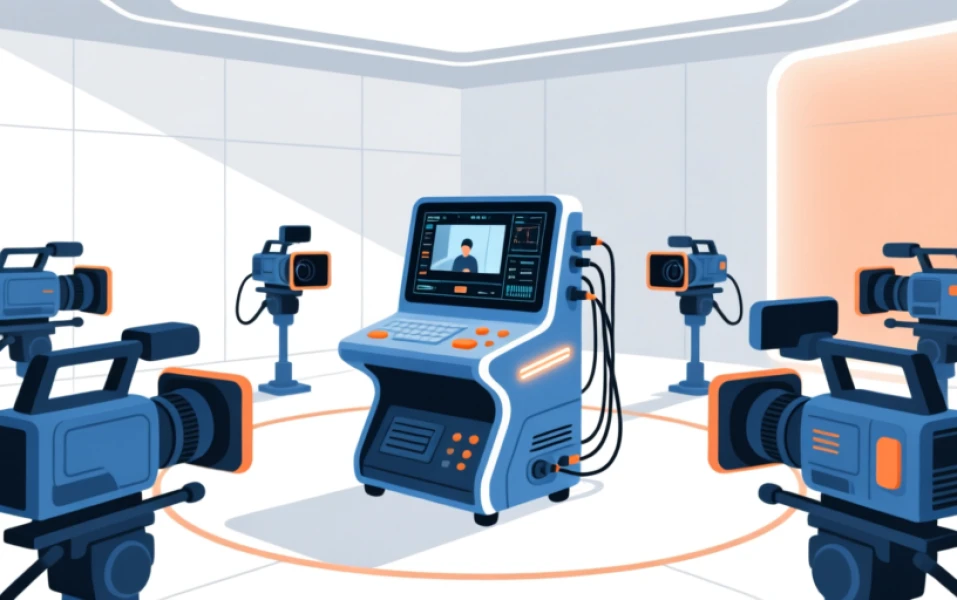
Saving “Mistakes and Stuttering”: Unrivaled Latency Compensation and Frame Synchronization Mechanism
On a virtual production set, there is an extremely fatal problem that often only surfaces after shooting begins:System LatencyWhen the real camera moves, there is a physical delay of several frames between the tracking data reaching the computer, the engine rendering the image, and the output to the screen. If not handled properly, the image will have a strong “tearing” effect, or the background in the composite will always be “a step behind.”
Aximmetry has an extremely matureBroadcast-grade underlying architectureIt features highly precise built-inDelay Compensation和andFrame Synchronization (Genlock/Timecode)
management. As a producer, I don't need to frantically search for various external hardware devices on set to “align” the timeline. Aximmetry can elegantly coordinate the frame rates of camera signals, tracking data, and engine-rendered images within the software, ensuring millisecond-level precision between real footage and virtual assets. This underlying stability is the strongest guarantee that a project can "wrap on time."
The "Command Tower" for Multi-Camera Sets: Breaking the Bottleneck of Single-Camera Rendering
Traditional native Unreal Engine performs adequately for single-camera film shoots, but for a large e-sports opening ceremony, an XR virtual concert, or a variety show requiring simultaneous multi-camera recording, native UE's multi-camera real-time switching and rendering logic becomes extremely bloated and fragile. Aximmetry is essentially not just a rendering controller, but a super "virtual vision mixer."It can easily handle three, four, or even more camera signals (SDI/NDI). Through simple node connections, operators can performseamless hard cuts or transitions with effects“between multiple real camera feeds and virtual roaming cameras, with each camera's tracking data and lens distortion calculated independently without interference. This means the crew can achieve”"Live to Tape"
in a virtual studio, just like recording a traditional TV program, greatly compressing the shooting schedule and post-production editing costs.
The Perfect Downward Integration of 2D and 3D: Rejecting the Waste of "Using a Sledgehammer to Crack a Nut"
In real projects, we don't always need to run a fully dynamic ray-traced UE5 scene at full load. Sometimes, the director just wants to insert a 2D floating screen playing a product video within a 3D virtual space, or overlay a 2D AR subtitle with an alpha channel on top of the live broadcast feed.Using pure UE to overlay these 2D elements is not only logically cumbersome but also wastes precious GPU rendering power. Aximmetry is anatural 2D/3D hybrid compositor“It allows you to very lightly drag in video MP4s, image sequences, or dynamic graphics into Aximmetry's native 2D nodes while running a UE scene. By handing complex 3D rendering to UE and basic 2D compositing and video playback back to Aximmetry, this”"rational allocation of computing power"
not only reduces the extreme demands on hardware servers but also makes on-site texture changes and video replacements as simple as using PowerPoint.
Extremely Compressed Deployment Cycle: Making "Guerrilla Warfare" Possible
In the past, setting up a virtual system—from installation, cabling, network debugging (nDisplay), to cluster alignment—often required a technical team to arrive 3 to 5 days in advance. Venue rental costs were bleeding money every day.Aximmetry's "lightweight" nature is reflected in its extremely agile deployment. For small to medium-scale green screen compositing or single-screen XR projects, a single top-tier graphics workstation running Aximmetry DE software can handle all tasks: tracking analysis, rendering, keying, compositing, and recording.No more massive server rooms, no complex LAN configurations needed. As long as the art assets pass testing in pre-production, the on-site technician only needs to "wheel in the cart, plug in the cables, and calibrate the cameras," often taking justhalf a day or even a few hours
to complete the entire setup and be ready for live shooting.
Producer's Summary: Say Goodbye to Stacking Hardware, Return to AgilityWe are experiencing a phase where virtual production is moving from "hype" to "practicality." As a producer, I crave stunning visuals more than anyone, but I know even better that
only controllable timelines, stable systems, and flexible scheduling can make a project truly profitable and keep the team from burning the midnight oil.
Aximmetry is like putting a lightweight, sturdy, and extremely handy set of reins on the spirited horse that is Unreal Engine. It turns virtual production from a “privileged game” for a few major studios into a "standard weapon" that more mid-tier crews, advertising agencies, and live streaming teams can use daily.

 简体中文
简体中文  English