
In Hollywood, there was once a behemoth that made all producers tremble at the mention of it, yet they had no choice but to pay for it—“the ”Render Farm"。
To present a perfect, detail-rich digital world on screen (whether it's the Pandora of Avatar or the pores on Thanos's face), hundreds of high-performance servers would run day and night for months in windowless server rooms, consuming staggering amounts of electricity. In that era, the essence of movie visual effects wastrading exorbitant time and electricity for pixels。
However, in the the daily reality of和 ICVFX (In-Camera Visual Effects)era, this behemoth is being ruthlessly deconstructed.
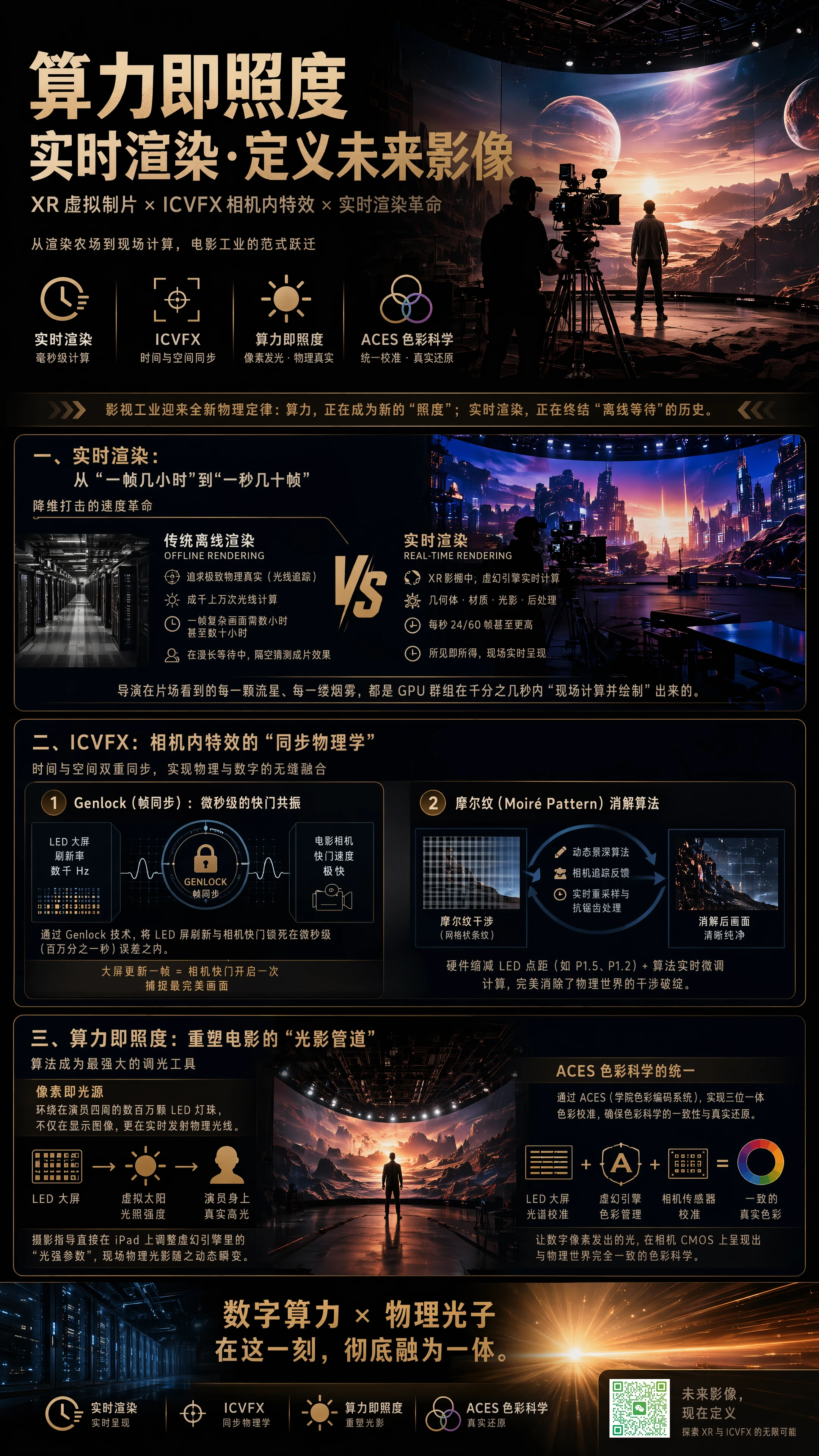
The film industry has ushered in a new physical law:Computing power is becoming the new “illuminance”; real-time rendering is ending the history of “offline waiting.”
I. Real-Time Rendering: From “Hours per Frame” to “Tens of Frames per Second”
To grasp the shock of this revolution, one must first understand the dimensional gap between traditional post-rendering and real-time rendering.
- Traditional Offline Rendering: Pursues ultimate physical realism (Ray Tracing). The thousands of refractions of light on different material surfaces require immense computational power. A single complex movie frame might take a serverhours, or even tens of hoursto calculate. Filmmakers had to guess the final result from a distance during the “long wait.”
- Real-Time Rendering: In an XR studio, the Unreal Engine must complete the calculation of geometry, materials, lighting, and post-processing for an entire 3D scene withinmilliseconds, and output it to thousands of square meters of LED screens at24, 60, or even higher frames per second.
This is not just a speed improvement; it's a leap in dimensionality. This means“What You See Is What You Get”has become a reality. Every shooting star and wisp of smoke the director sees on set is "calculated and rendered on-site" by the GPU (Graphics Processing Unit) cluster in thousandths of a second“.”II. ICVFX: The "Synchronized Physics" of In-Camera Visual Effects
In XR virtual production, the core and most technically challenging concept is called“
ICVFX (In-Camera Visual Effects) It demands a near-miraculous"dual synchronization of time and space"“between the digital background and the physical camera.”。
To achieve this, the film industry has introduced the most advanced physical and computational technologies:
Genlock: Microsecond-Level Shutter Resonance
The refresh rate of LED screens is typically thousands of hertz, while movie camera shutters are extremely fast. Without absolute synchronization, the camera captures invisible “black lines,” “flicker,” or “tearing.” ThroughGenlock (frame synchronization)technology, the camera's shutter opening and closing is precisely locked to the LED screen's frame refresh withinmicrosecond (one-millionth of a second)tolerance. The screen updates one frame, and the camera shutter opens exactly once, ensuring the perfect image is captured.
Moiré Pattern Elimination Algorithm
When the camera focuses on the LED screen, the camera's CMOS sensor interferes with the screen's light-emitting pixels, creating highly distracting grid-like patterns—moiré patterns. To solve this, technical teams not only reduce the LED'spixel pitch (e.g., P1.5, P1.2)in hardware but also perform real-time algorithmic adjustments: using dynamic depth-of-field algorithms and camera tracking feedback, the Unreal Engine performs finedigital resampling and anti-aliasing。
calculations on the out-of-focus background, perfectly eliminating the interference flaws of the physical world.
III. Computing Power as Illuminance: Reshaping the “Lighting Pipeline” of Film”
In traditional cinematography, controlling light relied on incandescent lamps, LED lights, diffusion paper, and reflectors. But on an ICVFX set,“algorithms” become the cinematographer's most powerful lighting tool。
- Pixels as Light Sources: Millions of LED beads surrounding the actors not only display images but also emit physical light in real time. The brightness of the sun rendered on the screen determines the realism of the highlights on the actors on set. The Director of Photography (DP) no longer needs to climb rigs to adjust lights; they simply adjust the “light intensity parameters” in the Unreal Engine on an iPad, and the physical lighting on set changes dynamically in an instant.
- ACES Color Science Unification: The light spectrum emitted by LED screens differs greatly from natural light, easily causing color shifts when captured by the camera sensor. To achieve absolute color reproduction, XR production introduces ACES (Academy Color Encoding System)Through a trinity ofcolor calibrationfor the LED screen, Unreal Engine, and camera sensor, the light emitted by digital pixels presents a color science on the camera's CMOS that is perfectly consistent with the physical world.
At this level,digital computing power and physical photons are completely fused。
Conclusion
From the era of chemical film, to the era of digital cinema cameras, to the current “era of real-time rendering and computing,”
the tools of filmmaking have shifted from“optics and mechanics”to“silicon and computing power”In an XR production studio, those massive LED screens are no longer mere displays but supercomputers that frantically calculate and simulate the physical universe in real time.
Computing power not only illuminates the set but also lights the way for the film industry's future channel to infinite creativity.
From now on, film is not just the art of light and shadow but a symphony of computing power and algorithms.

 简体中文
简体中文  English