
In cinematic virtual production (ICVFX) and high-end HDR broadcast relay,“Color Science Consistency”is the lifeline that determines the final texture of the image.
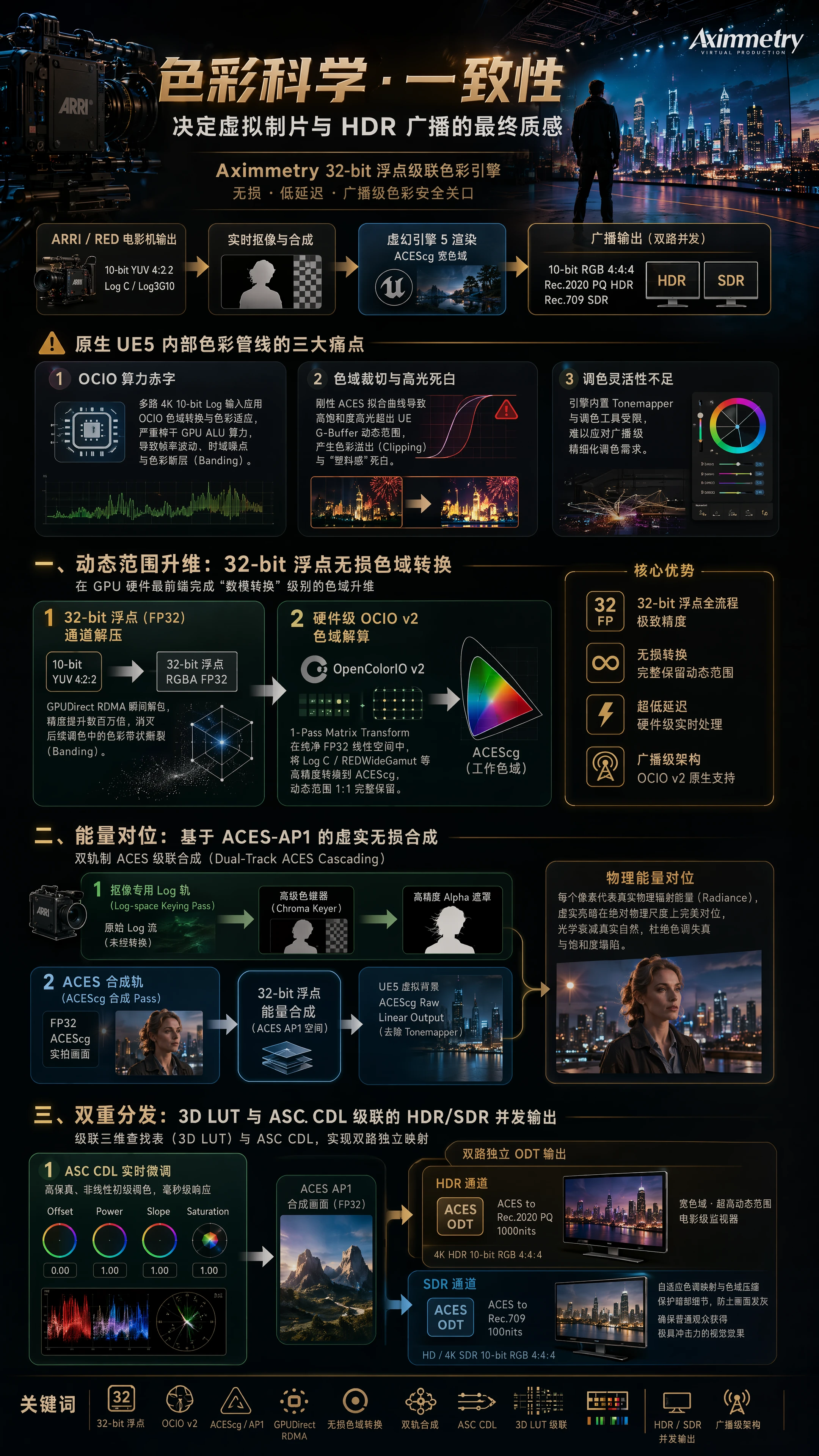
On a typical production set, the technical team must navigate an extremely complex color pipeline: ARRI/RED cinema camera output (10-bit YUV 4:2:2 Log C/Log3G10) -> Real-time keying and compositing -> 3D virtual background rendered by Unreal Engine 5 (UE5) (ACEScg wide color gamut) -> Broadcast output (10-bit RGB 4:4:4 Rec.2020 PQ HDR / Rec.709 SDR dual-stream concurrent).
However, when a Technical Director (TD) attempts to Native Unreal Engine 5 When internally completing this high dynamic range (HDR) color reconstruction chain, it immediately hits a physical wall:
- The computational deficit of the engine's built-in OCIO (OpenColorIO): UE5's Viewport rendering, Post-process, and Media Plate are designed for game rendering. In a real-time pipeline, applying OCIO for color space conversion and chromatic adaptation at high frequency to multiple 4K 10-bit Log inputs will severely drain the GPU's shader ALU compute power. This not only causes frame rate fluctuations but also leads to uncontrollableTemporal Noise and Color Banding。
- Gamut Clipping and “Highlight Burnout”: The native UE5 internal Tonemapper typically applies a rigid ACES fit curve. When high-saturation neon lights or firelight (high dynamic range highlights from the physical world) from the live-action footage enter the engine, their color values easily exceed the dynamic range of the UE G-Buffer, causing severeColor Clipping and “Plastic-like” Burnout at the boundaries。
Facing this hard collision between high-precision color vector transformation and real-time rendering compute power,Aximmetry leveraging its underlying“32-bit Float Cascading Color Engine”and built-in OCIO v2 Broadcast Architecture, it builds a lossless, ultra-low latency color safety checkpoint around the renderer.
I. Dynamic Range Elevation: GPU Register-Based 32-bit Float Lossless Color Space Conversion
To protect the extremely precious Shadow details and Highlight transitions in the live-action footage, Aximmetry establishes an iron rule:Before video input enters the compositor, it must undergo a “digital-to-analog conversion” level of color space elevation at the very front end of the GPU hardware.
Aximmetry bypasses the default YUV conversion of the Windows system and conventional capture card drivers, deploying directly at the bottom layer of GPU memory a“Precision Matrix Transform”:
32-bit Float (FP32) Channel Decompression
The moment the 10-bit YUV 4:2:2 physical signal from the live-action footage enters the GPU via GPUDirect RDMA, Aximmetry immediately invokes a dedicated GPU Compute Shader to unpack and reconstruct it into a 32-bit Float (RGBA FP32) format. This operation increases the precision of color data by millions of times, completely eliminating “Color Banding” caused by insufficient bit depth in subsequent Color Grading.
Hardware-Level OCIO v2 Color Space Calculation
Aximmetry integrates an industrial-grade OpenColorIO v2 engineat the very front of its flow graph. Directly at the GPU hardware layer, through a 1-Pass Matrix Transform, it converts the camera's native Log space, such as ARRI Log C or REDWideGamut, with high precision into the gold standard for 3D compositing—ACEScg Working Color SpaceBecause this conversion is performed in an extremely pure FP32 Linear Space, the dynamic range of the live-action footage is preserved 1:1 intact, with no pixel information being prematurely “clipped” or discarded.
II. Energy Alignment: Lossless Virtual-Real Compositing Based on ACES-AP1
After completing the color space conversion, the second step is to composite the “live-action actor” with the “virtual background” in the same color physical dimension. The traditional approach is to forcibly flatten (De-log) the live-action footage before keying, which leads to severe edge softening or spill on the keying edges due to loss of contrast.
Aximmetry introduces“Dual-Track ACES Cascading”technology:
Keying-Specific Log Track (Log-space Keying Pass)
Aximmetry duplicates an original Log video stream that has not undergone any color space conversion, sending it specifically to its proprietary advanced Chroma Keyer. Because the Log space retains the most complete and finest edge grayscale gradient, the Keyer can strip out real, fine hair strands and semi-transparent smoke with extremely high precision, generating a near-perfect Alpha matte.
ACES AP1 Space Energy Compositing
At the final image compositing stage, Aximmetry blends the ACEScg format live-action footage obtained from the first step with the ACEScg format virtual background rendered by UE5 (Raw Linear Output with UE Tonemapper removed), pixel by pixel in a 32-bit float environment.
At this stage, the R, G, B values of each pixel no longer represent “color,” buttrue physical RadianceThe bright and dark areas of the virtual and real worlds achieve perfect alignment on an absolute physical scale. When strong light from the virtual world hits the live-action actor, the scattering and light spill generated at the actor's edges perfectly conform to the optical attenuation laws of the real physical world, completely eliminating color distortion and saturation collapse.
III. Dual Distribution: HDR/SDR Concurrent Output via Cascaded 3D LUT and ASC CDL
In television broadcasting and multi-platform distribution, the production site often needs to output both 4K HDR (High Dynamic Range) and HD SDR (Standard Dynamic Range) signals simultaneously. Using a single conversion would result in an overly dark SDR image or abnormal saturation in the HDR image.
At the end of its color pipeline, Aximmetry deploys a“Cascaded 3D Look-Up Table (3D LUT) and ASC CDL (Color Decision List)”architecture, enabling dual independent mapping:
ASC CDL Real-Time Fine-Tuning
Aximmetry provides standard ASC CDL (Offset/Power/Slope/Saturation) controllers before output. Colorists can use a control panel on-site to perform high-fidelity, non-linear Primary Grading on the composited ACES image with millisecond response times, without introducing any rendering latency.
Dual Independent ODT (Output Device Transform)
Aximmetry forks two independent ODT channels at the end of the compositor, outputting concurrently:
- HDR Channel: Using the built-in ACES ODT (e.g., ACES to Rec.2020 PQ 1000nits), it directly outputs a wide color gamut, ultra-high dynamic range signal to cinematic monitors.
- SDR Channel: Independently runs an advanced set of tone mapping and gamut compression algorithms (e.g., ACES to Rec.709 100nits). While compressing highlight energy, it protects shadow details through adaptive Gamut Mapping, preventing the SDR image from appearing washed out, ensuring that ordinary viewers on the broadcast end still receive a visually impactful result.
Conclusion: Let Light and Shadow Return to Purity
In today's highly advanced digital imaging technology, every bit of image brightness and every coordinate of the color space directly determines the success or failure of virtual-real fusion. Any compromise or concession in color format conversion will be exposed under the sharp sensor of a 4K HDR cinema camera.
Unreal Engine 5 outlines a magnificent digital cathedral, but its inherent game rendering attributes make it difficult to perfectly accommodate complex broadcast-grade Log signals and stringent color gamut standards without sacrificing performance.
Aximmetry The core value of Aximmetry is to act as the“Color Guardian”。
in this interlocking of virtual and real light and shadow. It eliminates color banding at the bottom layer with FP32 memory direct access technology, protects the true dynamic range with OCIO v2 and a dual-track compositing pipeline, and achieves high-quality HDR/SDR dual-stream distribution with a cascaded ODT architecture. It is precisely because of Aximmetry's physical-level rigor and uncompromising approach to pixel-level color conversion that technical directors and film colorists can unleash cinematic light and shadow tension on the live stage of virtual production, allowing the boundary between silicon and carbon to completely dissolve in a pure, lossless river of photons.

 简体中文
简体中文  English