
Do you trust your own eyes?
Under the setting sun, that glint of golden afterglow refracting from the protagonist's eye; the neon reflections swiftly flowing across the metal body of a speeding sports car; the vast and profound rotating nebula on an astronaut's visor...
In front of the screen, you are deeply moved by these incredibly realistic details. But the cruel truth is:None of this is real.
There is no sunset here, no neon lights, and certainly no universe. All of this is merely happening inside a hundred-square-meter studio—“A ”visual illusion."。
And the mastermind behind this illusion is preciselythe daily reality of。
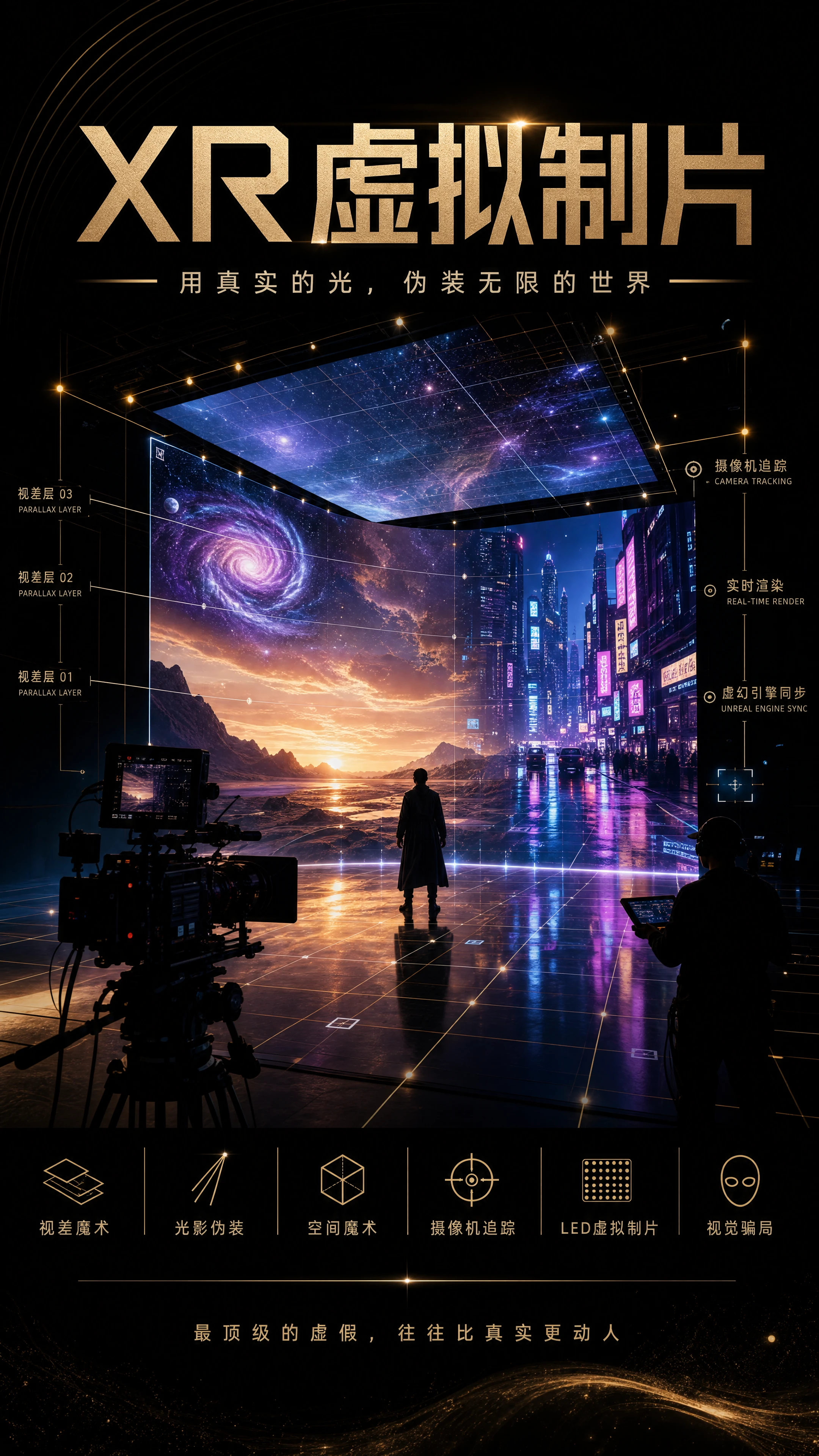
I. Parallax Magic: How to Deceive the Most Demanding Lens?
The human eye and the camera lens are extremely picky. If there's even a hint of “perspective mismatch” in the frame, the brain immediately sounds the alarm: “This is fake!”
Traditional backdrops are flat, and the moment the camera moves, the illusion is broken. But XR virtual production can perfectly“deceive”the lens.
Its secret weapon is thecamera tracking system.When the real camera moves one centimeter to the left, the tracking system captures this movement within milliseconds and notifies the Unreal Engine, causing the 3D background on the LED screen to render one centimeter to the right in sync.
In the frame, the distant mountains in the background and the props nearby create a perfect“parallax.”This physically precise perspective shift instantly gives the flat screen infinite depth within the lens.
The lens is fooled, believing it is facing a real, physical world.
II. Light and Shadow Disguise: How to Deceive the Most Sensitive Brain?
The brain's core criterion for judging whether an object is real or fake is“the coherence of light and shadow.”。
Why does green screen compositing always feel “fake”? Because the green screen cannot emit light; the light on the actor is artificially projected and can never be 100% integrated with the background's lighting.
XR virtual production, however, is an“ultimate disguise based on image-based lighting.”。
- If the screen shows blazing flames, the LED wall physically casts real red light and intense shadows onto the actor's face and armor.
- When a water droplet slides across the car body, it refracts the faint light from the virtual streetlights on the screen.
This detail of “real light and real shadow” deceives the most discerning brain. You might think the post-production VFX artist spent months rendering the lighting, but in reality, it's just beams of physical light emitted by the LED screen on set.
III. Spatial Magic: Creating Vastness Within Arm's Reach
The most magical aspect of this “illusion” is that itcompletely breaks the constraints of physical space.。
Inside a studio that is only a dozen meters long and wide, and just a few meters high:
- An actor takes three steps forward, and on screen, they have already crossed half the Sahara Desert;
- The sports car remains stationary, but in the frame, it is racing through the streets of Tokyo at 200 kilometers per hour.
XR technology uses algorithms and pixels to fabricate an infinitely extending universe for creators within a cramped physical space.It not only deceives the audience but even fools the actors standing within it.
Conclusion
The highest level of magic is making the audience choose to believe, even when they know it's fake.
XR virtual production is the greatest “magician” in the film and television industry. It uses cold chips, algorithms, and LED beads to weave a warm, stunning, and flawless visual dream.
So, don't trust your eyes too much. Because in the world of XR,the most premium falsehood is often more moving than reality itself.

 简体中文
简体中文  English