
If you've ever spent time in a multi-million dollar LED virtual production (VP) studio, you've surely witnessed a “disaster” like this:
The director requested a shot of a car speeding through a virtual cyberpunk city. To make the reflections on the car body look realistic, the technical team used UE5 to project the rendered city neon sign image onto the overhead LED ceiling (Ceiling LED) as a light source. At the same time, several DMX-controlled physical strobe lights were set up on set to simulate the effect of streetlights whizzing by.
When the director yelled “Action,” the画面 on the monitor was extremely eerie: the neon sign reflections on the LED ceiling and the physical movement of the car itselfshowed obvious trailing (delay); and the flashing rhythm of the physical strobe lights was completely out of sync with the passing speed of the virtual streetlights in the UE5 engine.。
This is the technical dead end that gives every Gaffer and TD (Technical Director) the biggest headache:“Lighting Desynchronization”。
In the native pipeline, the display delay of the LED screen, the rendering delay of the engine, and the signal delay of the DMX lighting console are three completely independent tracks. When you try to make them synchronize lighting in an instant, the huge time difference is enough to destroy the physical realism of the image.
Faced with this pain point that could ruin the entire shot,Aximmetrythe solution provided demonstrates its terrifying dominance as an industrial-grade master controller:Taking over all photometric data at the bottom layer, establishing a “zero-latency” pixel-level physical synchronization reflex arc.
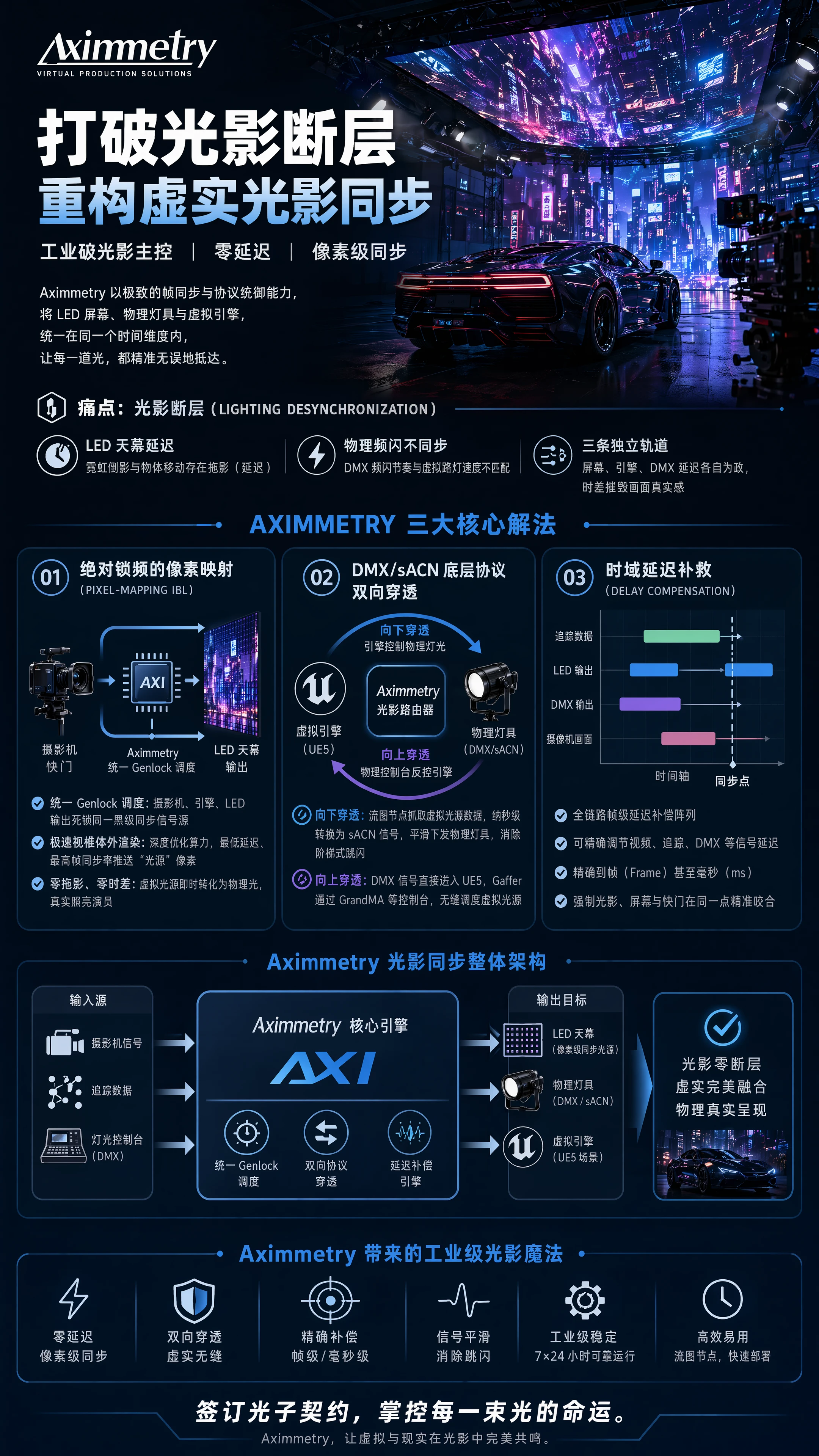
Core Solution 1: Absolute Locked-Frequency Pixel-Mapping IBL
In high-end VP shooting, the best light source is often the glowing LED screen itself (Image-Based Lighting). But this requires the light emitted by the screen to be absolutely synchronized with the frames captured by the camera.
If using the native pipeline, slicing UE5 frames and sending them to the LED processor often results in 2-3 frames of input delay.
Aximmetry, through its highly optimized underlying I/O architecture,completely reconstructs the synchronization logic of pixel mapping.:
- Unified Genlock Scheduling: Aximmetry locks the camera shutter, engine rendering frames, and LED controller output signals tightly under the same Genlock (black burst) signal source.
- High-Speed Outer Frustum Rendering: When rendering the LED screen portion (outer frustum) used for lighting, Aximmetry performs deep computational optimization. It ensures that these pixels, acting as “light sources,” are pushed to the screen with the lowest latency and highest frame synchronization rate. When a fireball flies by in the virtual scene, the LED screen instantly releases a highly synchronized orange physical light, illuminating the actor's face without any trailing or time lag.
Core Solution 2: “Bidirectional Penetration” of DMX/sACN Underlying Protocols”
Relying solely on the LED screen for light is not enough; often, high-brightness physical fixtures (like ARRI SkyPanel) must be added. But in the native workflow, having the UE5 engine precisely control hundreds of DMX fixtures is not only extremely cumbersome to configure but also prone to network congestion causing flickering instability.
Aximmetry transforms itself into a powerful“Bidirectional Lighting Router.”:
- Downward Penetration (Engine Controls Physical Lights): Aximmetry natively includes deep support for professional lighting protocols like DMX, Art-Net, and sACN. Through extremely simple Flow Graph nodes, you can directly capture the brightness, color RGB values of a virtual light source in the UE5 scene, or even the average color of a specific pixel area. Aximmetry converts these floating-point numbers into sACN network signals at nanosecond speed, directly sending them to the physical fixtures on set. This not only has no latency but also provides extremely smooth signals, completely eliminating the “stepped flickering” of lights caused by traditional relay solutions.
- Upward Penetration (Physical Console Controls Engine): An even more advanced approach is that the on-set lighting expert (Gaffer) doesn't want to touch a mouse; they only trust their GrandMA lighting console. Aximmetry allows the console's DMX signalsto penetrate the pipeline directly into UE5.When the Gaffer pushes a fader on the console, Aximmetry instantly converts the level signal into the intensity parameter or rotation of the virtual sun in UE5. Real-world lighting and virtual lighting achieve perfect integrated scheduling on the same physical console.
Core Solution 3: Time-Domain Delay Compensation
Although Aximmetry strives to minimize latency, in the physical world, the acquisition of camera video streams and processor calculations inevitably take time. This can cause a lighting mismatch between tracking data (which takes effect immediately) and the video image (which lags by a few frames).
Deep within the pipeline, Aximmetry deploys a“Full-Chain Frame-Level Delay Compensation Array.”As a TD, you can individually adjust the delay for input video, tracking data streams, and even DMX output commands in Aximmetry, with precision down to “frames” or even “milliseconds.” Aximmetry acts like a precision gearbox, holding back faster signals to force the flashing of physical lights, the refresh of the LED screen, and the camera shutter to precisely engage at the same point on the timeline.
Conclusion: Reconstructing the “Photon Contract” of the Physical World”
In the extremely demanding technical art of virtual production, “light and shadow” are the most powerful weapons to deceive the human brain, yet also the easiest weakness to expose.
The native Unreal Engine is unmatched in computing virtual ray tracing, but when it comes to coordinating complex physical light-emitting devices, it seems like a conductor struggling to manage an orchestra where each musician plays their own tune.
Aximmetry deeply understands the devastating blow caused by this “virtual-physical lighting gap.” With its extremely powerful protocol parsing capabilities and uncompromising frame synchronization algorithms, it forcibly signs a“Photon Contract”。
between the virtual and physical worlds. Through absolute locked-frequency pixel mapping, a bidirectionally penetrating lighting network, and millisecond-level delay compensation, Aximmetry unifies the complex physical fixtures, LED screens, and digital light within an impeccable temporal dimension. Under its command, every splash of a virtual spark instantly ignites a real reflection in the actor's pupil—this is the true industrial-grade lighting magic.

 简体中文
简体中文  English