
In the tech world, “Spatial Computing” has become an absolute focal point due to the release of Apple Vision Pro. It heralds humanity's transition from the “screen era” to the “era of spatial interaction.”
However, many people are unaware that, thousands of kilometers away from Silicon Valley, on the film production lines of Hollywood and top-tier digital studios in China, a“Spatial Computing” Revolution in the Film Industryhas already quietly erupted.
The vehicle of this revolution is the daily reality of。
It is not merely an “upgraded green screen” or a “larger LED screen,” but rather a“Dimensional Reconstruction” of Cinema's Century-Old Physical Visual Grammar”It is elevating filmmaking from an “art of recording two-dimensional frames” into a “science of manipulating three-dimensional space.”
I. Frustum Tracking: Reconstructing the Spatial Coordinates of Camera and World
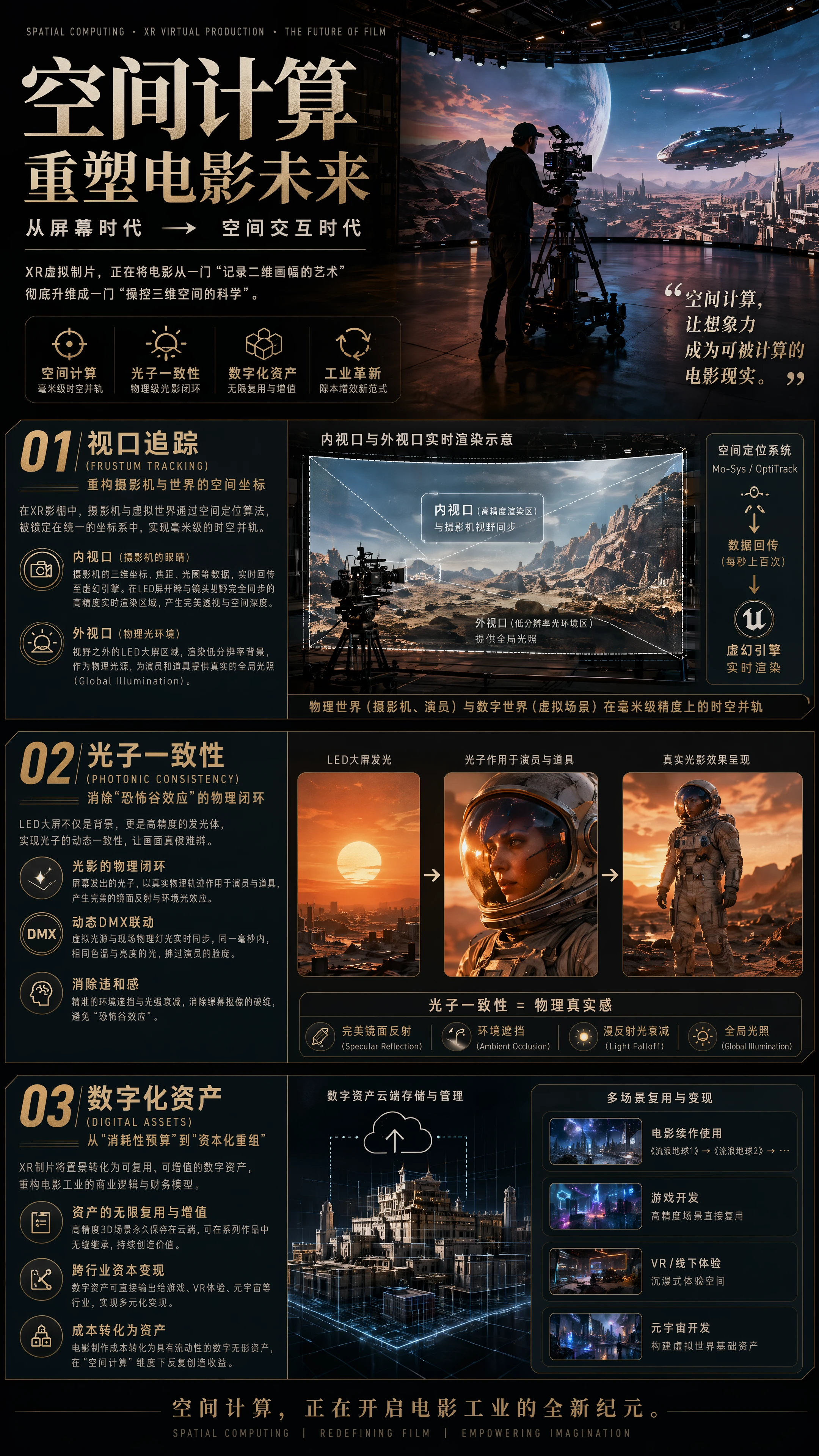
In traditional filmmaking, the camera and physical background are disconnected. But in an XR studio, the two aretightly locked into a unified "coordinate system" throughspatial positioning algorithms.
This is the core professional technology in virtual production:Real-Time Rendering of the Inner Frustum and Outer Frustum。
- Inner Frustum (The Camera's Eye): When the physical camera on set moves, a high-precision spatial tracking system (such as Mo-Sys or OptiTrack) transmits the camera's 3D coordinates, focal length, aperture, and other data in real time, hundreds of times per second, to Unreal Engine. The engine then opens up a high-precision, real-time rendering area on the LED wall that is perfectly synchronized with the camera's field of view—the Inner FrustumIt produces perfect parallax changes as the lens pans, creating flawless spatial depth in the shot.
- Outer Frustum (Physical Light Environment): The area of the LED wall outside the camera's field of view (theOuter Frustum) renders a low-resolution background, serving as a physical light source to provide physically accurate global illumination for actors and props.
This spatial computation achievesthe millimeter-precision spatiotemporal synchronization of the physical world (camera, actors) and the digital world (virtual scene).。
II. Photonic Consistency: The Physical Closed Loop Eliminating the “Uncanny Valley”
Why can audiences instantly spot the flaws in green screen compositing? Because green screens cannot solve“Photonic Consistency.”That is the real question.
Green screens do not emit light; the light on actors relies entirely on artificial lighting simulation. This simulation, lacking reflective media, cannot generate accurateAmbient Occlusion和or Light Falloff, creating an unnatural “fringing” effect on the edges of actors, triggering the brain's visual alarm.
In an XR studio based on spatial computing, the LED wall is not just a background but ahigh-precision light emitter (Image-Based Lighting).:
- The Physical Closed Loop of Light and Shadow: Photons from the sunset, lightning, or sci-fi neon on the screen follow real physical trajectories, hitting the actor's skin, metal armor, and glass visor, producing perfectSpecular Reflection.。
- Dynamic DMX Synchronization: Through the DMX control protocol, virtual light sources in Unreal Engine achieve real-time numerical synchronization with physical lights on set (such as ARRI soft lights). When a burning spaceship flies across the screen, the physical lights on set, within the same millisecond, sweep across the actor's face with the same color temperature and brightness.
This dynamic consistency of photons achieves a film image that is“indistinguishable from reality” at the physical level.”。
III. Digital Assets: From “Consumable Budget” to “Capitalized Restructuring”
Beyond the technological upgrade, spatial computing is fundamentally restructuring the film industry'sbusiness logic and financial model.。
Traditional film set construction is a “one-time consumable.” The streets and palaces built by a crew for millions of yuan are demolished as industrial waste after filming, with the budget reduced to zero.
But in the XR production workflow, set construction becomes“Digital Assets.”:
- Infinite Reuse and Appreciation of Assets: High-precision 3D scenes created by the crew through LiDAR scanning or Unreal Engine can be permanently stored in the cloud. They can be used not only in "The Wandering Earth 1" but also seamlessly inherited by "The Wandering Earth 2" and "The Wandering Earth 3."
- Cross-Industry Capital Monetization: Digital assets left over from film production can be directly packaged and exported to game developers, VR experience stores, or metaverse developers. In the dimension of “spatial computing,” the cost of filmmaking is transformed into liquiddigital intangible assets that can be repeatedly monetized.。
Conclusion
From silent to sound, from black-and-white to color, from film to digital, every astonishing leap forward in the film industry has essentially been another expansion of the human audiovisual dimension by technology.
XR virtual production is the milestone marking the film industry's entry into the era of “spatial computing.”
It integrates “shooting, effects, lighting, and time-space” into one, using algorithms and pixels to define a new physical universe within the studio. In this new universe, technology is no longer post-production patching but a pre-production creative force.
Welcome to the elevated era of cinema, where space is computed by programs, and imagination has completely broken through physical boundaries.

 简体中文
简体中文  English