
In the live production of virtual production (ICVFX) and multi-camera mixed reality (MR), there exists an invisible killer that keeps system engineers and directors of photography (DP) up all night—Temporal Phase Drift and Non-Genlocked Tearing。
When a camera performs a rapid lateral move toward a high-resolution LED stage, a horizontal dark band (scan line) occasionally appears on the monitor, or the virtual background exhibits an extremely subtle physical jitter the moment the camera starts or stops. The physical essence of this visual disaster isthe temporal desynchronization among the physical camera shutter, the LED screen refresh cycle, and the GPU rendering clock。
In top-tier broadcast and film production, the ultimate weapon to solve this problem is Genlock (Global Lock Synchronization)However, when the technical team attempts todeploy Genlock in native Unreal Engine 5 (UE5), they immediately hit the soft real-time bottleneck of the operating system:
- Instability of software-level frame pacing: Native UE5 relies on the Windows operating system's DWM (Desktop Window Manager) or DX12 swap chain for frame rate control. Under heavy Lumen rendering loads, the engine's frame time experiences severe millisecond-level jitter. This software-level clock control is fundamentally incapable of nanosecond-level physical alignment with broadcast-grade rigid hardware clocks (such as Tri-Level Sync).
- Blind spot of Phase Tuning: Even if both the camera and the engine are locked to the same 50Hz sync signal, if there is a microsecond-level phase offset between the camera's shutter opening action and the LED screen's pixel update cycle, the camera will still capture a partially refreshed frame from the LED screen, resulting in black bars or flickering.
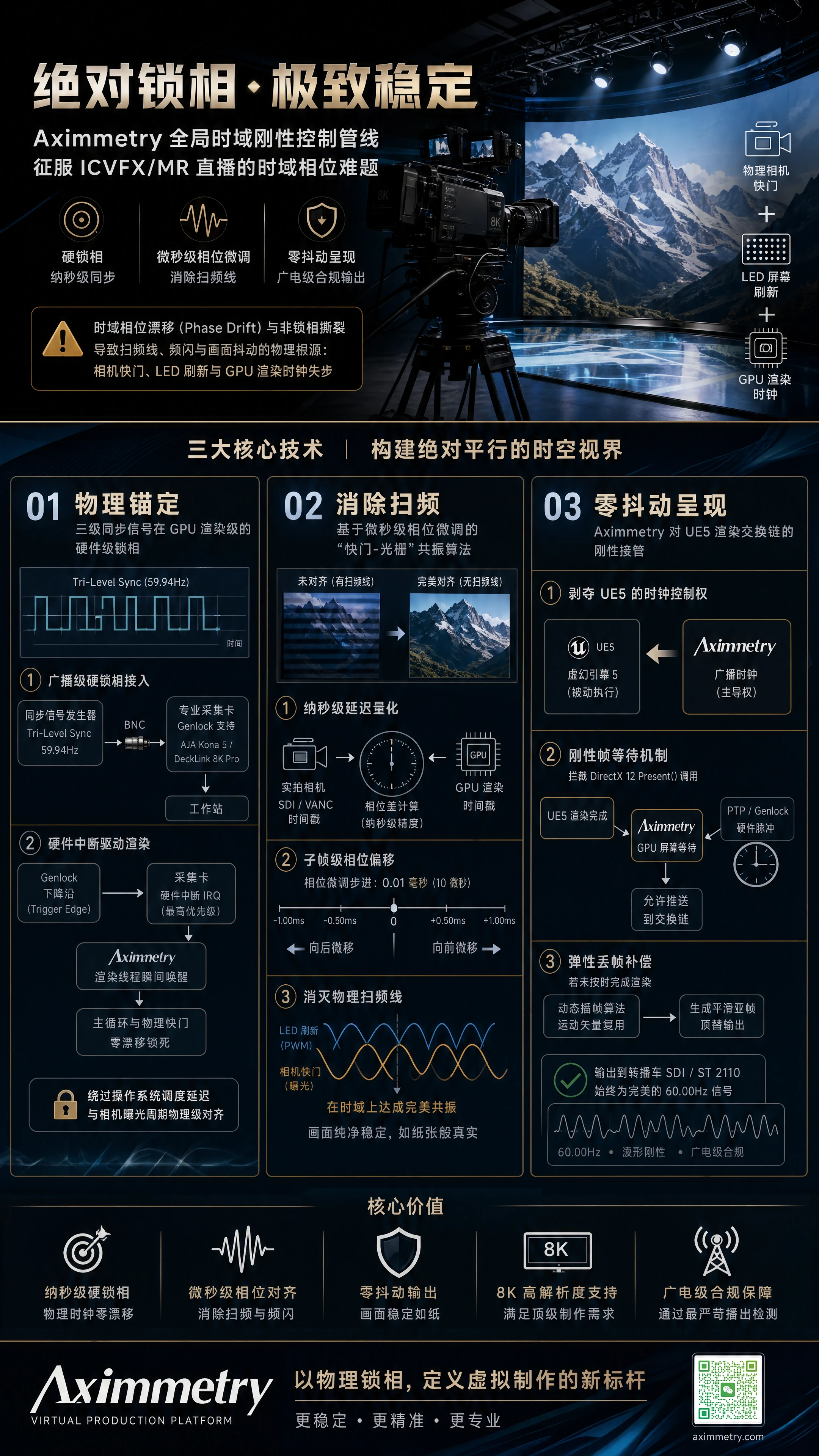
Aximmetry With its Rigid Temporal Control Pipeline, specifically reconstructed for broadcast-grade hard-lock synchronization,“Rigid Temporal Control Pipeline”, it forcibly establishes an absolutely parallel temporal horizon between the physical shutter and the digital raster.
I. Physical Anchoring: Hardware-Level Phase Locking of Tri-Level Sync Signals at the GPU Rendering Level
To completely conquer clock drift, the system must introduce an absolutely authoritative “time ruler” at the hardware bottom layer.
Aximmetry rejects any operating system-based software-level frame synchronization and instead takes over at the very front end:Hardware-Level Genlock Signal (Black Burst / Tri-Level Sync):
Broadcast-Grade Hard Genlock Input
The workstation is equipped with a professional capture card that supports hardware Genlock (e.g., AJA Kona 5 or Blackmagic DeckLink 8K Pro). The Tri-Level sync signal generated by an external sync generator is fed directly into the capture card's hardware chip via a BNC physical cable at an absolutely rigid frequency (e.g., 59.94Hz).
Hardware Interrupt-Driven Rendering
Aximmetry's underlying engine directly hooks into the capture card's hardware interrupt request (IRQ). During runtime, whenever the capture card detects the falling edge (Trigger Edge) of the external Genlock signal, it sends a highest-priority physical hardware interrupt to the operating system. Upon receiving this interrupt, Aximmetry instantly wakes the rendering thread. This mechanism bypasses Windows' thread scheduling latency, locking Aximmetry's main compositing loop and the physical camera sensor's exposure cycle to the same physical, zero-drift time origin.
II. Eliminating Scan Lines: A “Shutter-Raster” Resonance Algorithm Based on Microsecond-Level Phase Tuning
After solving the frequency (frame rate) matching issue, the next step must address the most troublesome “Phase Offset” problem—ensuring that the moment the camera shutter opens, the LED screen is in its emitting state, not refreshing.
Aximmetry introduces“Microsecond Phase Shifter”:
Nanosecond-Level Delay Quantification
Aximmetry can read the VANC (Vertical Ancillary Data) timestamp from the SDI frame header of the live camera input with nanosecond precision, physically compare it with the current GPU rendering timestamp, and calculate the absolute phase offset between the live shutter and the virtual rendering.
Sub-frame Phase Tuning
Within Aximmetry's system console, engineers can perform non-destructive phase tuning of the rendering clock in steps of 01 milliseconds (10 microseconds) This algorithm does not change the rendering frame rate but instead shifts the moment the GPU sends image data to the LED controller backward or forward on the timeline.
Eliminating Physical Scan Lines
Through this microsecond-level tuning, the technical team can, like modulating a radio wave, achieve perfect temporal “resonance” between the LED screen's PWM refresh high-frequency cycle and the physical camera sensor's rolling shutter or global shutter. Scan lines and flicker are instantly eliminated at this physical resonance point, presenting the LED screen in the lens as a stable, pure color physical entity, as solid as paper.
III. Zero-Jitter Presentation: Aximmetry's Rigid Takeover of the Unreal Engine Rendering Swap Chain
Even if the first two steps are executed perfectly, if UE5 experiences a 2-millisecond stutter during a frame due to scene complexity, the entire phase-locked loop will instantly collapse, causing dropped frames on the output.
Native UE5, when performing physical depth of field calculations at high resolution, requires multi-sampling of massive pixels, resulting in extremely high graphics card bandwidth overhead.“Virtual Clock Takeover and Swapchain Interception”Strategy:
Depriving UE5 of Clock Control
In Aximmetry's dual-computer (Multi-Machine) or single-machine compositing pipeline, Unreal Engine 5“s native clock (Delta Time) is forcibly mounted under Aximmetry's broadcast clock. UE5 loses the authority to decide when to render the next frame, becoming a passive ”3D rendering executor."
Rigid Present Barrier
During rendering, Aximmetry forcibly intercepts the DirectX 12 Present() call. If UE5 completes rendering early, it must remain in a suspended state at the GPU barrier until Aximmetry's PTP/Genlock hardware pulse signal arrives, only then being allowed to push the rendered frame into the video memory swap chain.
Dynamic Frame Recovery
If UE5 occasionally fails to complete rendering on time due to computational overload, Aximmetry's compositor will never send a corrupted frame to the output. It uses built-in high-dynamic interpolation algorithms or instantly reuses the motion vectors from the previous frame to generate a smooth transitional sub-frame as a replacement. This ensures that the SDI/ST 2110 physical link output to the OB van is always an absolutely perfect, waveform-rigid 60.00Hz signal, completely passing the strictest physical compliance checks of the broadcast output.
Conclusion: The Rigid Order of Time
In the highest echelons of real-time audiovisual production, the perfect fusion of spatial dimensions is merely the surface, while the rigid alignment of the temporal dimension is the invisible backbone supporting all digital illusions. Any temporal misalignment, even by a single frame or microsecond, will be instantly magnified into glaring visual artifacts under the physical scrutiny of modern high-definition, high-frame-rate cameras.
Unreal Engine 5, with its Lumen and Nanite, constructs an unparalleled 3D dreamscape, but as a game engine, it inherently lacks the respect and capability to interface with broadcast-grade hardware clocks.
Aximmetry The core value of Aximmetry is to act as the "Time Judge" within this vast system.“Time Judge”。
It locks the Tri-Level sync signal at the bottom layer with hardware interrupts, eliminates scan lines with microsecond-level phase tuning, and eradicates dropped frame jitter with rigid swap chain control. Aximmetry unifies the chaotic, disordered pulse of 3D rendering onto the absolutely rigid timeline of broadcast standards. It is this iron-fisted governance of time at the nanosecond level that ensures every shutter opening and every raster scan meets at the perfect physical resonance point, delivering an unbreakable visual feast to global audiences.

 简体中文
简体中文  English