
In 3D games or VR (Virtual Reality) experiences, there is a physiological nightmare almost everyone encounters—“Motion Sickness”。
When your body feels like it's moving, but the images your eyes see lag behind by a fraction, this subtle perceptual “disconnect” immediately triggers a chemical alarm in your brain, causing intense dizziness and nausea.
And on the set of the daily reality of, there exists the same physiological and technical nightmare, known as“Space-Time Tearing”。
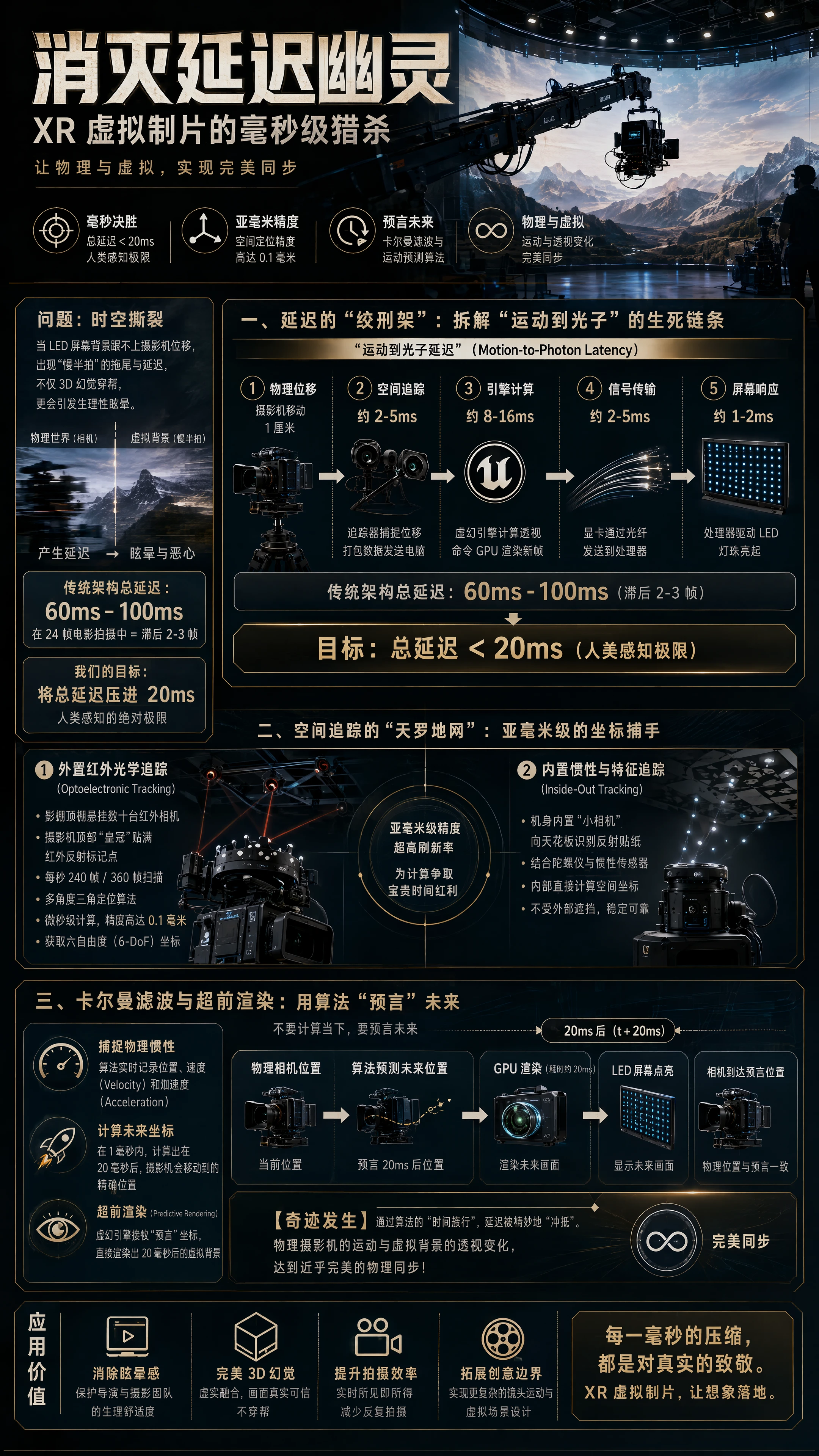
When a camera sweeps quickly on a crane, if the virtual background on the LED screen fails to keep up with the camera's movement at an absolutely synchronized speed, the background will appear to “lag behind” with trailing and latency. This millisecond-level misalignment between physical space and digital space not only instantly breaks the 3D illusion but also causes physiological dizziness for the director and cinematographer watching the monitor.
To eliminate this “latency ghost,” the film and television technology industry has launched a thrilling"millisecond-level hunt"in the microscopic dimension of time.
I. The “Gallows” of Latency: Deconstructing the Life-and-Death Chain of “Motion to Photon”
In the professional field, the entire process from physical camera movement to the LED screen updating the correct image and being recaptured by the camera is called “Motion-to-Photon Latency”。
This is an extremely stringent physical chain composed of hardware, software, and transmission media:
- Physical Displacement: The camera moves 1 centimeter.
- Spatial Tracking (approx. 2-5ms): The tracker (e.g., infrared camera or mechanical sensor) captures this displacement, packages the data, and sends it to the computer.
- Engine Computation (approx. 8-16ms): Unreal Engine receives the data, recalculates the perspective of the 3D space, and commands the GPU to render a new frame.
- Signal Transmission (approx. 2-5ms): The graphics card sends the rendered image to the LED video processor via fiber optic cable.
- Screen Response (approx. 1-2ms): The processor drives millions of LED lamp beads to light up.
In traditional computing architectures, the cumulative latency of this chain typically reaches as high as 60ms to 100msIn 24fps film shooting, this means the image lags by 2 to 3 frames.
When the lens pans quickly, the audience will clearly see: the actor in the foreground has already moved, but the mountain in the background, as if stuck to the screen, lags for a moment before “swinging” over.
To eliminate this 2-frame latency, the total latency must be strictly compressed within the safety line of 20 milliseconds (the absolute limit of human perception) .
II. The “Inescapable Net” of Spatial Tracking: Sub-Millimeter Coordinate Catchers
To conquer latency, the first step is to achieve“instant perception”of the camera's position at the source. Currently, top-tier XR studios use two complementary “spatial positioning” solutions:
External Infrared Optical Tracking
Dozens of infrared radiation cameras (e.g., Vicon or OptiTrack) are densely hung on the steel trusses of the studio ceiling. A rigid structure called a “crown” is mounted on top of the camera, covered with markers that reflect infrared light. These cameras scan the physical space at an ultra-high frequency of240 or 360 frames per secondUsing multi-angle triangulation algorithms, the system can calculate the camera's six degrees of freedom (6-DoF) coordinates in 3D space with an accuracy of up to1 millimeterswithin microseconds .
Inside-Out Tracking
For example, the Mo-Sys StarTracker installs a “small camera” on the camera body that looks up at the ceiling. By recognizing reflective stickers randomly posted on the ceiling, resembling a star map, combined with the gyroscope inside the body, it calculates spatial coordinates directly internally.
This sub-millimeter, ultra-high refresh rate data source buys precious “time dividends” for subsequent calculations.
III. Kalman Filtering and Predictive Rendering: Using Algorithms to “Predict” the Future
However, even if transmission and tracking reach the speed of light, GPU graphics rendering still requires physical time. How can latency be eliminated when rendering time cannot be reduced to zero?
The answer is:Don't calculate the present; predict the future.
XR virtual production introduces a mathematical algorithm crucial in aerospace navigation and autonomous driving—Kalman Filtering and Motion Prediction Algorithms。
- Capturing Physical Inertia: The algorithm not only records the camera's current position but also monitors its velocity and acceleration in real time.
- Calculating Future Coordinates: Based on classical mechanics models, the algorithm calculates within 1 millisecond:The exact position the camera will move to 20 milliseconds later (i.e., the current rendering latency time difference).
- Predictive Rendering: Unreal Engine receives this “predicted” coordinate and directly renders the virtual background 20 milliseconds into the futureWhen the GPU finally finishes rendering the image after 20 milliseconds and the LED screen lights up, the camera has physically moved to that predicted position.
[The Miracle Happens]: Through the algorithm's “time travel,” latency is ingeniously “offset.” In the camera's monitor, the movement of the physical camera and the perspective change of the virtual background achieve near-perfect physical synchronization.
Conclusion
In the grand narrative of XR virtual production, people often marvel at the vast starry skies and towering snow-capped mountains. But film and television technology workers know that the greatest magic often occurs on those invisible microscopic scales.
The “millisecond-level hunt” for the latency ghost is a limit game where humans use algorithms and computing power to tame physical constraints.
It not only eliminates dizziness but also gives digital space real physical inertia. When the tear in the space-time gap is completely smoothed over, the digital world and the real world finally merge into one, breathing at the same frequency.

 简体中文
简体中文  English