
In the production of green screen virtual studios,Chroma Keyingis the first and most unforgiving physical lifeline determining visual authenticity.
When an actor with fluffy blonde hair, holding a highball glass filled with translucent champagne, wearing a light gauze skirt, stands in front of a strong green screen, the technical team faces the ultimate challenge in real-time image compositing:
- Sub-pixel Hair Strand Loss: Human hair typically has a diameter between 50 and 100 microns. On the imaging plane of a 4K camera, edge hair strands deeply blend with green background pixels, forming translucentMixed PixelsTraditional chroma key algorithms, when extracting the Alpha channel, easily misjudge these fine hair strands as background and directly erase them, resulting in a harsh, cut-out “plastic helmet” look around the actor's head edges.
- Physical Light Dispersion and Green Spill: Green light waves have high diffuse reflectivity in physical space. The green light reflected from the green screen acts like a green floodlight, spilling onto the actor's blonde hair, fair skin, the glass refraction surfaces of the highball glass, and the gaps in the gauze skirt. Simply “desaturating” these areas leaves a lifeless gray dark halo around the actor's edges, instantly breaking immersion.
- Refraction Chaos of Translucent Media: Media like glass cups, champagne liquid, and gauze skirts have complex physical refractive indices. While transmitting background light, they also superimpose their own Fresnel reflections. How can the green screen be removed while preserving these high-order physical optical features and correctly projecting the virtual background's colors behind them?
In native Unreal Engine (UE5), its built-in Composure plugin or simple green screen Material Functions, lacking a dedicated high-performance colorimetric matrix solver, struggle with these extreme conditions: increasing keying intensity loses hair strands and translucent details; decreasing it allows edge spill and green artifacts to run rampant.
Aximmetry Leveraging its industry-renowned proprietary “Broadcast-grade 3D Spatial Chroma Segmentation & Spectral Spill Reconstruction Engine (Advanced Chroma Keyer & Spectral Despill Pipeline)”, it physically deconstructs and recomposes the color energy of pixels at the GPU memory level, delivering an impeccable keying result.
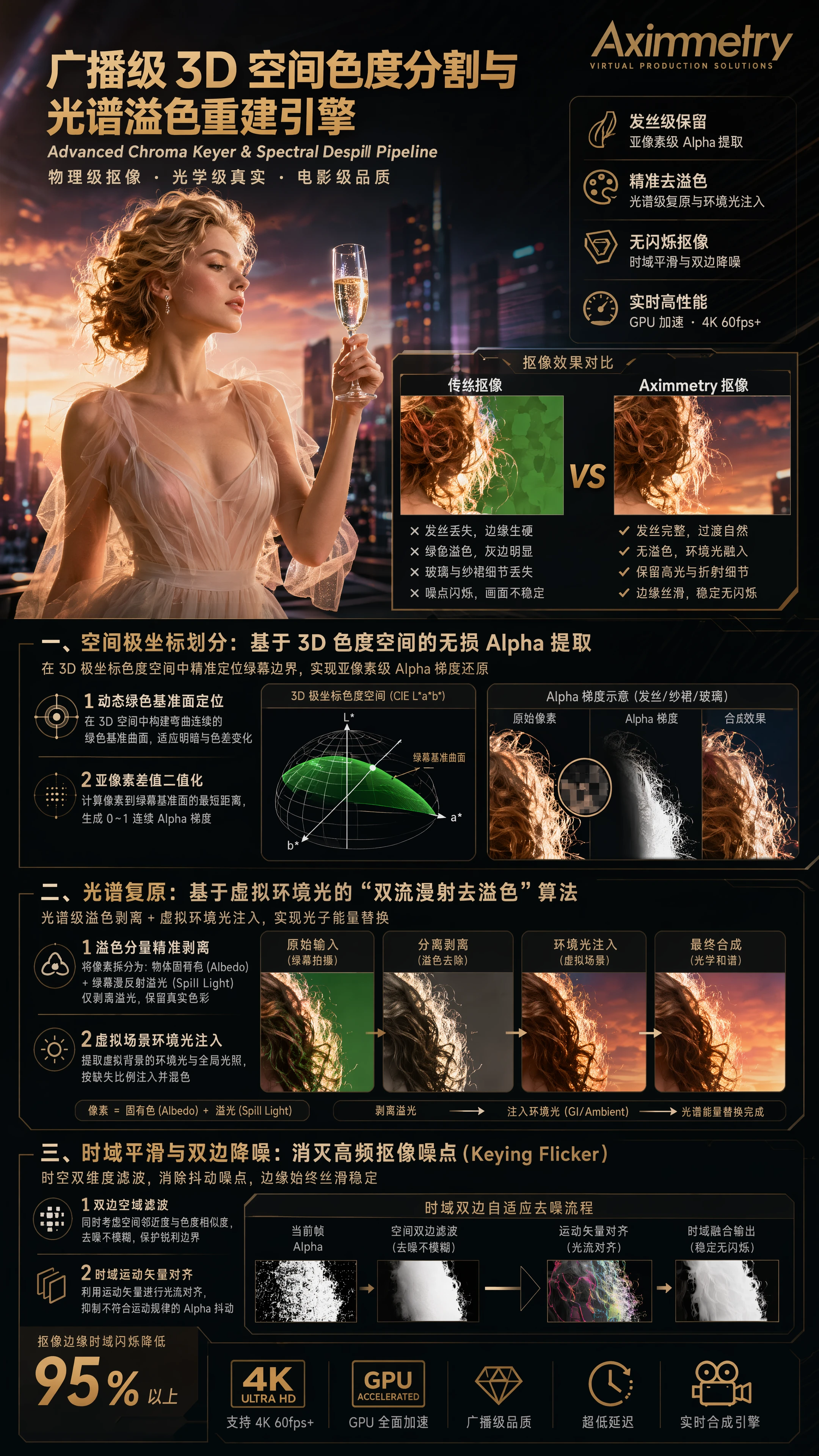
I. Spatial Polar Coordinate Division: Lossless Alpha Extraction Based on 3D Color Space
Aximmetry's first step is redefining how color space is segmented. Traditional keying software (e.g., using simple RGB differences) slices within a cubic color space, which easily introduces noise when dealing with bright or dark areas of the green screen.
Aximmetry projects the input YUV/RGB signal into a high-dimensional 3D Polar Coordinate Color Space (CIE L*a*b* or Custom 3D HSV Space) :
Dynamic Green Vector Reference Positioning
In polar coordinate space, Aximmetry defines the physical green screen's chroma, saturation, and luminance as a curved, continuous 3D surface, rather than a single value. Even if the physical green screen has shadows (dark green) and highlights (bright green) due to uneven on-site lighting, the algorithm precisely delineates the green screen's “color boundary” in 3D space.
Sub-pixel Delta Masking
When calculating the Alpha mask, Aximmetry's GPU shader computes the shortest spatial Euclidean distance from each pixel to the green screen's 3D reference surface.
- For pure green areas, the distance is 0, Alpha is 0 (fully transparent);
- For fully opaque body areas, the distance is large, Alpha is 1 (fully opaque);
- For hair strands, gauze skirts, glass cups, and otherMixed Pixels, the algorithm accurately restores a continuous Alpha Gradientbetween 0 and 1 by calculating the vector projection ratio in 3D space. This ensures that every barely visible hair strand is assigned a physically accurate translucent grayscale value in the Alpha channel.
II. Spectral Restoration: “Dual-Stream Diffuse Despill Algorithm” Based on Virtual Environment Light
Extracting a perfect Alpha channel is only half the battle. How to remove the physical green light (spill) cast on the actor and replace it with the virtual scene's colors is the core differentiator of Aximmetry from ordinary keying software.
Aximmetry abandons crude color suppression and introduces“Spectral-Level Color Reconstruction & Ambient Infusion”technology:
Precise Spill Component Separation (Spill Attribution)
Aximmetry's GPU pixel shader not only detects green but also analyzes the “source” of the green in the pixel. Using an extremely precise physical formula, it decomposes the green component in the pixel into:Object Albedo和Green Screen Diffuse Spill LightThe system only extracts the electromagnetic wave energy belonging to the “spill light” from the pixel, while the object's own color (e.g., the faint yellow-green of blonde hair itself) is perfectly preserved.
Virtual Scene Ambient Light Injection (Ambient Light Wrapping)
This is the most magical step. After the green light is extracted, an “energy void” appears in the pixel's spectrum. Aximmetry does not fill this void with black or gray; instead, itextracts in real-time the 3D ambient color and global illumination (GI) information of the virtual background from Unreal Engine at the actor's current positionThe algorithm “injects” and blends the virtual background's colors (e.g., the orange-red of a virtual sunset or the blue of tech-style neon lights) back into the edges of hair strands and translucent glass cups, proportionally to the missing spill amount.
This causes the edges of blonde hair, originally tinted green by the green screen, to naturally carry the sunset highlights of the virtual scene, and the physical glass cup to refract the vibrant colors of the virtual background. This “photon energy exchange” between the real and virtual achieves physically accurate optical harmony in the composited image.
III. Temporal Smoothing & Bilateral Denoising: Eliminating High-Frequency Keying Flicker
In 4K 60fps ultra-high-definition live broadcasts, the camera sensor's thermal noise can cause subtle, high-frequency Alpha jitter at keying edges, manifesting as dirty “tiny black mosquitoes” or “snow flickering” around hair strands.
At the very end of the compositing pipeline, Aximmetry deploys a“Temporal Bilateral Adaptive Denoising Filter”:
Spatial Bilateral Filtering
Within a single frame, the filter considers both the spatial closeness andcolor similarityof pixels. While powerfully smoothing tiny noise in the gaps between hair strands, it resolutely avoids blurring the sharp boundary between the hair itself and the virtual background, preserving the image's ultra-high resolution.
Temporal Alignment via Motion Vectors
To eliminate flickering between frames, Aximmetry introduces camera motion vectors. The filter performs optical flow alignment on the Alpha masks of consecutive frames along the time axis. If a pixel's Alpha mutation does not conform to the camera's physical motion laws, it is judged as sensor noise and smoothly suppressed.
This combination reduces temporal flickering at keying edges by over 95%, ensuring that in complex dynamic shots, edge transitions remain consistently smooth and clean, achieving cinematic post-production quality.
Conclusion: Reshaping the Physical Reality of Real-Time Compositing
In the long chain of virtual production and extended reality, chroma key compositing is the “final checkpoint” for deceiving the viewer's eyes. No matter how magnificent and realistic the background rendered by the 3D engine is, once the actor's edges show hair loss, color-biased green fringes, or dead whites in translucent media, the meticulously constructed virtual illusion shatters instantly.
Unreal Engine 5 is the king of real-time 3D rendering, but its high-energy real-time pixel rasterization architecture is not adept at handling such delicate, messy translucent optical intersections from the physical world.
Aximmetry The greatness of Aximmetry lies in its perfect fusion of“Physical Optical Laws”与“and ”Real-Time GPU Computing Power".
It protects sub-pixel hair details through 3D polar coordinate segmentation, replaces physical green light with virtual ambient light through dual-stream diffuse despill technology, and irons out every frame's burrs and noise through temporal bilateral filtering. It is precisely because of Aximmetry's uncompromising and industrial-grade rigor in the chroma key compositing pipeline that the carbon-based actors in the real studio and the silicon-based light and shadow in the digital universe achieve this seamless, elegant embrace across the physical boundaries of time and space.

 简体中文
简体中文  English