
In the traditional film and television production system, there is a well-known mantra full of compromise and helplessness:“Alright, let's just shoot it like this, we'll fix it in post.”
This phrase is both the “safety valve” of Hollywood's century-old assembly line and the “bottomless pit” of producers' budget overruns.
In the traditional linear pipeline, filmmaking is like a relay race: the screenwriter hands off to the director, the director hands off to the editor, and the editor hands off to VFX compositing. In this process,post-production becomes the “fall guy” for all pre-production mistakes and on-set compromises.”Directors and cinematographers are often “half-blind” on set, shooting against green screens and leaving all visual suspense to the post-production suite months later.
However,the daily reality ofThe emergence of XR is radically and almost brutally severing this century-old pipeline.
The film industry is witnessing an unprecedented paradigm shift:“Fix it in post” is dying, replaced by “Fix it in prep.”
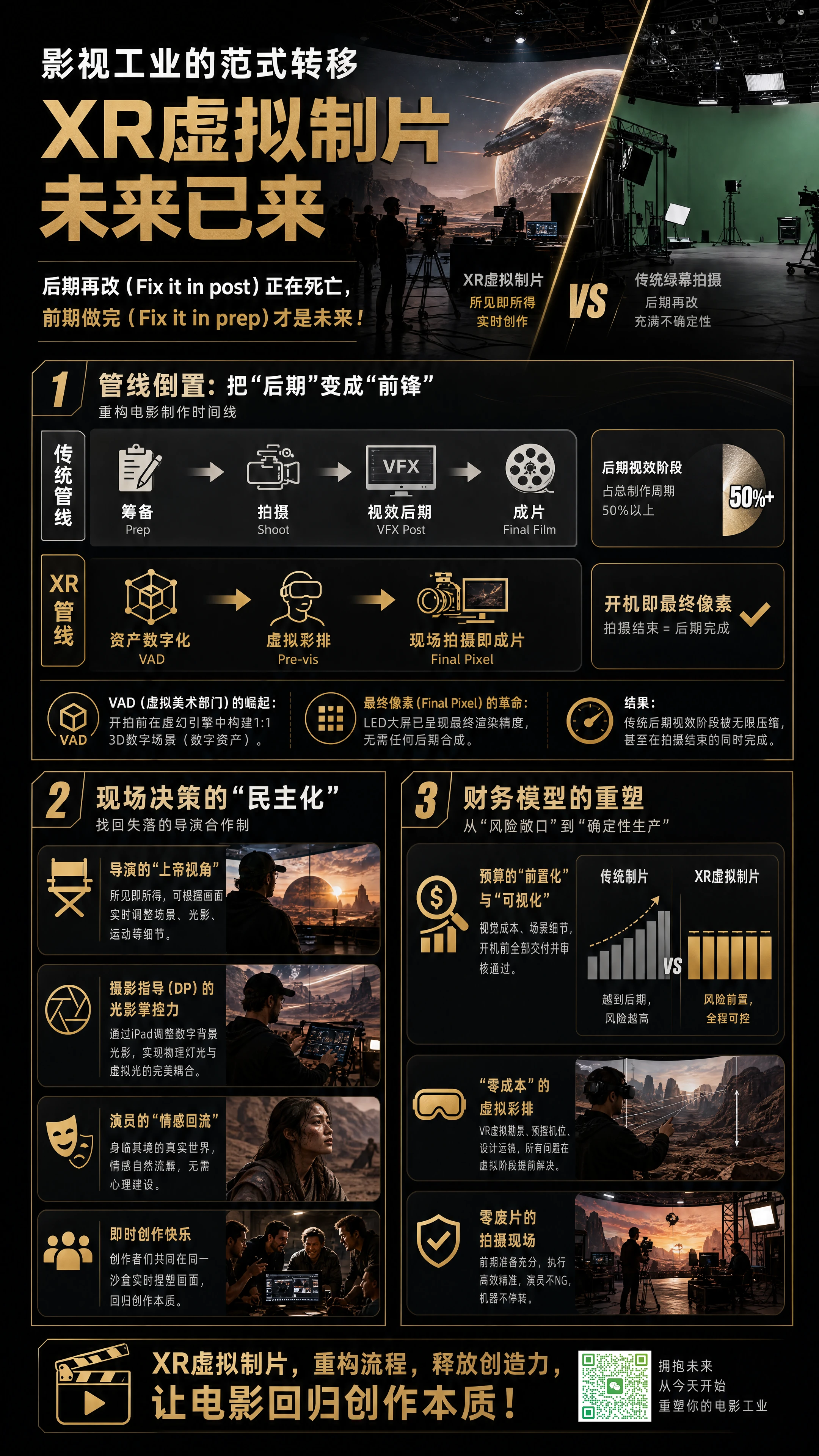
I. Pipeline Inversion: Turning “Post-Production” into the “Vanguard”
The most profound change XR virtual production brings to the industry is not the stunning images it can create, but how itreconstructs the timeline of filmmaking.。
In traditional workflows, the VFX team gets involved only after shooting wraps. In the XR workflow,the VFX team completes most of their work months before the first day of principal photography.。
- The Rise of VAD (Virtual Art Department): Before shooting begins, directors and production designers no longer just sketch concepts. Instead, they collaborate with the VAD team to build 1:1 3D digital scenes (digital assets) directly in Unreal Engine.
- “The Revolution of ”Final Pixel": The moment an actor steps onto the stage and the camera starts rolling, the background displayed on the LED wall is alreadyat final render quality, requiring no post-production compositing whatsoever.This means that every frame captured by the camera has already undergone “VFX compositing” the instant the shutter is pressed.
[Result]: The “post-production VFX phase,” which traditionally accounts for over 50% of the total production cycle, is infinitely compressed in the XR workflow and is essentially completed the moment shooting ends.
II. The “Democratization” of On-Set Decision-Making: Rediscovering the Lost Collaborative Director Model
In the green screen era, the set was a “one-man show.” Only the VFX Supervisor, holding the visual effects design blueprints, knew what the final image would look like. Directors, actors, and cinematographers were, to some extent, deprived of their on-set creative intuition.
XR, with its “What You See Is What You Get” (WYSIWYG) real-time visuals, re-establishes the“democratization” of on-set creativity.”:
- The Director's “God's Eye View”: The director no longer sees a sea of green in the monitor but the stunning image of a spaceship soaring past a red planet. Based on this image, they can instruct the VFX artist on the spot: “Move that mountain fifty meters to the left, and double the speed of the sunset.”
- The DP's Control Over Light and Shadow: The DP no longer has to blindly guess what lighting will be composited in post. They can directly adjust the brightness and color temperature of the digital background via an iPad, achieving perfect optical coupling between the on-set physical lights and the virtual world's natural light.
- The Actor's “Emotional Resonance”: Actors, seeing the apocalyptic ruins behind them, can naturally express feelings of tragedy and fear without any psychological preparation.
This is a long-lost“joy of instant creation.”Creators are no longer passive assembly line workers; they are once again sitting around the same sandbox, collaboratively sculpting the image in real-time.
III. Reshaping the Financial Model: From “Risk Exposure” to “Deterministic Production”
For producers and investors, the greatest benefit of the pipeline inversion is theprecise control over film budget and risk.。
In traditional film investment, the risk increases the further along the project gets. Post-production VFX is particularly prone to “creative drift”—the director decides the composited monster isn't realistic enough and demands a redo, causing the budget to spiral out of control like a snowball.
XR production completely closes this “risk exposure”:
- “Front-loading” and “Visualizing” the Budget: Because all 3D digital assets must be delivered before shooting begins, all visual costs and scene details are “approved” by investors and the director before the first day of filming.
- “Zero-Cost” Virtual Rehearsals: Before entering the expensive physical soundstage, the director and cinematographer can put on VR headsets and conduct “virtual scouting” in a virtual art gallery. They can pre-visualize camera positions and design camera movements in the software. All mistakes, impractical camera angles, and visible seams are discovered and corrected during the zero-cost virtual phase.
- A Set with Zero Waste: Due to extremely thorough pre-production, on-set shooting becomes highly efficient “execution.” Actors don't flub their lines, the camera keeps rolling, and the crew no longer wastes expensive film or digital storage space on “safety takes.”
Conclusion
In the second century of the film industry's development, technology is evolving from “helping humans record reality” to “helping humans compute reality.”
XR virtual production is not just a hardware iteration; it is a thoroughmanagement revolution.It ends the procrastination and uncertainty of “fix it in post,” using the certainty of “fix it in prep” to bring filmmaking back to a golden age of collective creation and WYSIWYG.
On this inverted and reconstructed production line, technology hasn't cooled art; instead, with precise computation, it has paved the safest and most efficient path for imagination to land.

 简体中文
简体中文  English